ADVERTISEMENT
ADVERTISEMENT



India criticizes Pakistan for politicizing UN Security Council forum on Kashmir
India's UN envoy says Pakistan misused its role as co-chair by raising Kashmir at an informal Security Council meeting.
-
 IANS
IANS - Wed, 24, Jun 2026
- 06:15 EDT
- 57
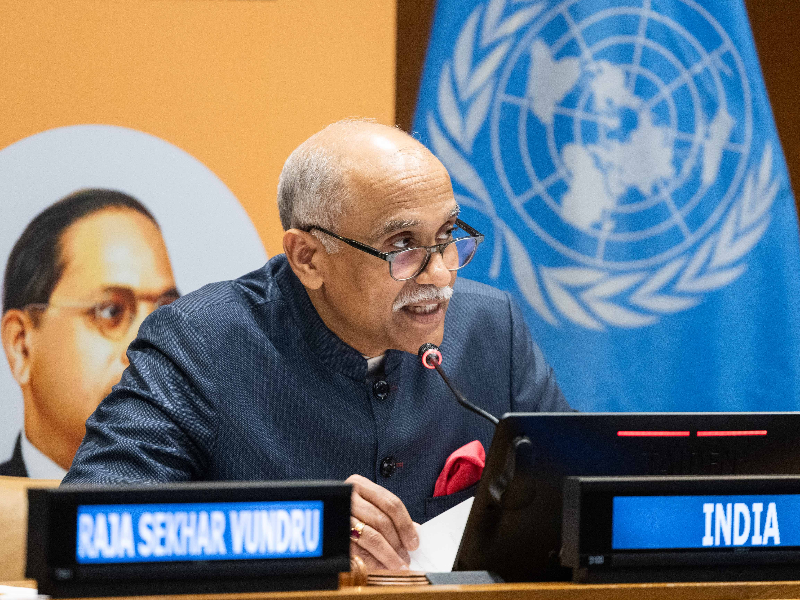 Permanent Representative of India to the United Nations Parvathaneni Harish / Courtesy photo
India has slammed Pakistan for misusing its position as co-chair to politicize a UN forum instead of being unbiased as behooves the position.
“The Union Territory of Jammu and Kashmir is a matter strictly internal to India. It always has been, is, and will remain so,” India's Permanent Representative P. Harish declared on Tuesday at an informal meeting of the Security Council.
Also read: India welcomes US-Iran MoU, says NSA Doval at BRICS meet
“It is incredible that a co-chair expected to be balanced and unbiased in conduct, has chosen to politicize this forum,” he said.
The meeting on “Bridging the Implementation Gap: Security Council Resolutions and Maintenance of International Peace and Security” was jointly convened by China and Pakistan, with their ambassadors co-chairing.
Pakistan's Permanent Representative Asim Iftikhar Ahmad raised the Kashmir issue as his country does at every opportunity.
While he criticized India, Pakistan itself is the barrier to implementing Council resolutions.
It defied the Council's Resolution 47 of April 1948 that demanded Pakistan withdraw its armed forces, security personnel, and civilians from the areas of Kashmir it had invaded.
Kashmiris in the areas that Pakistan continues to occupy illegally, defying the Council resolution, have risen in revolt, and Islamabad's security forces are trying to brutally put them down, killing 20 of them just this month.
Tuesday's forum was a so-called Arria Formula meeting that is held informally by the Council with the participation of interested nations, officials, organizations, and individuals.
It is named for Venezuelan diplomat Diego Arria, who introduced the format to bypass the Council's rule-bound procedures and leadership.
Harish called for reviewing the Council's mandate as it is being done in the UN80 process underway to review the functioning of the world organization in its 80th year to make it more relevant.
“India would like to emphasize that at a time when member states are undertaking mandate implementation review under the UN80 framework for all UN General Assembly mandates in order to achieve efficiencies, there is no reason why UN Security Council mandates should be outside the purview of such UN80 frameworks,” he said.
He suggested a review of the UN Charter's provisions in Chapter VI for mediation and negotiations as tools for settling disputes that could “endanger the maintenance of international peace and security.”
"These interventions are drawn up in order to address the prevailing realities and do not have perpetual validity,” and, therefore, “they warrant a review in accordance with changing circumstances and contexts,” he said.
Harish cited the case of Palestine, where a solution has remained elusive despite the “constant churn of mediation frameworks in tune with the changing circumstances of the conflict” over decades.
“There exists an undeniable case for reviewing outdated mediation frameworks,” he said. “Any assumption of the perpetual applicability of a Chapter VI mediation intervention is erroneous to say the least.”
Discover more at New India Abroad.
Related





ADVERTISEMENT

ADVERTISEMENT
E Paper
Video

Comments
Start the conversation
Become a member of New India Abroad to start commenting.
Sign Up Now
Already have an account? Login