ADVERTISEMENT

ADVERTISEMENT



How Pakistan tried to revive homegrown terror in India and failed
The Pahalgam attack, which was initially claimed by the TRF, exposed the bluff as all the terrorists, who were part of that operation, were Pakistani nationals.
-
 IANS
IANS - Sat, 27, Dec 2025
- 04:06 EST
- 12
 File Photo / IANS
The fall of the deadly Indian Mujahideen, an outfit backed by Pakistan comprising only Indian operatives, marked the end of homegrown terror in India.
The idea was to show the world that terrorism in India is an internal issue and not a Pakistan-created and sponsored one. Since the fall of the Indian Mujahideen in 2014, terror incidents have largely been reported from Jammu and Kashmir alone, with Pakistani actors participating in most of them.
ALSO READ: 2025 tests India–U.S. relations amid tariffs, Pakistan tilt: Expert
Over the last couple of years, there has been immense international scrutiny of Pakistan. With an economy that has crashed, Pakistan could not afford to come under the lens of the Financial Action Task Force (FATF) once again. It created The Resistance Front (TRF) in Jammu and Kashmir and projected it as a homegrown terror module.
The Pahalgam attack, which was initially claimed by the TRF, exposed the bluff as all the terrorists, who were part of that operation, were Pakistani nationals.
The TRF, which is a Lashkar-e-Taiba proxy, fell silent after the Pahalgam attack and the subsequent action by the Indian Armed Forces, which executed Operation Sindoor. Post the operation, Pakistan desperately needed a homegrown terror group. Moreover, it wanted this group to operate outside of Jammu and Kashmir. Pakistan decided to activate the Faridabad module that has been in the making since the abrogation of Article 370.
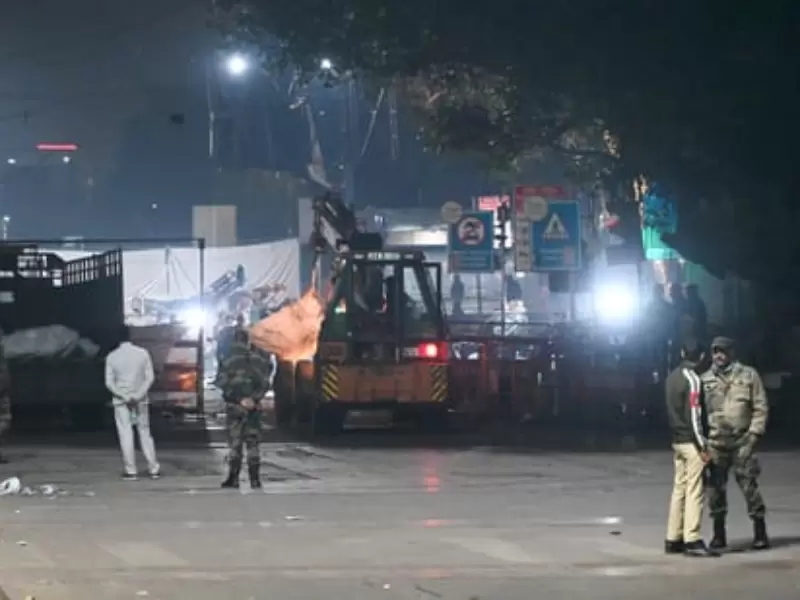
The module was busted in November 2025, and the subsequent investigation led the police to a deadly trail. Just days later, a member of this module carried out an explosion near the Red Fort in Delhi in which 13 people died.
The police identified the terrorist as Dr Umar Mohammad, a resident of Pulwama. During the course of the investigation, the police managed to seize 2,900 kilograms of ammonium nitrate. The probe also found that the module comprised mainly doctors, and all of them were associated with the Al-Falah University in Faridabad. The module that was inspired by the Jaish-e-Mohammad (JeM)comprised highly radicalised persons. They had plans to carry out blasts in multiple places in Delhi and nearby areas.
It was also learnt that the members of these modules were recruited and handled by one Mufti Irfan Ahmed from Jammu and Kashmir. He was closely associated with the JeM and was in regular touch with ISI operatives.
Irfan had managed to conceal his Pakistan links and made it seem as though this module was entirely homegrown and had no association with the ISI. The Jammu and Kashmir Police got wind of this module when posters sympathetic to the JeM cropped up. The probe led them up to Irfan, and this led to the busting of the Faridabad module. The probe revealed a tactical shift by Pakistan, which has been finding it hard to send in its terrorists through the Line of Control (LoC).
It was pushing for a homegrown module that could attack other parts of the country. This was largely to divert the attention of the security forces from Jammu and Kashmir, so that infiltrations could take place from the multiple launch pads set up in Pakistan-occupied Kashmir (PoK).
Further, the ISI also wanted a module that was on the lines of the Indian Mujahideen. On one hand, this homegrown module would keep the security mechanism stressed by carrying out blasts, while on the other hand, Pakistan would have the deniability factor.
Officials say that the ISI was not in touch with the handlers of this module on a regular basis. The agency wanted the Pakistan links to remain discreet and make it seem that the people of India, especially Jammu and Kashmir, had formed this module entirely on their own. The ISI also wanted this module to convey a message that everyone in Jammu and Kashmir is opposed to the abrogation of Article 370.
Intelligence agencies also learnt that the ISI was in the process of creating many more such modules across the length and breadth of the country. The plan was to carry out blasts at regular intervals as the Indian Mujahideen used to do, and also ensure that the trail does not reach out to Pakistan.
Pakistan, which was finding it hard to infiltrate terrorists, was also seeking to buy time by diverting the attention of the security agencies. It needed time for its terror outfits to regroup and create a diversion at the border so that infiltrations could take place.
The module was, however, busted in the nick of time. Officials say that had the module gone through with its plan completely, then the unthinkable would have taken place.
The agencies say the Faridabad module busted in November 2025 was also meant to be a template for more such homegrown modules to come up in the country.
Related









ADVERTISEMENT
ADVERTISEMENT
E Paper
Video

Comments
Start the conversation
Become a member of New India Abroad to start commenting.
Sign Up Now
Already have an account? Login