ADVERTISEMENT

ADVERTISEMENT



From Sangam to Silicon Valley
Relevance of Indian Knowledge Systems (IKS) to the Ai era
-
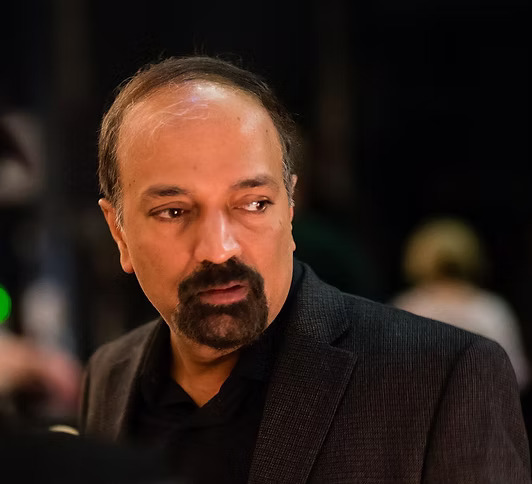 Dr Kanniks Kannikeswaran
 - Thu, 26, Feb 2026
- 16:10 EST
- 31
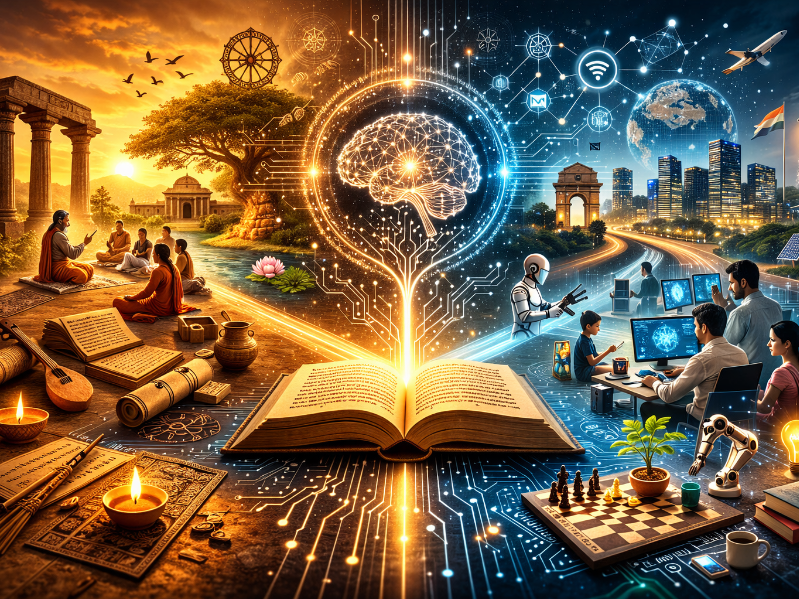 Representative Image / Generated using AI
As the AI era accelerates in the laboratories of Silicon Valley and the boardrooms of global tech hubs, a distinct need for a new framework is emerging. The next generation of innovative leaders, schooled in the rigorous logic of STEM, will need to look beyond conventional boundaries.
They will find that the ancient "Sangam"—the confluence of thought, art, and science from the Indian subcontinent—offers a foundational, surprisingly resonant blueprint for navigating the ethical, cognitive, and systemic complexities posed by 21st-century Artificial Intelligence.
We often think of Indian Knowledge Systems (IKS) as relics of the past—spiritual chants or museum artifacts. Swami Dayananda Saraswati, a modern day teacher of Vedanta refers to it as Purna Vidya or wholesome knowledge. For modern professionals, IKS is better understood as a sophisticated Operating System. It is a way of organizing reality that balances the "Hard Logic" of the algorithm with the "Human Resonance" of the arts, Yoga and a holistic approach to living.
Much of the ancient Indian greats that we know are are ‘renaissance’ personalities whose scholarship in a multitude of disciplines shows up in their work. Saranga Dev of Kashmir, the author of the musical treatise ‘Sangita Ratnakara’ in the 11th century stands out as an example. He from a family of Ayurvedins, was a respected musicologist whose work is cited even today; his work reflects his awareness of Yoga Shastra, Sanskrit grammar, the human anatomy above and beyond his knowledge of music and his abilities as a composer and author of several compositions seen in his work.
Also Read: Vivekananda Yoga University in LA receives accreditation
The Algorithm of Art
Indian Art is multi-disciplinary. Take, for example, the architecture of a Raga or the structural precision of a temple’s Vimana. These aren't just aesthetic choices; they are exercises in high-level systemic thinking. To compose within a Raga is to operate within a set of constraints.. Introducing a set of prosodical rules and the constructs tighten the framework even more - is to —a "code"— within which the brilliance of the creator shines forth as she breathes her imagination alive..
In our contemporary world, this is precisely what a solutions architect does: creating fluidity within a defined structure.
When we study the mathematical precision of Tala (rhythm) or the geometric symmetry of sacred spaces, we aren't just looking at art; we are looking at the ancient precursors to information architecture and modular design.
The "No-Otherness" Framework for Leadership
In 2026, the greatest challenge for any global leader is polarization—the "Us vs. Them" mentality. Here, the Indic concept of Advaita, or "No-Otherness," becomes a strategic asset.
In my work with large-scale choral productions, I have seen hundreds of disparate voices—tech CEOs, Physicians, trained singers, students, and retirees—come together. By applying the "No-Otherness" framework, we shift from "managing diversity" to "orchestrating a large multi-cultural ensemb;e." Leaders are finding that when they view their teams not as fragmented units but as part of a singular, resonant whole, innovation happens faster and burnout decreases.
Beyond the "Soft Skill"
For the Indian-American diaspora, reclaiming IKS is more than a cultural hobby. It is about expanding one's outlook with ‘yogic’ presence. The discipline of Sadhana (focused practice) and the clarity of Dhyana (meditation) are the ultimate "productivity hacks."
The confluence of rivers in India is revered and celebrated with the name ‘Sangam’. The major confluences attract millions of seekers.In a similar vein, Indian Knowledge Systems (IKS) represent a confluence of deep wisdom, offering new perspectives, and attracting modern seekers as a valuable reservoir for creators of today.
The journey from the ancient Sangam to the modern Silicon Valley isn't a leap across time; it’s a realization of continuity. As we navigate the complexities of AI, global markets, and societal shifts, the "Deep Resonance" of our heritage provides the steady ground we need to build a future that is as soulful as it is smart.
The writer is an internationally recognized musician and composer based in the United States, who draws on decades of research and practice. He is the author of ‘Anubhuti - Experiencing Muthusvami Dikshitar’, the first book to be published on Dikshitar during his 250th year.
(The views and opinions expressed in this article are those of the author and do not necessarily reflect the official policy or position of New India Abroad)
Discover more at New India Abroad.
Related










ADVERTISEMENT

ADVERTISEMENT
E Paper
Video

Comments
Start the conversation
Become a member of New India Abroad to start commenting.
Sign Up Now
Already have an account? Login