ADVERTISEMENT

ADVERTISEMENT



From India's Jalpaiguri to Dhaka: Khaleda Zia's noteworthy journey
Rising from a largely private life, Khaleda Zia became Bangladesh's first female Prime Minister and a defining figure in its post-independence history.
-
 IANS
IANS - Tue, 30, Dec 2025
- 04:43 EST
- 12
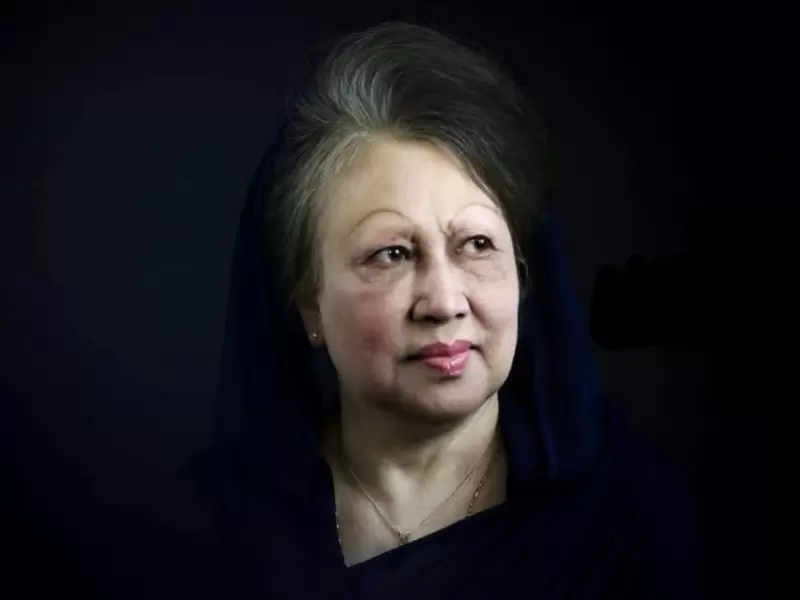 Khaleda Zia / X/@bdbnp78
Khaleda Zia's journey, from being born in undivided India to becoming Bangladesh's first woman Prime Minister, established her as a prominent figure in the South Asian nation's politics for over four decades.
Zia, a three-time Prime Minister and Chairperson of the Bangladesh Nationalist Party (BNP), died early on morning of Dec. 30 after a prolonged illness at the age of 80.
Rising from a largely private life, she became the country's first female Prime Minister and a defining figure in its post-independence history.
Khaleda Zia was born in 1945 in Jalpaiguri, part of Greater Dinajpur in undivided India. Khaleda later moved with her family to what was then East Pakistan, following the partition of India.
In 1960, she married Ziaur Rahman, then a captain in the Pakistani Army. Ziaur Rahman later revolted against Pakistani forces during the 1971 Bangladesh Liberation War.
He went on to serve as the President of Bangladesh in 1977 and formed the BNP the following year.
After Ziaur Rahman's assassination on May. 30, 1981, BNP plunged into a serious crisis, prompting senior leaders and BNP workers to urge Khaleda Zia to assume a leadership role in the party.
She was appointed as the Vice-President of the party on Jan. 12, 1984, and was elected BNP's chairperson on May. 10 in the same year. She retained her position through successive party councils in 1993, 2009 and 2016, cementing a nearly 41-year tenure as BNP chairperson.
Following BNP's victory in the 1991 parliamentary election, Khaleda Zia was sworn in as the first female Prime Minister of Bangladesh. She assumed the office of the Prime Minister for a second consecutive term after the 1996 national elections, which were held amid a boycott from major opposition parties. She was sworn in as Prime Minister for the third time on Oct. 10, 2001.
Zia's tenure as Bangladesh Prime Minister also coincided with some of the most difficult phases in India–Bangladesh relations, a period characterised by hostility and several missed strategic opportunities.
In her early years, Khaleda Zia adopted a cautious and, in many respects, adversarial posture towards New Delhi, a stance that shaped bilateral ties for over a decade.
Zia consistently opposed overland transit and connectivity initiatives with India, both during her time as Prime Minister and later as Leader of the Opposition, a role she held twice between 1996 and 2014.
As Prime Minister, she flatly denied India transit rights through Bangladeshi territory to access its northeastern states, arguing that such arrangements would compromise Bangladesh's security and sovereignty.
She went further to claim that toll-free movement of Indian trucks on Bangladeshi roads amounted to "slavery".
Her resistance also extended to diplomatic agreements.
Zia opposed the renewal of the 1972 Indo-Bangladesh Friendship Treaty, widely regarded by strategic experts as significant from a military standpoint.
She argued the treaty had "shackled" Bangladesh and constrained its independence.
Positioning her Bangladesh Nationalist Party (BNP) as a "protector of Bangladesh's interests", Zia often framed her policies as a defence against what she described as Indian domination.
This rhetoric was evident even years later. At a rally in Dhaka in 2018, when Sheikh Hasina was Prime Minister, and Zia was Leader of the Opposition, she criticised Hasina for exempting India from paying transit duties.
Another major source of friction during Zia's tenure was India's Farakka Barrage, operational since 1975 to divert water from the Ganges into the Hooghly River through a feeder canal.
While the barrage helps reduce silt, improves navigability around Kolkata Port and supplies fresh water to the city, Zia maintained that it deprived Bangladesh of its rightful share of Ganges water.
In 2007, she accused India of deliberately opening sluice gates to aggravate flooding in Bangladesh.
Her foreign policy choices further heightened tensions.
In 2002, Zia actively pursued defence cooperation with China.
India viewed this as a direct strategic challenge and responded by increasing diplomatic pressure. This included a counter-offensive in which Delhi accused the BNP government of sheltering separatist groups and terrorists operating in India's northeastern states.
Zia had earlier described insurgent outfits such as ULFA and NSCN as "freedom fighters".
During her tenure, India alleged that anti-India terror groups operated freely from Bangladeshi soil. The 2004 Chittagong arms haul, intended for Indian insurgents, minority violence within Bangladesh, and the near-total absence of cooperation on counter-terrorism further strained relations.
Ties between the two neighbours began to improve only after Zia exited power.
For more than three decades, Bangladeshi politics was dominated by two women -- Khaleda Zia and Awami League chief Sheikh Hasina.
After the Sheikh Hasina-led government came to power in 2009, Zia renewed what she described as her struggle for democracy.
She was evicted from her residence and placed under house arrest twice during movements she launched against the government. In 2011, she received international recognition when New Jersey's State Senate honoured her as a 'Fighter for Democracy'.
Khaleda Zia was sentenced to five years' imprisonment by a special court in Dhaka on Feb. 8, 2018, in the Zia Orphanage Trust corruption case.
Her jail sentence was suspended on Mar. 25, 2020, when the then Awami League government temporarily released her through an executive order amid the Covid-19 pandemic, on the condition that she remain in her Gulshan home and not leave the country.
She was completely freed on Aug. 6, 2024, after President Mohammed Shahabuddin granted her an exemption from the sentence under the presidential powers.
Khaleda Zia returned to Dhaka this May after four months of medical treatment in London.
She had been admitted to the private hospital in Dhaka on Nov. 23 after developing serious complications related to her heart and lungs, and remained under close medical supervision before passing away on Dec. 30.
She is survived by her elder son, BNP acting chairman Tarique Rahman, his wife Zubaida Rahman, and their daughter Zaima Rahman.
Tarique Rahman returned to Bangladesh on Dec. 25 after spending 17 years in self-imposed exile. Her younger son, Arafat Rahman Koko, died several years ago in Malaysia.
Related





ADVERTISEMENT
ADVERTISEMENT
E Paper
Video

Comments
Start the conversation
Become a member of New India Abroad to start commenting.
Sign Up Now
Already have an account? Login