ADVERTISEMENT

ADVERTISEMENT



Cortina scripts another golden chapter to its 70-year-old Olympic history
The Cortina Curling Olympic Stadium played host to the closing ceremony.
-
 Prabhjot Paul Singh
 - Mon, 16, Mar 2026
- 06:24 EDT
- 11
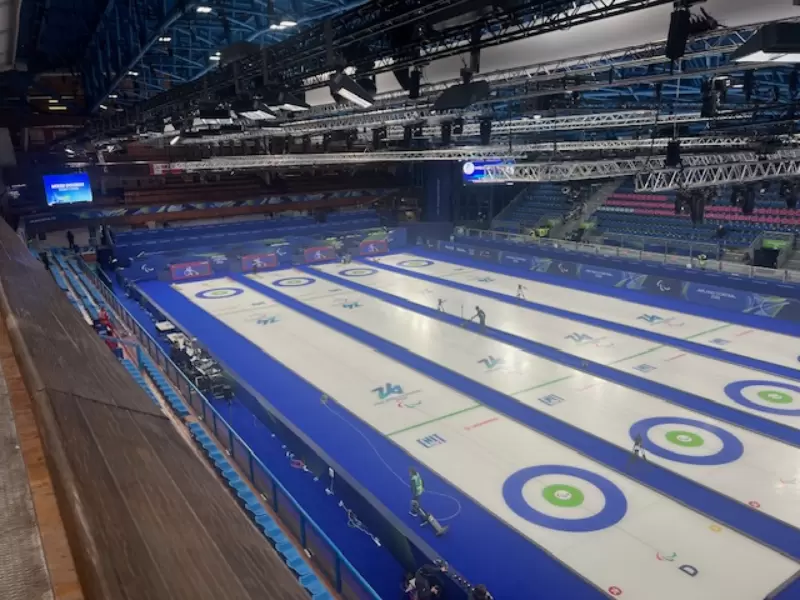 The Cortina Curling Stadium. / Maninder K. Chandhoke
As the curtain was rung down on the Milano Cortina 2026 Winter Paralympics, a 70-year circle linking this mountainous Italian town had come to a complete close.
The Cortina Curling Olympic Stadium, which played host to the closing ceremony, would be known to the progeny as games that saw opening and closing ceremonies held hundreds of miles apart.
The ceremony, an emotional farewell to hundreds of athletes, minus para ice hockey athletes, was not only a farewell to the competitions but also an ideal bridge to the historic 1956 Olympic Winter Games.
ALSO READ: Milano Cortina Winter Paralympics: Spain’s golden girl proves pink is the best
A thread connects the black and white of 1956 to the vivid colours of 2026. It is the bond of memory in Cortina d'Ampezzo, as seventy years separate the Olympic Closing Ceremony of 1956 from the final Paralympic act, the Paralympic Closing Ceremony, on March 15 at the Cortina Curling Olympic Stadium.
The ceremony was all about a passing of the torch between generations that have learned to master the ice and turn challenges into legend. The link between these two eras does not live only in the venues of the ceremonies but also in the stories of those who experienced 1956 through family memories.
There are those families who have been witnesses to the events, both in 1956 and 2026. Jgor Scappin, who today manages the rental service at the departure station of the Faloria cable car, preserves the legacy of his father, a Venetian photographer who arrived in Cortina in 1953 to document the Olympic revolution.
While in Cortina, one cannot miss small banners adorning the walls and buildings saying "Cortina 1956 2026 Host City"
“My father was one of the 'scattini,' as photographers who captured tourists and athletes were called at the time,” Jgor recalls. “I remember his photos of cross-country skiing in Campo and the ski jumps. He always told me that until just a few days before the start, everything was uncertain because there was no snow. Then those 20 centimeters of snow arrived and saved both the atmosphere and the competitions.”
That passion sparked in 1956 changed the destiny of many families: “My father became so passionate about cross-country skiing that my sister even made it to the national team. Before then, Cortina was a small village; elegant tourists came, but few foreigners. After the Olympics, the international boom began.”
The Scappin family is not the only one to remember. Among Cortina’s long-standing shopkeepers, there is a generation that, in 1956, was still in infancy but grew up with the myth of the success of that edition.
Today, looking ahead to the Milano Cortina 2026 Games, the feeling is one of deep satisfaction: “We learned from our parents what it means to host the world,” explain some shopkeepers from the town center. “Seeing this participation today makes us proud; we have managed the event while enhancing the local economy.”
Among the most evocative memories resurfacing during these closing days are those linked to the technical challenges of seventy years ago: the effort and skill required to level the natural ice of Lake Misurina, where the speed skating competitions were held. An achievement from another era that today, in the age of Paralympic technology, takes on the legendary flavour of humanity challenging nature.
In 1956, the Closing Ceremony at the Olympic Ice Stadium was a triumph of elegance, featuring figure skating performances and the protocol that passed the Olympic flag to the United States. It was also the first Olympic Winter Games broadcast on television, transforming Cortina into an unprecedented media event.
This time, that venue—renovated and made fully accessible—has become the Cortina Curling Olympic Stadium. If back then pure technique was celebrated, today the celebration is of overcoming limits. The ceremony concept, “Italian Souvenir," will transform the stadium into a great album of shared memories.
Cortina, yesterday as today, remains the place where these stories find their final chapter before beginning to write a new page of the future.
Interestingly, it is the Winter Olympics that use old, small, and historic towns as host cities, while the Summer Olympics continue to be the prerogative of the big cosmopolises.
Related









ADVERTISEMENT

ADVERTISEMENT
E Paper
Video

Comments
Start the conversation
Become a member of New India Abroad to start commenting.
Sign Up Now
Already have an account? Login