ADVERTISEMENT

ADVERTISEMENT



Collective Wisdom, Shared Future: Global Voices from the Second Global Buddhist Summit
The Second Global Buddhist Summit ultimately served as a call for global unity among Buddhist communities and spiritual practitioners worldwide.
-
 Amit Deshmukh
 - Wed, 11, Feb 2026
- 16:30 EST
- 15
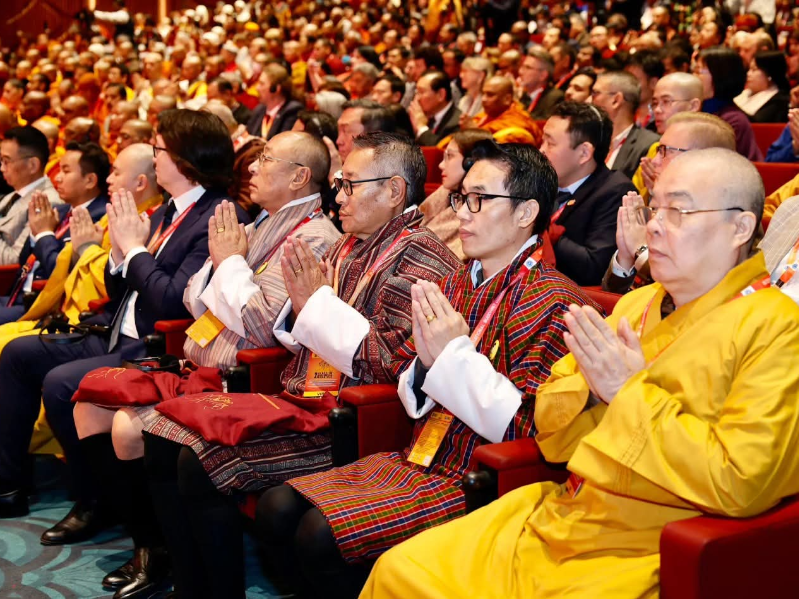 Second Global Buddhist Summit / Special Arrangement
The Second Global Buddhist Summit (GBS), held in New Delhi under the theme “Collective Wisdom, United Voice, and Mutual Coexistence,” emerged as more than a scholarly or spiritual gathering. It became a global dialogue platform where Buddhist scholars, monks, cultural custodians, and practitioners from diverse regions reaffirmed the relevance of Buddhist philosophy in addressing contemporary global challenges.
The summit brought together voices from Europe, Africa, Southeast Asia, and beyond, reflecting the truly international character of Buddhism. Their reflections demonstrate how the ancient teachings of the Buddha continue to guide modern societies in areas ranging from education and ethical economics to environmental sustainability and spiritual governance.
Preserving Heritage
For Julia Elikhina, curator of Tibetan, Mongolian, and Khotanese Buddhist art at the State Hermitage Museum in St. Petersburg, the summit reinforced the vital connection between Buddhist heritage and education. Having spent years studying the formation and evolution of Tibetan Buddhist art, she emphasized that Buddhist art is not merely an aesthetic or historical collection of artifacts. Instead, it represents a living philosophical and spiritual tradition that conveys profound ethical values and cosmological understanding.
Also Read: Walk for peace: Buddhist monks arrive in Washington after 2,300-mile journey
Elikhina noted that her ongoing work on a Buddhist art textbook for universities and monastic institutions aligns closely with the summit’s emphasis on Buddhist education. She observed that the congress’ structure—combining academic presentations with interactive discussions—created an enriching environment for intellectual and spiritual exchange. The discussions ranged from the management of Buddhist monasteries worldwide to the moral upbringing of youth in a rapidly changing world.
Importantly, she highlighted the role of young voices and Sangha representatives in shaping future spiritual discourse. Inspired by the summit’s collaborative spirit, she expressed hope to involve Buddhist monks from the St. Petersburg Buddhist Temple in future global forums, reinforcing the idea that international cooperation is essential for sustaining Buddhist heritage and spiritual life.
The African Perspective
From the Democratic Republic of Congo, a Buddhist monk representing the emerging Buddhist community in Africa shared how the summit strengthened his mission of expanding the Dhamma in regions where Buddhism is still developing. His reflections focused on three major themes discussed during the summit that hold particular significance for the African context.
The first was the concept of Entrepreneurship and Right Livelihood, rooted in Buddhist ethical discipline (Sīla). The discussions demonstrated how modern business practices can align with Buddhist values by avoiding industries that promote violence, addiction, or harm. Ethical entrepreneurship, he noted, allows practitioners to balance material prosperity with spiritual growth, using wealth as a tool for generosity (Dāna) and social welfare.
The second theme—Scientific Research, Healthcare, and Sustainable Living—highlighted Buddhism’s capacity to complement modern science. Scholars and practitioners discussed how Buddhist principles such as mindfulness, compassion, and moderation can address global crises, including mental health challenges and environmental degradation. The integration of spiritual wisdom with scientific inquiry was widely recognized as a pathway toward sustainable development and global well-being.
The third significant discussion revolved around Sangha Dynamics and Institutional Preservation. Monastic leaders shared strategies to maintain the relevance, discipline, and unity of the Sangha across generations. For emerging Buddhist communities, particularly in Africa, these insights provide a framework for building resilient spiritual institutions capable of guiding social and cultural transformation.
Message of Peace
Adding another dimension to the summit’s global resonance, international Buddhist participation from Southeast Asia highlighted Buddhism’s continuing role as a universal message of peace and harmony. Delegations from Vietnam and other countries actively participated in ceremonial processions, exhibitions of sacred relics, and interfaith dialogues that symbolized Buddhism’s enduring capacity to unite cultures and nations.
These events showcased how Buddhist traditions transcend national boundaries while reinforcing shared spiritual values such as compassion, non-violence, and coexistence. The cultural and spiritual exchanges further demonstrated that Buddhism remains not only a religious practice but also a powerful instrument for cultural diplomacy and global peacebuilding.
Buddhism in the Modern World
A defining feature of the summit was its ability to connect spiritual philosophy with practical global issues. Discussions explored how Buddhist teachings can guide modern governance, economic systems, and educational frameworks. The summit highlighted that Buddhism offers not only personal spiritual guidance but also a moral blueprint for collective social development.
Participants widely acknowledged that the challenges of the 21st century—ranging from technological disruptions to moral uncertainty—require a balance between material advancement and spiritual wisdom. Buddhist principles such as mindfulness, ethical conduct, and interdependence provide a philosophical foundation capable of addressing these challenges holistically.
A Unified Path Forward
The Second Global Buddhist Summit ultimately served as a call for global unity among Buddhist communities and spiritual practitioners worldwide. By fostering dialogue across continents, traditions, and disciplines, the summit reaffirmed the Buddha’s timeless message of compassion, wisdom, and mutual coexistence.
As reflected by participants from Russia, Africa, and Southeast Asia, the summit was not merely a forum for intellectual exchange but a platform for action. Their collective reflections underscore a shared aspiration—to ensure that the Buddhadhamma continues to guide humanity toward peace, ethical living, and sustainable progress.
In an era marked by social fragmentation and moral dilemmas, the summit’s message resonates strongly: the integration of spiritual wisdom with modern realities may hold the key to building a more compassionate and harmonious global society.
May the teachings of the Buddha continue to flourish, inspiring individuals and communities worldwide to work toward the well-being and happiness of all beings.
The Writer is a former journalist, researcher, and expert in media law and digital diplomacy..
(The views and opinions expressed in this article are those of the author and do not necessarily reflect the official policy or position of New India Abroad.)
Related







ADVERTISEMENT

ADVERTISEMENT
E Paper
Video

Comments
Start the conversation
Become a member of New India Abroad to start commenting.
Sign Up Now
Already have an account? Login