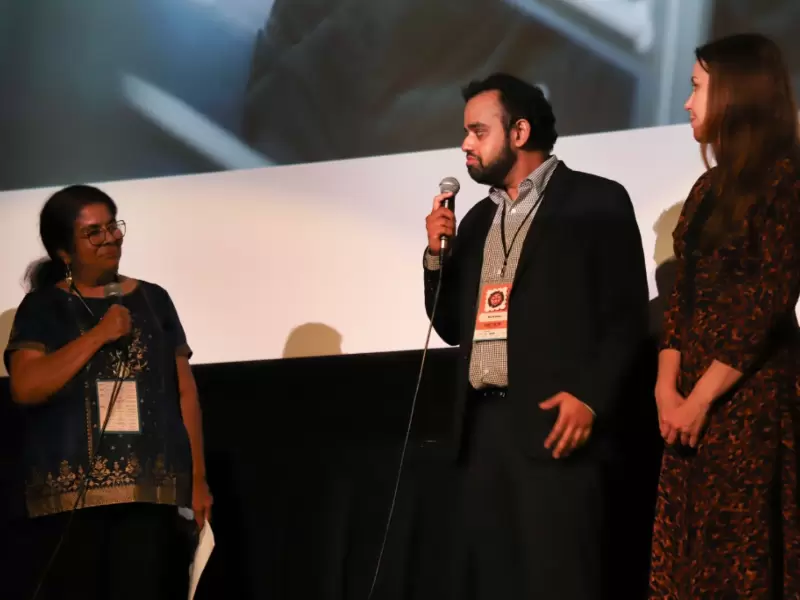
Creative producer Kovid Gupta, producer Sarah Kuck (right) who organized the film’s distribution, and psychologist Dr. Vagdevi Meunier (left) answer questions at the Indie Meme Film Festival on Thursday, April 23. / Courtesy photo
University of Texas at Austin graduates Rachel Immaraj and Kovid Gupta both have obsessive-compulsive disorder, but hid the condition from each other throughout a years-long friendship. For Gupta, that initially seemed normal. Diagnosed at 13, his parents told him to keep it secret while he underwent medication and therapy.
“When (Rachel) was 28, that's when we all found out she had OCD,” Gupta explained to an audience. “That's when I kind of came out of the closet and told her about my OCD also, and we realized, how have we been friends for so many years but never told each other we have OCD? There's a story here to tell.”
That story became An Unquiet Mind, a feature-length documentary chronicling the experiences of two people, Vinay and Natasha, and how OCD affects them. The film is a nearly decade-long, fully crowdfunded endeavour, spanning through the COVID-19 pandemic and including a brief time skip to an older, wiser era of the subjects’ lives.
The transformative tale of the mental condition premiered in Austin, Texas at the Indie Meme Film Festival, which has spent over a decade showcasing socially conscious, thought-provoking South Asian cinema. Creative producer Gupta, distribution producer Sarah Kuck, and Austin psychologist Dr. Vagdevi Meunier answered audience questions about the film at a Q&A during the festival.
“With a director who has OCD, with a producer who has OCD, yeah…it takes seven years (to film) when your OCD is working against each other,” Gupta said, eliciting laughter from the crowd.
The film is told through the eyes of Vinay, a New York-based activist, and Natasha, who hails from California. Gupta said Immaraj attended the International OCD Foundation Conference, hosted by the nation’s largest OCD-related nonprofit, noticed Vinay – another Indian person! – and started a conversation. Immaraj reached out to various clinics and health organizations and eventually met Natasha, who also became an executive producer of the film.
Vinay developed harm OCD after 9/11 and excessively fears hurting other people. Natasha developed the relatively common post-partum OCD, as well as pedophilia OCD. Both Vinay and Natasha have considered suicide.
“We wanted people who were not only very vulnerable about their stories, but who also had good screen presence and who could connect with audiences,” Gupta described. “We also wanted people who had these ‘taboo’ types of OCD, because that's what we wanted to highlight. The one thing we did not have control on is how Vinay and Natasha's lives unfolded, so we kind of had to go with the flow.”
Mental health is not talked about often in South Asian and other cultures, adding a nuance to the film. Psychologist Dr. Vagdevi Meuinier revealed to the viewers that she did a dissertation on South Asian students at UT Austin 30 years ago, finding OCD was underdiagnosed and undertreated among that group.
“Very often, they came in with somatic symptoms,” Meunier explained. “They would say things like, ‘My stomach hurts,’ or they would come in with perfectionism. And often their parents would be telling them, ‘What's wrong with that? You should be perfectionistic.’”
For distribution producer Sarah Kuck, Immaraj’s and Gupta’s OCD added a unique level of thoughtfulness to the film.
“Working with Rachel and Kovid is really wonderful,” Kuck said. “Something that you see in the film is these ways that our minds work differently. It can be really painful, but can also be an asset and be tremendously useful in thinking through things and making sure everything is right.”
A key mission of An Unquiet Mind is to fight stereotypes mainstream media has promoted over decades, like handwashing and constant cleaning, and focus on the actual thought processes and holistic identities of people with OCD.
“We're not like Monica from Friends,” Gupta said. “Our minds work very differently from what they show on that sitcom or other sitcoms. Personal experiences definitely played a role in how we shaped the narrative.”
Meuinier added that there must be more support for cultures that don’t view mental health from a white or Western perspective.
“When you look at Asian and South Asian clients, there's a spirituality component that's associated with OCD, so it's much harder to break,” Meuiner said. “There's a superstition associated with the compulsions, and they're mental, they're not necessarily like handwashing. We need to promote and educate people about the fact that there are cultural differences so that more research can be done.”
Discover more at New India Abroad
ADVERTISEMENT
ADVERTISEMENT

Comments
Start the conversation
Become a member of New India Abroad to start commenting.
Sign Up Now
Already have an account? Login