ADVERTISEMENT
ADVERTISEMENT



Anang Mittal launches dashboard tracking diaspora research claims
He said the platform also tracks how claims move across media, policy, and advocacy spaces, documenting instances where the same information is reused and amplified.
-
 Pranavi Sharma
 - Tue, 14, Apr 2026
- 02:23 EDT
- 180
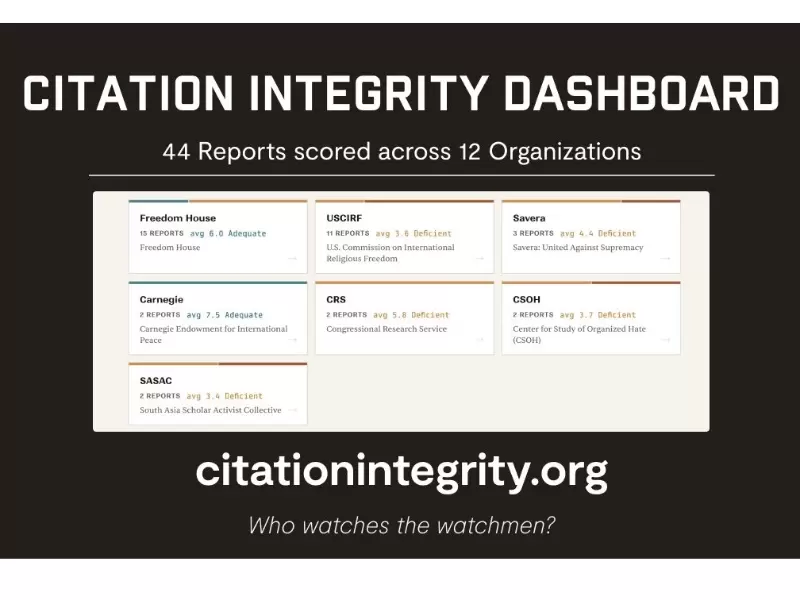 The dashboard, referred to as CID, evaluates reports using a scoring system based on eight factors related to methodological rigor. / Anang Mittal
Indian national communications strategist and Capitol Hill veteran Anang Mittal launched the Citation Integrity Dashboard, a platform designed to assess how advocacy reports about India and its diaspora are cited across media, policy, and research.
Mittal said the initiative responds to what he described as a recurring “citation loop,” where advocacy reports are published with strong claims and then repeatedly cited by journalists, lawmakers, and institutions without scrutiny. According to his explanation, this cycle can lead to unverified information gaining legitimacy over time and influencing public discourse and decision-making.
ALSO READ: First of its kind Indian American voter data platform launched
He outlined the process: advocacy groups publish reports, which are then cited in news coverage. Lawmakers and officials may reference those reports or related media coverage to support policies or statements. The same advocacy groups may later cite those official statements as validation of their original claims, reinforcing the cycle.
For decades, a select group of organizations has published reports that shape public perception of India, Indian immigrants, and Hindus. Today, I'm launching a new project that scores these reports on their methodology. Read my twitter article and https://t.co/jrZFDbCHZ2 pic.twitter.com/ZtEALIWuj0
— Anang Mittal अनंग मित्तल (@anangbhai) April 13, 2026
Mittal argued that such patterns allow reports with unclear sampling methods, vague definitions, or limited transparency to gain traction in courtrooms, legislative discussions, and national media. He pointed to organizations including the U.S. Commission on International Religious Freedom, Equality Labs, and groups such as Savera and the Center for the Study of Organized Hate as examples of entities whose reports are frequently cited in discussions about India and Indian Americans.
The dashboard, referred to as CID, evaluates reports using a scoring system based on eight factors related to methodological rigor, including definitions, sampling, and data transparency. Mittal said the framework is publicly available and focuses on research standards rather than political viewpoints.
He said the platform also tracks how claims move across media, policy, and advocacy spaces, documenting instances where the same information is reused and amplified. All evaluations, he added, are open to challenge, allowing users to review scoring methods and submit evidence if they disagree.
Mittal described the project as an attempt to introduce greater accountability in how research is cited and used. He said the lack of a shared standard for citation integrity across academic, journalistic, and policy institutions has allowed such issues to persist.
Community organizations responded to the launch. The Coalition of Hindus of North America called it “an important and much overdue initiative.” The group said there is “a huge gap where elite organizations and a small group of privileged individuals have hijacked the conversation, often with a manufactured narrative that drown out reality on the ground.”
CohNA added that “a thoughtful, data driven and balanced analysis like this is very essential in a world powered by circular citation loops, flawed surveys, leading questions and biased data models.”
Suhag Shukla, executive director of the Hindu American Foundation, also commented on the initiative. “I personally have gone down crazy source & citation rabbit holes — one time finding through publicly available info that a ‘special report’ on India commissioned by one of these select orgs was written by a Pakistani operative. Can’t make this stuff up,” she said.
“Thanks @anangbhai for this much needed resource,” she added.
The Citation Integrity Dashboard is available online and allows users to review, assess, and challenge how research is cited in public discourse.
Mittal previously launched the ‘Indian American Voter Atlas’ on Feb. 23, a civic data initiative aimed at mapping the political engagement of Indian Americans ahead of the midterm elections later this fall. The platform describes itself as a nonpartisan effort focused on understanding the community’s political footprint.
Discover more at New India Abroad.
Leave A Comment
Related










ADVERTISEMENT

ADVERTISEMENT
E Paper
Video

Comments
Start the conversation
Become a member of New India Abroad to start commenting.
Sign Up Now
Already have an account? Login