ADVERTISEMENT
ADVERTISEMENT



America 250: What does it mean to be a Hindu American?
Honoring the Past. Inspiring the Future.
-
1781639013.png) Ganesh Ramakrishnan
Ganesh Ramakrishnan - Mon, 15, Jun 2026
- 17:34 EDT
- 1676
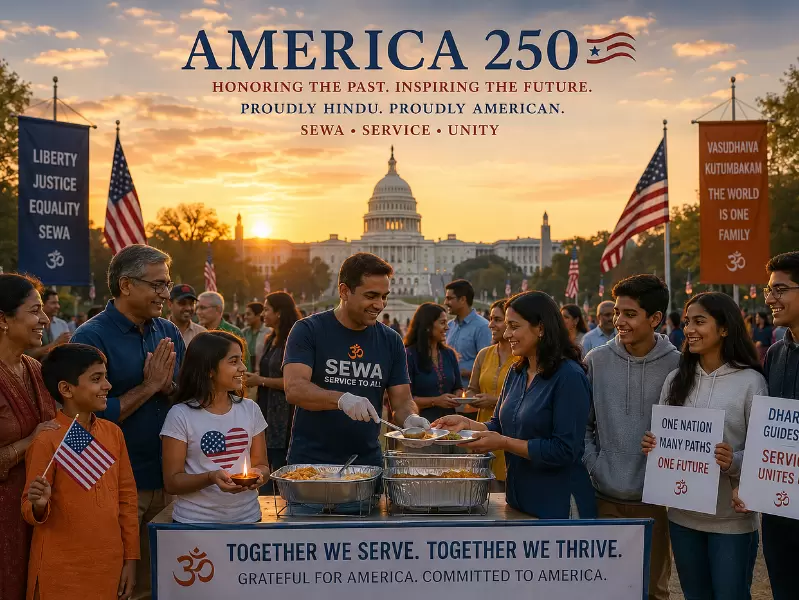 Representative Image / Generated using AI
In 2026, America marks the 250th anniversary of the signing of Declaration of Independence — a historic milestone that invites all Americans to reflect on our nation’s journey and imagine its future.
The last major national commemoration, the Bicentennial of 1976, was far more than a celebration. It became a nationwide movement. Communities across the country organized parades, exhibitions, civic projects, educational programs, and local festivities that brought Americans together in a shared spirit of gratitude and renewal.
Also read: When will the Indian (Hindu) American community learn?
Some of the most memorable Bicentennial initiatives included Operation Sail, which brought tall ships from around the world to American harbors; the American Freedom Train, a traveling museum carrying treasured artifacts across the nation; and the Wagon Train Pilgrimage, which connected communities through a symbolic journey to Valley Forge.
The Bicentennial succeeded because it belonged to everyone. Students, veterans, faith communities, civic organizations, and local leaders all found meaningful ways to participate. Notably, an Indian spiritual teacher Sri Chinmoy organized a nationwide “Liberty Torch Relay” across all 50 states emphasizing spiritual values, service and American ideals. While it was not a Hindu organizational event per se, it represented a visible Indian-origin contribution in 1976. Not many temples were around, and the immigrants were paltry and not well known.
As America approaches its 250th anniversary, Hindu Americans have a unique opportunity to contribute to this national moment.
The Hindu-American Journey
The story of Hindu Americans is inseparable from the broader American story.
It was interesting to note that first recorded immigrant was an East Indian named Tom who settled in Jamesburg, Virginia in 1635 (yes, you heard it right). Till recently, Indian Americans make up approximately 1.5% of the U.S. population (about 5.2 million people).
They are the highest-earning major ethnic group in the country, boasting a median household income of roughly $151,200 to $157,000 and a per capita income exceeding $53,000. This has been a success story of a very vibrant immigrant community.
What began with small numbers of immigrants seeking opportunity has evolved into one of the most successful and vibrant communities in the country. Today, Indian Americans serve as CEOs of major corporations, physicians, entrepreneurs, scientists, educators, public servants, military personnel, and elected officials.
Yet the Hindu-American contribution extends beyond economic success. It is a story of families, values, volunteerism, and a deep commitment to education, community, and service.
America provided freedom and opportunity. Hindu traditions provided the values that helped many families thrive.
Together, they created a uniquely Hindu-American experience.
American Ideals and Hindu Values
E Pluribus Unum and Vasudhaiva Kutumbakam
America’s “Out of Many, One” resonates with the Hindu vision of the interconnectedness of humanity. The America 250 initiative frequently speaks of “Honoring the Past, Inspiring the Future.”
For Hindu Americans, this theme resonates deeply.
The American ideals of liberty, equality, justice, and the pursuit of happiness find meaningful parallels within Hindu thought.
Also Read: Hindu values, the U.S. Constitution, and a silent American contradiction
Dharma teaches responsibility, ethical conduct, and service to society. It encourages individuals to pursue excellence while remaining mindful of their obligations to family, community, and nation.
The Hindu spiritual journey emphasizes the search for truth and self-realization. Likewise, the American experiment has always championed freedom of thought, conscience, and belief.
Both traditions place tremendous faith in the dignity and potential of the individual.
America celebrates freedom.
Dharma teaches how freedom can be exercised responsibly.
Sewa: A Hindu Contribution to America 250
Perhaps the most visible and practical contribution Hindu Americans can make during America 250 is Sewa — selfless service.
Across the United States, Hindu organizations and volunteers quietly serve their communities through food drives, disaster relief, health initiatives, environmental projects, educational programs, and humanitarian assistance.
These acts of service rarely seek recognition. They are expressions of a simple belief: that serving humanity is a sacred duty.
America 250 presents an opportunity to expand this spirit of service.
Hindu families, temples, youth groups, and community organizations can organize volunteer projects, support local civic initiatives, beautify public spaces, assist veterans, mentor students, and strengthen neighborhoods.
Service is where patriotism and Dharma naturally meet.
Temples as Centers of Civic Engagement
Over the past several decades, Hindu temples have become important institutions throughout America.
Beyond places of worship, they serve as cultural, educational, and community centers.
America 250 provides an opportunity for temples to engage even more deeply with the broader community by hosting open houses, educational exhibitions, interfaith dialogues, cultural programs, service projects, and discussions about citizenship and civic responsibility, voter awareness etc.
Such efforts help build bridges of understanding and reinforce a simple truth: Hindu Americans are not observers of the American story — they are participants in it.
Celebrating America’s Pluralistic Promise
One of America’s greatest strengths is its ability to bring together people of different backgrounds, beliefs, and traditions.
This spirit of pluralism finds a natural echo in a well-known Vedic teaching:
“Ekam Sat Vipra Bahudha Vadanti” — Truth is One; the wise describe it in many ways.
While rooted in a different historical and philosophical context, this principle encourages humility, mutual respect, and openness toward diverse paths and perspectives.
America’s constitutional commitment to religious freedom created a society where people of many faiths could flourish together.
For Hindu Americans, protecting and strengthening that pluralistic vision remains an important civic responsibility.
Looking Ahead to the Next 250 Years
As we celebrate America’s first 250 years, the question is not merely what America has given us.
The deeper question is: What can we contribute to America’s next 250 years?
Hindu Americans can contribute a culture of service, strong families, educational excellence, respect for diversity, environmental stewardship, and a philosophy that balances rights with responsibilities.
American freedom provides opportunity.
Dharma provides responsibility.
American citizenship calls for participation.
Sewa calls for selfless contribution.
American pluralism protects diversity.
Hindu thought celebrates it.
These are not competing ideals. They are complementary strengths.
As America enters its next chapter, Hindu Americans have every reason to celebrate with gratitude, confidence, and purpose.
Let us honor the past.
Let us serve in the present.
Let us help inspire America’s future.
The writer is a technology executive, community leader, and thought contributor.
(The views and opinions expressed in this article are those of the author and do not necessarily reflect the official policy or position of New India Abroad.)
Discover more at New India Abroad.
Leave A Comment
Related









.png)
ADVERTISEMENT

ADVERTISEMENT
E Paper
Video

Comments
Start the conversation
Become a member of New India Abroad to start commenting.
Sign Up Now
Already have an account? Login