ADVERTISEMENT
ADVERTISEMENT



Harvard researcher advances faster, cheaper brain mapping
Aravinthan Samuel is a triple Harvard alumnus with several honors to his name.
-
 Rwittika Chakraborty
 - Sun, 18, Jan 2026
- 00:00 EST
- 152
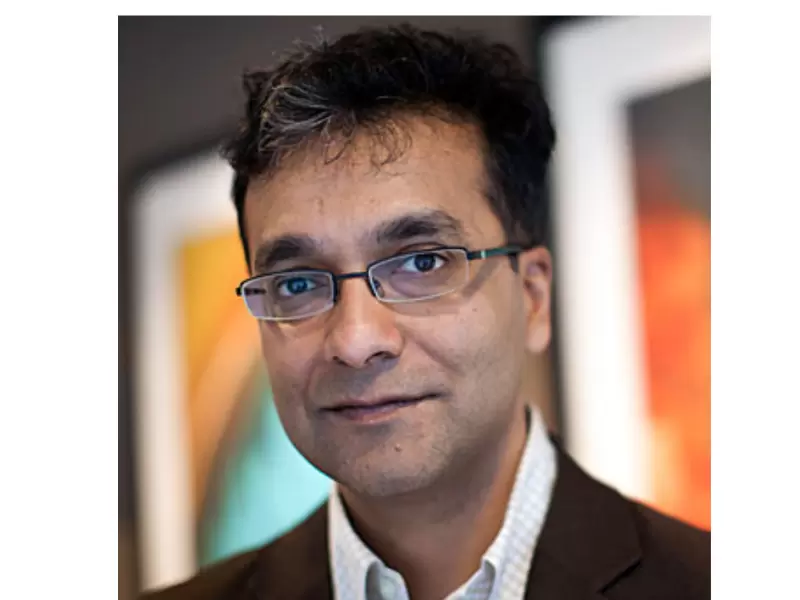 South Asian origin Harvard professor and researcher, Aravinthan Samuel. / Harvard University (harvard.edu/)
South Asian origin Harvard professor and researcher, Aravinthan Samuel, along with other scientists at Harvard and MIT, has developed a system called SmartEM, which uses machine learning to guide a simpler and cheaper microscope to scan brains.
While normally creating very detailed maps of the brain is slow and expensive because it requires powerful electron microscopes, this new approach makes brain scanning significantly faster and less costly.
ALSO READ: Indian-origin MIT prof. develops AI sensors for early cancer detection
The objective is to study the brain by making microscopes work more like human eyes and aiding more scientists to study detailed brain connections, and furthering related research.
Samuel explained that this innovation has the potential to turn connectomics, which is the branch of neuroscience concerned with the study and modelling of connectomes (the system of neural pathways in a brain or nervous system), into a benchtop tool.
Samuel, who is from Harvard’s Department of Physics and Center for Brain Science and one of the senior authors of this new research paper published in Nature Methods, spoke about the goal of the innovation and told the university,
“SmartEM has the potential to turn connectomics into a benchtop tool. Our goal is to democratize connectomics. If you can make the relatively common single-beam scanning electron microscope more intelligent, it can run an order of magnitude faster.”
“With foreseeable improvements, a single-beam microscope with SmartEM capability can reach the performance of a very expensive and rare machine,” he added.
The method is the product of a five-year collaboration between researchers at Harvard, MIT, Johns Hopkins Applied Physics Laboratory, and microscope manufacturer Thermo Fisher Scientific.
SmartEM marks a new advance in the decades-long quest to create wiring diagrams of brains from across the animal kingdom, from worms to fruit flies to humans.
Samuel is a triple Harvard alumnus, graduating with a B.A. in Physics in 1993, a Ph.D. in Biophysics in 1999, and a Neuroscience Postdoctoral Fellow from 1999 to 2003. He has been the recipient of several honors, including the NIH Director’s Pioneer Award and the NSF CAREER Award, among others.
Read more stories on NewIndiaAbroad.
Leave A Comment
Related




.png)







ADVERTISEMENT

ADVERTISEMENT
E Paper
Video

Comments
Start the conversation
Become a member of New India Abroad to start commenting.
Sign Up Now
Already have an account? Login