ADVERTISEMENT

ADVERTISEMENT

Delivering the best AI outcomes requires hyper-wiring of sectors and disciplines, says Sethuraman Panchanathan

Former President Barack Obama's National Science Board appointee, Sethuraman Panchanathan talked to New India Abroad in an exclusive interview.

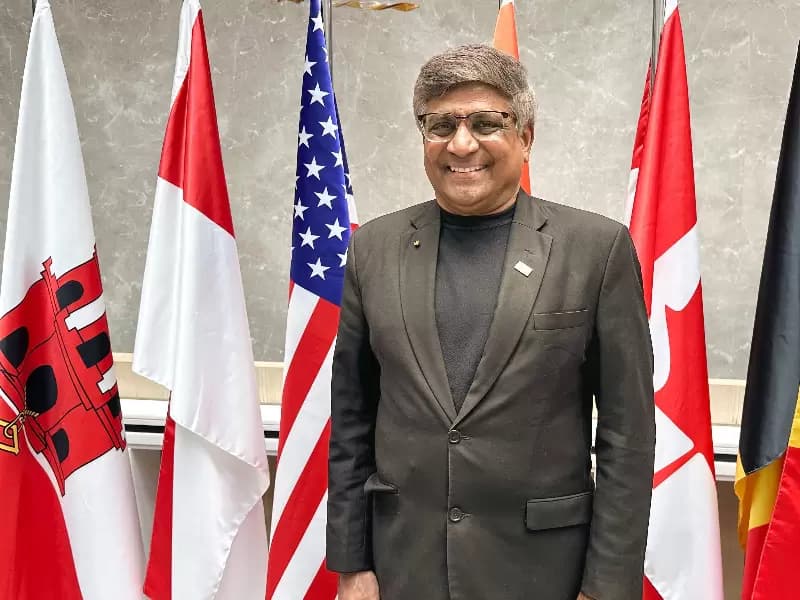
Sethuraman Panchanathan / Courtesy photo

Sethuraman Panchanathan is a man of many hats: professor, scientist, administrator, and former director of the U.S. National Science Foundation (2020–2025). Now a professor at  Arizona State University (ASU) - where he previously served as executive vice president and chief research and innovation officer - and foundation chair at the university’s School of Computing and Augmented Intelligence, Panchanathan’s NSF tenure was marked by the establishment of a network of AI research institutes. During a recent visit to Bengaluru for the Indiaspora Forum, a gathering of global Indian leaders, he spoke with Ishani Duttagupta on the current inflection point in AI and the vital importance of scientific collaboration between the U.S. and his birth country, India. Edited excerpts from the interview:

After your high-profile tenure as NSF director, you are now back in academia – what has the transition back from a high-profile government role been like?

I look at this as a continuum, not transition, because what I have done at the university has shaped my journey. From a student, to faculty, who did research at all levels, to chair of a department and a school director, I have been in different roles. I also became executive vice president of ASU’s Knowledge Enterprise. It is a journey in which you not only do your own research, but empower and enable researchers, students, and faculty to be successful in their endeavours. It is about how you prepare an environment so that they might be successful with their ideas and their talent. 

ALSO READ:  Panchanathan, Gupta to receive Hofstra University honorary degrees

And that led me to taking on roles at the national level, like being appointed by President Barack Obama to the National Science Board. And then I was a member of the National Advisory Council on Innovation and Entrepreneurship, Department of Commerce and executive vice president of research of the Association of Public and Land-grant Universities. All these provided a platform to elevate what I had been doing at my institution to a national level and also to bring back the national level perspectives to the institution that I was at.  

Please share some of the highlights of your tenure as director of the U.S. NSF between 2020 and 2025.

As director NSF, you get a perch to look at the national funding body, which is a very unique agency. It’s the only science and technology agency in the U.S. which funds all fields of science and technology. There are mission-oriented agencies like NASA, Department of Energy, Department of Commerce, Defense Advanced Research Projects Agency (DARPA) and even National Institutes of Health. But NSF is in all fields of science and technology and therefore you get a chance to play a role in terms of developing the strategy. You also partner with other agencies for hyperwiring and contributing to the science and technology innovation strategy of the future. For me, it is about using the learnings, experiences and the platforms to benefit the global scientific and technology community. And now, being physically present in Arizona does not limit me and I need to work at a global stage. So originally, I started with local, regional and national and now it’s global.

One of my learnings that I would like to enunciate is that even as talent and ideas are democratised; opportunities are not. This is not just true for the United States or Arizona, it is true for every part of globe. Every science leader I meet, attests to this, it doesn’t matter whether we are a developed nation, or a developing nation, or yet to develop nation. Everybody would like the ideas that are everywhere, waiting to be nurtured, motivated, inspired and brought to life. We haven’t done it in full-scale – but only in pockets. And that’s my job. That requires a systematic thinking of how do you ensure policies and investments, which follow policies, are put in place. So, we created a vision called innovation anywhere, opportunities everywhere for everyone at NSF. And there are many programs we put together. 

Now with the dominance of AI, do you see an increasing need for strong partnerships between academia, government and the private sector in technology?

Absolutely. So, I think we are reaching a moment of transformation. And without being too hyperbolic, I would say an inflection point. The time has come for us to hyper partner with multiple sectors, for the academic sector to be working with government, industry, and philanthropy. It’s time for regional economies, state governments, regional governments and cities, to be working together. And not only the sectors working together, but disciplines working together. In my five years at the NSF, we launched 27 AI institutes across the U.S. with an investment of $540 million. Of that, NSF’s investment was $320 million - 60 percent of it.

The other 40 percent was invested by other agencies, industry and philanthropy - a combination of sectors co investing. We are talking about AI for societal good. These AI projects range from fundamental AI work to AI in agriculture, AI for education,  AI for climate and weather and AI for transportation. We have invested in projects focussed on people who have speech language issues and how to use AI as a mechanism of not only diagnosing, but also finding solutions. There are not just researchers in computing and engineering working at these AI institutes, but also people from social sciences. behavioural sciences, humanities, arts, policy, business, law and others.

If you don’t bring all of them together, then the kind of solutions you will build with AI would be very narrow and result in some of the challenges that we talk about from AI. There are multiple challenges including those about bias, ethics, security, privacy and opportunity – a host of them. Delivering the best outcomes requires hyper-wiring of sectors, disciplines, and a whole host of things that come together, regionally, nationally and globally. And only then can we deliver for global good. The good news is that there is a collective will to want to do that. So, what we need to do is to take this moment of collective good and translate that into actionable things. The questions is: what does AI do to change the future paradigms of education? The answer: it is no longer about what you do in university, learning is now a lifelong KtoGray process.  

Beyond your scientific achievements, you’ve played a pivotal role in shaping institutions. What do you consider the defining highlights of your leadership in these areas?

When I started off as faculty at the university, I wanted to do impactful research; then as chair, I wanted to enable faculty to be successful. Those were moments that gave me the opportunity to think beyond myself and to want to serve. It helped me build newer frameworks for better outcomes and to start engaging with the K to 12 institutions, which is not what universities typically do. But we need to do that because in the U.S., the K to 12 outcomes are not as robust as some of the other parts of the world. So, we need to change that by lifting up and inspiring talent. When people are coming to the university, you want to make sure that universities are much more about welcoming talent and growing, grooming and nurturing them. I’m very proud to say that the institution that I come from, measures itself by who we include and how they succeed, rather than by who we exclude. Our aspirations are of taking ideas from everywhere and democratising them.

As institution builders, we need to make sure that we are always mindful of that imperative. At the university, we rapidly grew the research and are now labelled among the most innovative universities in the U.S. for 13 years in a row. When I started my research role, it was a university which was at about $250 million of research volume; when I left to go to NSF, it was at $717 million. We not only created an environment for faculty to be successful; but we also partnered up with the region including with cities in Arizona, the state of Arizona and with the industry to deliver more outcomes. For me, institution building is about a can-do spirit. It is about making things possible even when it seems difficult. And that’s the spirit I carried to NSF. We introduced a new directorate, the first in 31 years for NSF, called the  directorate of technology, innovation and partnerships (TIP). One of the exemplar programs was called the regional innovation engine. We felt that every region in the United States has got its native in-place innovation, which can be lifted up if we are intentional about it. And I am proud to say that the regional innovation engines are very successful.  In the five years at NSF, we did a number of things essentially about institution building at the national scale. 

Please share some of the connections that you have with India – both professional and personal.

I grew up in India and did my two undergraduate degrees from the University of Madras, in physics, and then the Indian Institute of Science. Then I did my master’s from IIT Madras. My father was a prolific researcher and did amazing work in terms of research, education and mentorship. He always valued the concept of hard work, excellence and giving back. And my mother, as a homemaker, was always giving back. So, early in my life, I was truly impacted by this unbelievable spirit of giving and excellence by my parents, and my surroundings in India. That essentially is what has made me who I am today. I feel that the U.S. and India have a common thread of democratic values as well as scientific values, openness, transparency, reciprocity, respect for intellectual property and research integrity. All of these are values that we subscribe to and we can naturally be partners. And despite challenges, there are companies that transcend U.S. and India and now education institutions that are transcending U.S. and India, I think this moment is a possibility for us to build bridges and strengthen the networks and connections. 

Discover more at New India Abroad.

Comments

Related

To continue...

Already have an account? Log in

Create your free account or log in