ADVERTISEMENT
ADVERTISEMENT



The manifesto is a Trojan Horse, not a joke
A closer look at the Cockroach Janta Party’s viral manifesto argues that its meme-driven demands package institutional distrust as satire.
-
1744362597.jpeg) Arun Anand
Arun Anand - Sun, 24, May 2026
- 15:13 EDT
- 2621
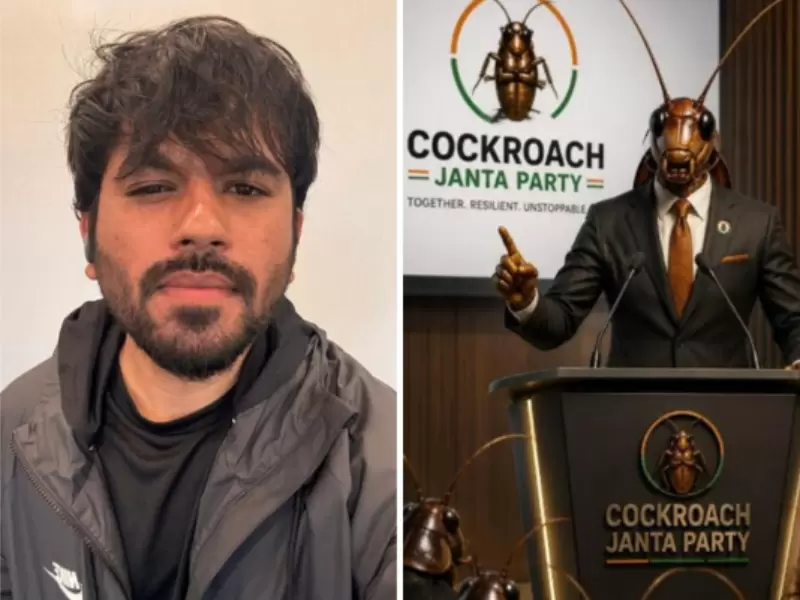 Abhijeet Dipke/ Cockroach Janta Party / Instagram/ Cockroach Janta Party
The Cockroach Janta Party (CJP) emerged in India in May 2026 as an internet-native political movement that combined meme culture, satire and anti-establishment rhetoric with a remarkably sophisticated digital mobilisation strategy. Founded by US-based student Abhijeet Dipke, the movement rapidly accumulated millions of followers across social media platforms
The five demands of the Cockroach Janta Party(CJP) have been received in the international press as harmless satire. They are not harmless. They are precisely calibrated, each demand sitting at the boundary between a reasonable-sounding grievance and a serious institutional attack. Read individually, each appears to be a legitimate concern dressed in the irreverent language of Gen Z. Read together, they constitute a draft assault on the Election Commission, the judiciary, the press and Parliament. The joke is the wrapping. The crowbar sits beneath it.
Also Read: Meet the Boston grad behind India’s viral ‘Cockroach’ youth party
Demand One: Arrest the CEC Under UAPA
The first demand calls for the arrest of the Chief Election Commissioner under the Unlawful Activities Prevention Act(UAPA) for any vote that has been deleted from the electoral rolls. Set aside, for a moment, the absurdity of using India's most serious anti-terrorism law against a constitutional functionary doing his statutory job. Even if one accepts that the electoral rolls require greater scrutiny, the legal framework already exists. The Representation of the People Act of 1951 provides multiple avenues for challenging voter deletions. Election petitions can be filed before the High Court of any state. Recent revisions of electoral rolls are routinely subject to judicial review.
Why, then, the demand for UAPA? Because UAPA is not a regulatory law. It is a national security law designed for terrorism cases, where conventional criminal procedure is inadequate. To demand its application against the CEC is to argue that running an election in a manner the movement disapproves of is equivalent to waging war against the state. This is not a serious legal claim. It is a rhetorical device intended to delegitimise the Election Commission itself. Once the office of the CEC can be associated, even satirically, with terrorism, the institutional credibility of the entire electoral process becomes contestable.
Demand Two: Break Up Ambani and Adani Media
The second demand calls for the cancellation of licences of all media houses owned by Mukesh Ambani and Gautam Adani, in order to make way for a truly independent media. The phrasing is careful. It invokes media pluralism, a value most democracies endorse. But the demand it makes is for executive action against named corporate groups, on the basis of their ownership, by an unspecified authority operating through unspecified procedures.
Indian media regulation operates through specific frameworks. The Ministry of Information and Broadcasting issues licences under specific rules. Cross-media ownership questions are addressed through TRAI consultations and the recommendations of the Telecom Regulatory Authority. Anti-trust questions fall under the Competition Commission of India. The Press Council provides further oversight. To demand that all media houses owned by two named businessmen be summarily de-licensed, without any of these procedures being followed, is to demand executive arbitrariness of a kind that no democratic state should normalise.
The deeper point is that the demand selects its targets by ownership identity rather than by demonstrated regulatory violation. If specific media houses have violated specific norms, the existing regulatory architecture can address it. The CJP demand is not about regulatory enforcement. It is about delegitimising private ownership of media outlets associated with certain political alignments. That is a different argument, and one that deserves to be debated on its merits rather than smuggled in under the cover of media reform.
Demand Three: 50 Percent Women's Reservation Without Expanding Seats
The third demand calls for fifty percent reservation for women in Parliament without expanding the number of seats. This sounds, on the surface, like a progressive demand for gender equality. The arithmetic, however, collapses on inspection.
Indian Parliament has 543 Lok Sabha seats. Of these, 84 are reserved for Scheduled Castes and 47 for Scheduled Tribes. To reserve 50 percent of seats for women, without expanding the total, would require that 271 of those 543 seats be designated as women-only. The Constitution's existing reservations for SCs and STs would either have to be reduced, abolished or layered with women-only sub-reservation. Each option produces legal challenges that would take years to resolve. The Nari Shakti Vandan Adhiniyam of 2023, India's actual women's reservation law, addresses precisely this complexity by tying implementation to delimitation, which will expand seats first.
The CJP demand ignores all of this. It collapses a serious constitutional question into a meme-friendly slogan. Anyone who actually wanted fifty percent women's reservation would engage with the Adhiniyam(Act), with delimitation, and with the constitutional architecture that makes the reform feasible. The CJP does not. Its demand is not designed to advance women's representation. It is designed to embarrass the Indian Parliament for not having achieved fifty percent already, on a timeline that ignores the basic structure of the Constitution.
Demands Four and Five: Judicial and Party Discipline
The fourth demand bars retired Chief Justices of India from accepting Rajya Sabha seats. The fifth seeks reforms to party discipline, particularly around defections. These are the most defensible of the five demands. The question of post-retirement appointments for judges is a serious one, raised by retired judges themselves. The question of party discipline and the anti-defection law has been debated by constitutional scholars for decades.
But even these defensible demands are framed in a manner that undermines rather than supports reform. The CJP's website calls for a twenty-year ban on any defecting MLA or MP from contesting elections or holding public office. Twenty years exceeds the working political life of most legislators. The demand is not a calibrated reform of the anti-defection law. It is a maximalist position that would, if implemented, freeze the political class out of the system entirely. The same maximalism appears in the post-retirement demand, which makes no distinction between Chief Justices who join Parliament after a brief gap and those who accept immediate appointment.
The pattern across all five demands is consistent. Each takes a real concern and frames it as a maximalist, headline-friendly slogan that cannot survive legal or institutional scrutiny. The movement appears to want neither serious reform nor serious debate. It wants viral propositions that pose as reform while functioning as critique.
There is a long tradition in Indian satire of stating impossible demands to expose institutional failures. The CJP belongs to a different tradition. Its demands are not impossible because reform is impossible.
They are impossible because they were designed to be. A movement that produces five demands engineered for collapse under legal scrutiny is not asking the institutions of the republic to be better. It is asking citizens to lose faith in the possibility that they can be.
The writer is an author and a columnist. He has authored more than 15 books including 'Taliban: War and Religion in Afghanistan'.
(The views and opinions expressed in this article are those of the author and do not necessarily reflect the official policy or position of New India Abroad.)
Discover more at New India Abroad.
Leave A Comment
Related












ADVERTISEMENT

ADVERTISEMENT
E Paper
Video

Comments
Start the conversation
Become a member of New India Abroad to start commenting.
Sign Up Now
Already have an account? Login