ADVERTISEMENT
ADVERTISEMENT


Modi, Trump, and the fight over democracy's fault lines
Modi and Trump should meet the challenge from leftists, communists, and Islamists bluntly rather than through the conventional etiquette of liberal-democratic debate
-
 Vibhuti Jha
 - Fri, 21, Aug 2026
- 12:15 EDT
- 43
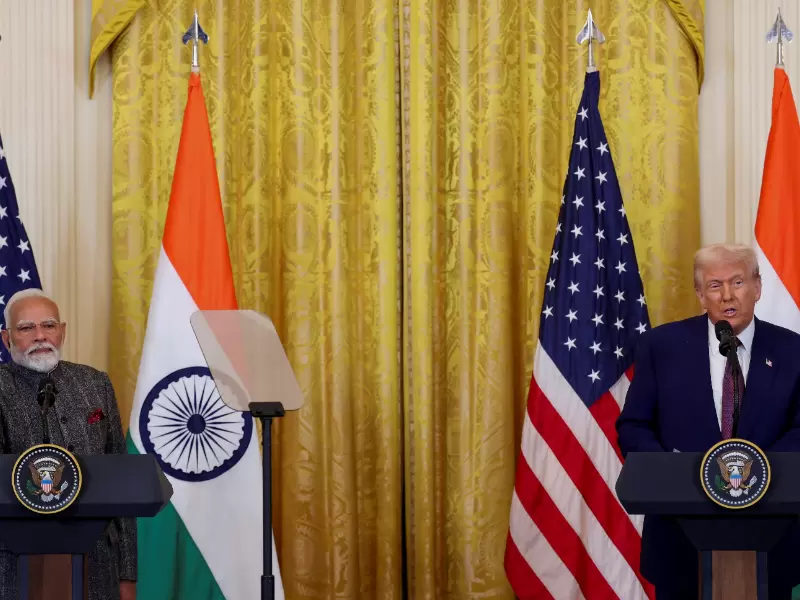 U.S. President Donald Trump holds a joint press conference with Indian Prime Minister Narendra Modi at the White House in Washington, D.C., U.S., February 13, 2025. / FILE PHOTO REUTERS/Kevin Lamarque
By most measures, Narendra Modi and Donald Trump could not be more different men. One rose through decades of grassroots party organizing in Gujarat, a disciplined ascetic who rarely deviates from script and treats governance as a long, patient project of institution-building.
The other is a New York real estate magnate turned reality-television star, an instinctive improviser who governs by gut feel and confrontation as much as by plan. One speaks in measured Hindi cadences about civilizational continuity; the other speaks in blunt, transactional English about winning and losing. Their personal style, their political roots, their relationship to their own parties — all diverge sharply.
Also Read: Makkah Pact: Alliance or Strategic Hedging?
And yet a growing chorus of their supporters argues that both men are fighting the same war, on different fronts, against a common opponent: a loose but increasingly coordinated coalition of progressive activists, socialist-leaning technocrats, and Islamist political movements that has learned to use the language and machinery of liberal democracy against itself. This is the argument worth taking seriously, whatever one's ultimate verdict on it.
The Shared Diagnosis
The case goes roughly like this. Modern democracies were built on the assumption that free institutions — a free press, independent universities, an impartial judiciary, open immigration and asylum systems — would be used in good faith by all political actors to compete for power and then hand it over peacefully when they lost.
What Modi's and Trump's supporters argue has changed is that a specific ideological bloc has stopped treating those institutions as neutral referees and started treating them as instruments to be captured. University humanities departments, they argue, no longer simply teach critical theory as one perspective among many but train a generation of bureaucrats, journalists, and NGO staff who see their job as advancing a specific social-justice agenda from inside supposedly neutral institutions.
Newsrooms, once committed to a fairly narrow conception of objectivity, are said to have drifted toward open activism on issues from gender identity to immigration to historical memory. And in both India and the West, critics argue, the language of rights and freedom has been selectively deployed — invoked loudly to protect certain groups and movements, and conspicuously withheld from others, especially majority religious and cultural communities who are cast by default as oppressors rather than as a constituency with legitimate interests of their own.
Layered onto this, in the Indian context specifically, is the argument about political Islamism: that certain strands of Muslim political organizing in India, and in parts of the Islamic world more broadly, do not merely seek equal citizenship within a secular constitutional order but actively contest the legitimacy of that order itself, using the protections of a pluralist democracy — free speech, free assembly, minority-rights law — as tools to expand parallel systems of authority incompatible with a unified civic nation.
Modi's supporters see the abrogation of Article 370, the Citizenship Amendment Act, and the broader push toward a more assertively Hindu civilizational self-definition as a corrective to decades of what they call "pseudo-secularism," in which minority appeasement was mistaken for genuine pluralism.
Trump's coalition tells a structurally similar story about a domestic left that they believe treats "diversity, equity, and inclusion" mandates, open-borders sympathies, and permissive urban criminal-justice policy not as good-faith policy positions but as a long march through American institutions — culminating in what they see as a bureaucratic and cultural establishment that no longer represents, or even much likes, the working- and middle-class majority that elected him twice.
Why the Comparison Resonates
What gives this argument its force, for those who find it persuasive, is the genuine sense of institutional capture that both leaders' bases report feeling before these men rose to power.
Trump voters watched federal agencies, major media outlets, and Silicon Valley platforms treat his first term as an emergency to be managed rather than a legitimate democratic outcome to be respected — and concluded that the "deep state" was not a conspiracy theory but a description. Modi's supporters watched decades of Congress-era patronage networks embedded in Delhi's bureaucracy, judiciary, and press, and concluded that what looked like neutral secularism was in practice a durable ideological monopoly.
Both men, on this reading, did not create a culture war so much as recognize one already underway and decide to fight it openly rather than concede the institutional battlefield by default. Their bluntness — Modi's civilizational rhetoric, Trump's willingness to call the press "the enemy of the people" — is, to their supporters, not authoritarian overreach but simply refusing to pretend that supposedly neutral institutions were neutral.
Operating on Fundamentally Different Terms
What sharpens this argument further, in the view of Modi's and Trump's supporters, is that the socialist, communist, and Islamist currents they describe are not simply competing within the shared rules of democracy, freedom, and capitalism — they are, in this reading, operating on an entirely different logic while using those rules as cover.
Democracy assumes that political actors compete for power and then relinquish it if they lose; supporters of this view argue that communist and Islamist movements historically treat electoral participation as tactical rather than principled; they contest elections, exploit courts, and organize under constitutional protections only until circumstances allow them to dispense with those protections altogether. Freedom of speech and assembly, in a genuinely liberal framework, is meant to be reciprocal — everyone gets to use it, including one's opponents.
Critics of the socialist-Islamist coalition argue that in practice these movements demand those freedoms for themselves while working to shrink them for everyone else, whether through blasphemy-style social enforcement, campus speech codes, or the delegitimizing of dissenting media as "misinformation."
Capitalism, too, is treated by this camp as something these movements engage with instrumentally rather than in good faith: communist and socialist organizing, on this account, uses the wealth, platforms, and institutional access that market economies generate — university endowments, tech platforms, NGO funding networks — not to compete within capitalism but to accumulate leverage against it, with the end goal of a more centrally managed, redistributive order.
The upshot, in this view, is an asymmetry that conventional democratic politics is not built to handle: one side is playing to preserve a pluralistic system it genuinely believes in, while the other, this argument holds, is playing to win a different kind of system altogether, using the current one's own tools to get there.
That asymmetry, in the view of their supporters, is exactly why Modi and Trump should meet the challenge from leftists, communists, and Islamists bluntly rather than through the conventional etiquette of liberal-democratic debate — since that same etiquette, they argue, will not be extended back to them by those who abuse, misuse, and exploit freedoms as democracy's fault line.
Conclusion
Whether Modi and Trump can, in fact, "beat back" this perceived agenda will be tested less by rhetoric than by governance — by whether their institutions remain strong enough, and their opponents' rights protected enough, that the fight stays a democratic contest rather than something else.
But the core claim animating both men's supporters is clear: that this is not an ordinary left-right disagreement to be split down the middle, but a contest between a system built on reciprocity and movements willing to use that system's own freedoms against it.
That framing, whatever else is said about it, is why both leaders have concluded the fight is worth having in the open — and why their supporters see this moment as a defining test of whether democracy, freedom, and capitalism can defend themselves against those who would use them as a means to their own dissolution.
(The views and opinions expressed in this article are those of the author and do not necessarily reflect the official policy or position of New India Abroad.)
Discover more at New India Abroad.
.
Leave A Comment
Related


ADVERTISEMENT

ADVERTISEMENT
E Paper
Video

Comments
Start the conversation
Become a member of New India Abroad to start commenting.
Sign Up Now
Already have an account? Login