ADVERTISEMENT
ADVERTISEMENT


India’s Exam Crisis Resolution: The Win and Resilience of Democratic Governance
India resolved its exam crisis through democratic engagement, institutional accountability, and sweeping reforms, reinforcing public trust in governance and examination integrity.
-
 Vijendra Agarwal
 - Sun, 26, Jul 2026
- 12:00 EDT
- 30
 Representative Image / AI Generated
In a rapidly developing superpower like India, the true test of leadership is not the absence of civic demonstrations but the leadership’s ability to effect swift, empathetic institutional corrections. For the global Indian diaspora watching from afar, the dramatic conclusion of India’s Gen Z "Cockroach Janta Party" (CJP) protests on Saturday, July 25, 2026, offers a masterclass in the resilience of the nation’s democratic systems.
Following weeks of demonstrations over exam paper leaks, the Modi administration courageously chose meaningful engagement over stagnation or confrontation. With the resignation of Union Education Minister Dharmendra Pradhan and the formal withdrawal of the CJP strike, India’s steadfast democracy has demonstrated that its internal check-and-balance mechanisms are fully functional.
The Triumph of Institutional Accountability
The peaceful resolution achieved at Jantar Mantar marks a significant victory for both India's youth and the state's governance model. Prime Minister Narendra Modi’s administration did not retreat into a defensive posture; instead, it engaged in direct, high-level talks to resolve the underlying policy vulnerabilities.
The government accepted the CJP’s core demands, including the immediate introduction of fast-track courts to prosecute leak cartels and dropping all outstanding police charges against student demonstrators. The government has also agreed to deliberate on providing financial compensation to families devastated by exam-related tragedies. Thus, the Modi government proved that India represents not only a strong state but also an empathetic one.
While critics may rightfully argue these comprehensive administrative measures should have been institutionalized sooner, the swiftness of the ultimate resolution underscores a robust republic. Dharmendra Pradhan’s resignation was a dignified act of accountability meant to deny opportunistic external forces any avenue to exploit internal domestic issues. Real accountability is now being measured by systemic overhaul, not political theater.
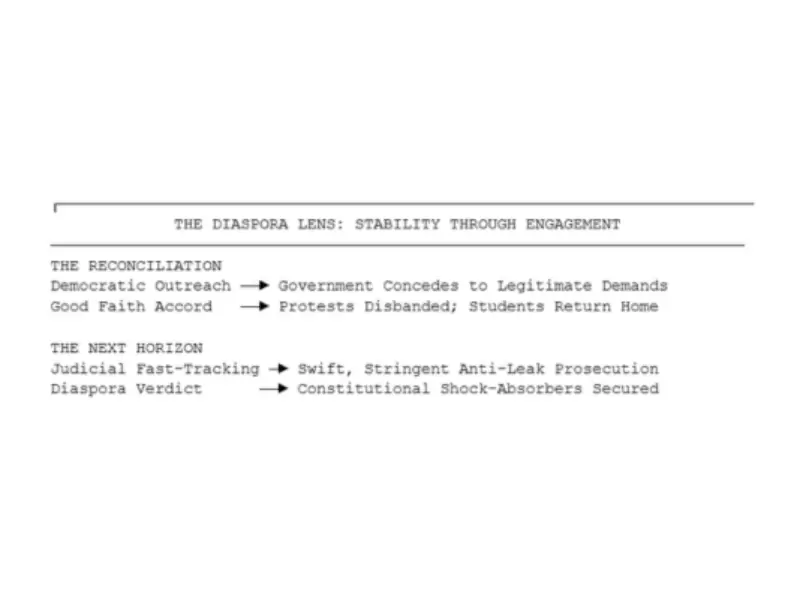 A snapshot of India's democratic response to the exam crisis. / Vijendra Agarwal,
Disarming the Partisan and External Overdrive
For the NRI community, this resolution completely disarms the hostile narratives pushed by both partisan domestic factions and Western media conglomerates. Outlets like the Public Radio, BBC, and The Guardian had rapidly attempted to frame a localized administrative failure as an existential breakdown of, and a threat to, the Modi government. They magnified selected street confrontations while entirely ignoring the good-faith legislative framework being put into motion.
Similarly, the strategic involvement of opposition leaders like Rahul Gandhi and CJP’s own AAP-linked digital strategists showed clear attempts to stretch a student welfare crisis into a tool for systemic regime destabilization. By reaching a mutual consensus and ending the agitation, one hopes that the student body has separated itself from partisan manipulation. The question, however, remains whether the infrastructure of the CJP will prove to be an organic, domestic manifestation of economic anxiety, rather than a shadow-funded foreign plot. Only time will decide what the future holds for CJP and if any foreign funding or any support was involved when the CJP founder left for India from Boston. For the time being, a peaceful dissolution of CJP-led protests leaves external as well as domestic anti-India narratives with nowhere to stand.
A Call to the Future
With the political battle resolved, the message to India’s nearly half-billion Gen Z individuals is clear: the state has listened, and it is time to return to building the future. The historic Public Examinations (Prevention of Unfair Means) Act, including 10-year prison sentences, coupled with a digital overhaul of the National Testing Agency (NTA), means that a clean, level playing field is bound to happen. The Parliament will be debating the new Bill, and a high-powered committee will immediately initiate its work on how technology can be used effectively for a better examination system.
Modi’s direct appeal to Gen Z on social media, not only once but twice,8 is a clear signal that India’s demographic dividend remains its greatest asset, and its youth can now return to their classrooms with full confidence. India’s sovereign democracy has once again established that the students’ merit and their future are fiercely protected by a responsive government.
(The views and opinions expressed in this article are those of the author and do not necessarily reflect the official policy or position of New India Abroad.)
Discover more at New India Abroad.
Leave A Comment
Related










ADVERTISEMENT

ADVERTISEMENT
E Paper
Video

Comments
Start the conversation
Become a member of New India Abroad to start commenting.
Sign Up Now
Already have an account? Login