ADVERTISEMENT
ADVERTISEMENT



India–Africa: Reinforcing partnerships
The India–Africa partnership needs to be assessed across four vital dimensions: multilateral, continental, regional and bilateral.
-
1769405603.jpeg) Rajiv Bhatia
Rajiv Bhatia - Mon, 26, Jan 2026
- 01:38 EST
- 121
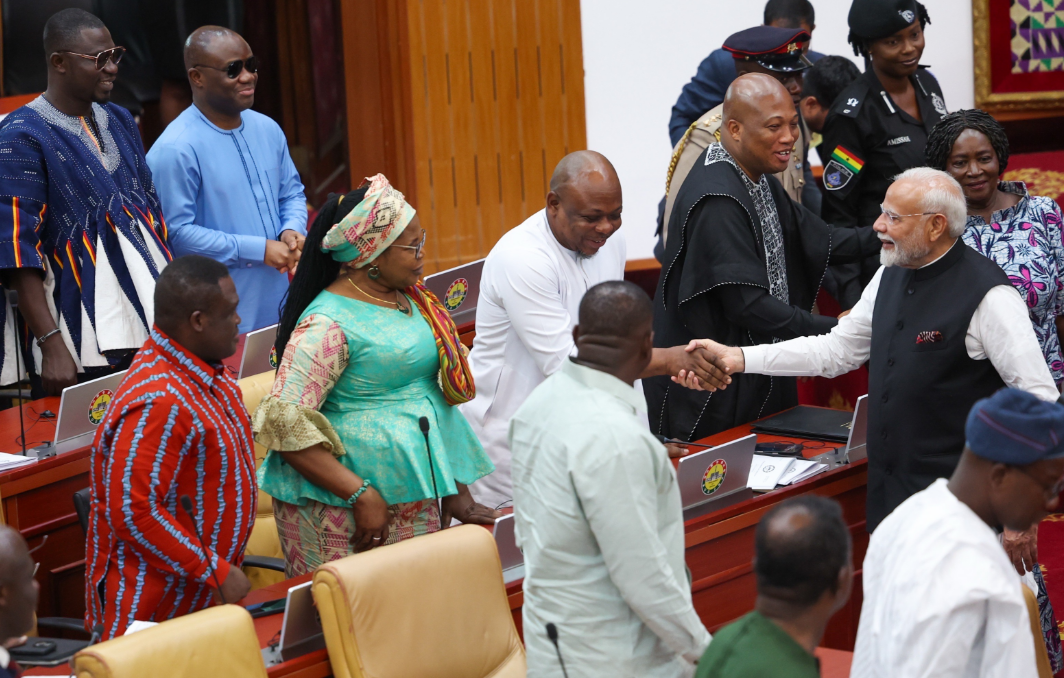 Modi interacting with Ghana's Members of Parliament / X/ narendramodi
Discussing a partnership between India, a country, and Africa, a continent of 54 countries, may sound asymmetrical. Still, two factors justify doing so: empathy and support for Africa in India are matched by admiration and respect that most Africans feel for India’s success as the world’s largest democracy and the fastest-growing large economy. Each, home to 1.4 billion people, can help the other secure its vision of good governance and prosperity. Hence, the evolution of the partnership between India and Africa in the 2020s is a subject of global interest.
The India–Africa partnership needs to be assessed across four vital dimensions: multilateral, continental, regional and bilateral.
First, the multilateral dimension begins with the UN, where, for decades, India and Africa have collaborated fruitfully to pursue shared goals, including decolonisation, economic development, peacekeeping and UN reform. Even today, India participates in UN peacekeeping operations in the Democratic Republic of Congo (DRC), South Sudan, the Central African Republic (CAR) and Western Sahara. At a time when multilateralism is under severe stress, the two sides continue to coordinate to keep UN reform, particularly of the Security Council, on the agenda. Global issues such as development assistance to Africa, debt relief, a just energy transition and inclusive growth are supported through proactive Indian diplomacy.
A significant contribution by India was its firm leadership as G20 president in 2022–23 in ensuring that Africa’s long-pending request for full G20 membership for the African Union (AU) was accepted. In addition, when BRICS undertook its first expansion, India had the privilege of supporting the entry of Egypt and Ethiopia into this influential forum.
Second, the continental dimension assumed greater substance with the launch of the India–Africa Forum Summit in 2008. Two more summits were held in 2011 and 2015. It was decided that the fourth summit would take place in 2020. The COVID-19 pandemic and other factors prevented this, but official indications now suggest that the next summit may be held sometime in 2026. This is overdue, as geopolitics has been changing rapidly to the detriment of the Global South. India, as the ‘voice’ of the Global South, and Africa, as its heart, must create an opportunity for candid and comprehensive dialogue to develop a mutually acceptable strategy for shared goals.
ALSO READ: Two Indian-origin jurists appointed to South Africa tribunal
Third, the regional dimension of the India–Africa partnership refers to India’s past efforts to cultivate cooperative ties with select regional economic communities (RECs) to diversify and deepen economic cooperation. These initiatives were pushed by apex Indian business chambers such as the CII and FICCI through periodic interactions with the East African Community (EAC), COMESA and SADC. Fresh momentum is required through stronger political leadership backing such business initiatives. Experts believe selected RECs remain useful platforms for increasing trade, investment and collaboration in critical minerals, as well as for introducing digital technologies across Africa.
Fourth, the bilateral channel for consolidating relations between India and African countries remains the most important. Keeping this in view, and given the vastness of the continent and the large number of countries involved, India has opened 18 new embassies in Africa in recent years. These are now operational, connecting Indian authorities, businesses, think tanks and others with their counterparts across the continent.
Political and diplomatic dialogue has been advanced through a steady exchange of high-level visits, resumed after a three-year hiatus caused by COVID-19. A total of 12 VVIP visits were undertaken by the Indian side during 2022–25, during which India’s President, Vice President or Prime Minister held discussions with leaders of 17 African countries. The list demonstrated that India’s interests extended to West Africa, North Africa and the Horn of Africa, even as it maintained its traditional diplomatic outreach in eastern and southern Africa.
In addition, during the Covid pandemic, India was at the forefront of assistance, supplying vaccines, medicines and medical equipment to countries across Africa. This stood in contrast to the regrettable practice of some Western countries, where surplus vaccine stocks lay idle instead of being shared with African populations at a critical moment.
Two areas of the partnership require particular attention. First, trade and economic cooperation are the top priorities for both sides. India’s trade with Africa was estimated at $103 billion in FY2025. New Delhi has set a target of raising this to $200 billion by 2030. India’s cumulative investment of $80 billion in Africa also needs to be expanded and diversified. Achieving this will require a practical roadmap jointly developed by business leaders and governments.
The second area is soft power: culture, education, skill development and thought leadership provided by universities, think tanks, media and NGOs. A concerted plan must be devised to enhance people-to-people interactions. A combined population of 2.8 billion people deserves to know and relate to one another far better than they do today.
The multidimensional India–Africa partnership has a promising future. However, leading actors in both regions will need to devote greater time, attention and financial resources to advance it to the next level.
Ambassador Rajiv Bhatia is a distinguished fellow at Gateway House, Mumbai. He is a former Indian high commissioner to Kenya, South Africa and Lesotho, and served as director general of the Indian Council of World Affairs during 2012–15. His book ‘India–Africa Relations: Changing Horizons’ (Routledge, 2022) received critical acclaim.
(The views and opinions expressed in this article are those of the author and do not necessarily reflect the official policy or position of New India Abroad.)
Discover more at NewIndiaAbroad
Leave A Comment
Related









ADVERTISEMENT

ADVERTISEMENT
E Paper
Video

Comments
Start the conversation
Become a member of New India Abroad to start commenting.
Sign Up Now
Already have an account? Login