ADVERTISEMENT
ADVERTISEMENT


I never thought of myself as casteist. Then Aisha Wahab labeled me one
SB 403 did not add protection. It added a term, and that term had our community's identity attached to it in every classroom, every newsroom, and every HR department in the state.
-
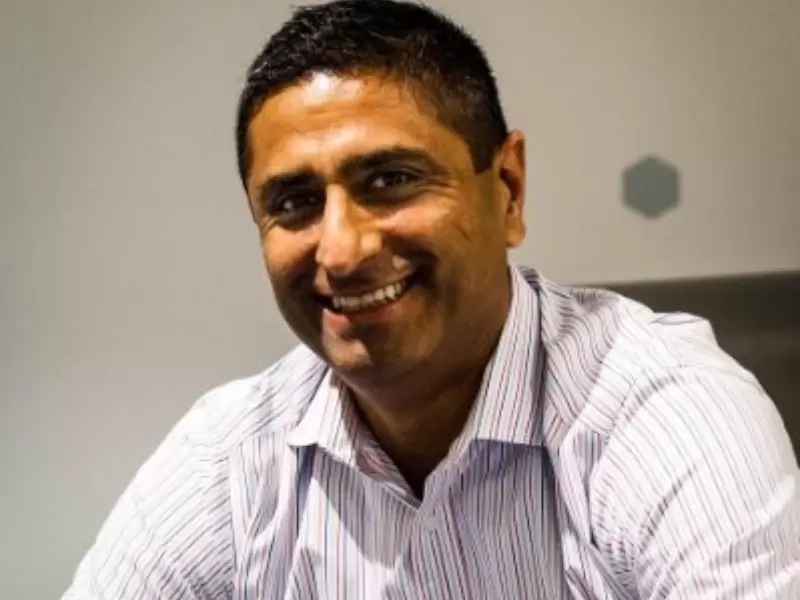
 Dilip Amin
 - Tue, 12, May 2026
- 13:26 EDT
- 2005
 Representative Image / Generated using AI
Why this matters right now
Senator Aisha Wahab is now running for Congress in California's 14th Congressional District, which covers Fremont, Hayward, Livermore, Dublin, and the East Bay. June 2 is the primary.
CA-14 is home to one of the largest Indian and Hindu American communities in the United States. These are the same people she labeled, profiled, and dismissed when they stood up to tell her that SB 403 was wrong.
She is asking for their trust now. They are entitled to ask whether she will work for them.
Representative Image / Generated using AI
Why this matters right now
Senator Aisha Wahab is now running for Congress in California's 14th Congressional District, which covers Fremont, Hayward, Livermore, Dublin, and the East Bay. June 2 is the primary.
CA-14 is home to one of the largest Indian and Hindu American communities in the United States. These are the same people she labeled, profiled, and dismissed when they stood up to tell her that SB 403 was wrong.
She is asking for their trust now. They are entitled to ask whether she will work for them.
I once asked my American-born son, when he was a faculty member at Stanford University, “What is your caste?” He rolled his eyes, trying to guess based on what his sixth-grade teacher had taught him. I had to clarify, “What is your caste, not what it should be?” He had no answer.
I have lived in this country for almost five decades. I came from India, got a doctorate degree and worked in the corporate world for four decades. I have never once come across a caste related situation in my life. That changed in 2023, when the state of California, through a bill introduced by a state senator, Aisha Wahab, could potentially put my last name, my religion, and my heritage as casteist.
I Had to Look Up the Word
When I first heard about Senate Bill 403, I had to look up the word caste in the context of American law. Not because I am ignorant of history, but because caste as a lived social reality had no presence in my life, not in personal nor in professional life.
So when Senator Aisha Wahab introduced a bill in November 2022 that would add "caste" to California's civil rights law, my first reaction was confusion. My second, after I read the bill's language, was a wake up call.
The bill defined caste as a person's "perceived position" in a social hierarchy based on "inherited status." Perceived by whom? It did not say. Which meant that any employer, any landlord, any colleague who assumed something about my identity based on my last name, my vegetarianism, my temple visits, could trigger a legal claim against me. Not because of anything I did. Because of what someone else perceived about what I was born into.
California's schools were already teaching caste as an institution of Hinduism. Which meant that in practice, "caste" in state law meant one thing: Hindu. Indian. South Asian. My community. Me. My children. Even my great grandchildren.
The bill's supporters called it protection. I was left astounded!
How Has My Life Changed?
After learning about the unjust SB-403 bill, I felt compelled to take action against it. I began reaching out to community leaders, encouraging and preparing them to speak up and organize opposition to the bill. I testified at several hearings in Sacramento and addressed numerous local legislative bodies. I also published many articles and recorded multiple video messages expressing concerns about the proposed caste legislation.
During that period, opposing SB-403 and advocating against what I believed to be an unjust bill became the central focus of my life.
The Bill Had No Solid Ground Beneath It
Here is what Senator Wahab did not tell the committees that voted yes. The primary evidence for SB 403, the 2018 Equality Labs survey that she and her supporters cited repeatedly, had been reviewed by the Carnegie Endowment for International Peace, which found it used a methodology that produced skewed results by design. It relied on what researchers call snowball sampling, meaning it recruited respondents through existing networks, and it dropped anyone who did not identify a caste, which guaranteed the sample would overrepresent those with strong views on the subject.
The Carnegie review of Equality Labs survey called it unscientific.
We submitted this to every committee. Bahujan and Dalit Hindus, people the bill claimed to protect, drove to Sacramento to testify against it. Bahujan community organizations submitted letters to the Assembly describing the bill as an attempt at cultural genocide against their identity. APNADB, the Ambedkar Phule Network of American Dalits and Bahujans, wrote that the unjust and unconstitutional bill threatened to divide communities and infringe upon the civil rights of marginalized people in California, and represented a stark contrast between unity and division.
None of it moved the needle. Six committees passed the bill. The Assembly voted 55-3 in favor. The Senate voted 31-5.
With fierce opposition, Senator Wahab responded by amending the bill, stripping 55 references to caste, removing explicit mentions of South Asian origins, recategorizing caste as a subset of ancestry. Albeit, Wahab wilfully ignored the fact that the Unruh Act already covered protection from caste discrimination in the ancestry category. She made the edits to manage optics while keeping the political outcome intact.
|
What Wahab said publicly vs. what the record shows ● On the Senate floor: "This bill is very simple. It is to protect all people against caste discrimination, regardless of caste." But the bill's language created liability based on perceived identity, with no clarity on who does the perceiving and no limit on which communities would be affected in practice. ● At an Assembly hearing: "SB 403 will end caste discrimination and protect millions." Compared to that, Governor Newsom's veto concluded that existing law already prohibited such discrimination. The bill was, in his words, unnecessary. ● At a public event: "There is something going on where people are trying to pretend the caste system doesn't exist." The community was saying the Equality Labs survey was flawed. There was no data to support caste discrimination exists in America. And this bill would not fix it if it did exist. In fact, it would harm innocent people. She immersed herself in her one-sided viewpoint. |
A Dalit Bahujan, Died Outside the Hearing Room, Opposing SB-403
IN MEMORIAM
Milind Makwana, 1979 to 2023 | Dalit. Hindu. Engineer. Father of two.
Milind was 44. He came from Mumbai, built a career as a Technical Program Manager in Silicon Valley, wrote books for Hindu children, and gave his time to Sewa International's disaster relief work. He was a Dalit-Bahujan leader. He was also a proud Hindu. And he believed SB 403 misrepresented both of those identities.
He showed up in Sacramento in a wheelchair. He kept showing up. On July 18, 2023, he testified at the Cupertino City Council. His last public words were:
"I am from a marginalized community and I am a proud Hindu. So whoever is claiming here to represent us but ignoring Hindus, are talking about us without us."
Just after the hearings that night, he collapsed outside the City Council building. He died later that night.
Senator Wahab has not, in any public statement on record, acknowledged him by name.
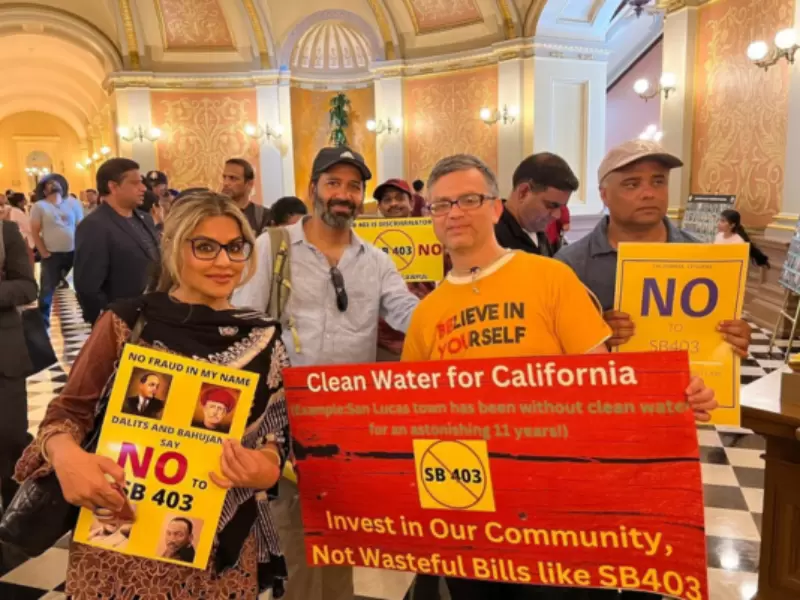 Milind Makwana in the center holding the placard on the wasteful nature of the bill, with other community leaders / Dilip Amin
Milind Makwana believed with everything he had that this bill misrepresented him, misrepresented his faith, and would brand his children with a stigma they had not earned. He showed up. He kept showing up. He died doing it.
The Organizations That Fought and What They Said
The Hindu American Foundation called the bill "built on racist rhetoric, a baseless lawsuit, and false claims about the Hindu religion." HAF Managing Director Samir Kalra said the veto "averted a civil rights and constitutional disaster that would have put a target on hundreds of thousands of Californians simply because of their ethnicity or their religious identity."
The Coalition of Hindus of North America called it "a targeted attack on a group of immigrants based on unproven accusations and unscientific studies." CoHNA President Nikunj Trivedi noted that Senator Wahab herself had acknowledged in earlier versions of the bill that existing law might already cover the conduct she was targeting. She knew, and she kept going.
City councils in Cupertino, Fremont, and Milpitas pushed back. Twenty-one members of Congress or their representatives attended a Hindu Advocacy Day on Capitol Hill organized by CoHNA. Hundreds of temples, businesses, and ordinary families organized and showed up in ways the community had never organized before.
APNADB, a Dalit-Bahujan led organization, wrote to the Assembly that the bill's proponents were "misrepresenting the Dalit community with the aim of enacting cultural genocide." They also flagged that proponents of hate and anti-Dalit groups were continuing to attempt serving the colonial narrative to divide us all, in the name of caste, in one or the other form".
Hundreds of temples, families, and community organizations joined. People who had never contacted a politician wrote letters. People who had never attended a hearing drove to Sacramento. One man, Milind Makwana, showed up in a wheelchair and gave his last breath to this fight. This was not a campaign by special interests. It was a community told it was guilty of something it had not done.
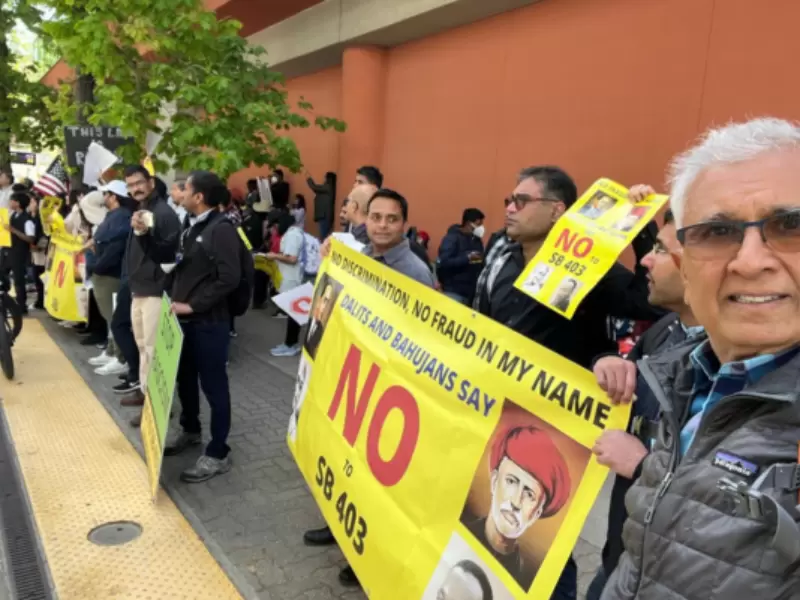 The author, with other concerned Indian-Americans in Sacramento raising protest on the bill being heard by the Senate / Dilip Amin
We did everything a civic community is supposed to do. We used the system exactly as intended. And the system, for nearly a year, did not care. The system failed us until it went to the Governor’s desk for his signature or veto.
The Governor Said in Eight Words What We Had Been Saying All Year
On October 7, 2023, Governor Gavin Newsom vetoed SB 403. His message was short: "Because discrimination based on caste is already prohibited under these existing categories, this bill is unnecessary."
Unnecessary. The word the community had been using since before the first hearing. Existing California law already prohibited discrimination based on ancestry. The bill did not add protection. It added a term, and that term had our community's identity attached to it in every classroom, every newsroom, and every HR department in the state.
"With the stroke of his pen, Governor Newsom has averted a civil rights and constitutional disaster that would have put a target on hundreds of thousands of Californians simply because of their ethnicity or their religious identity."
Samir Kalra, Managing Director, Hindu American Foundation, October 7, 2023
Now Wahab Is Running for Congress in Our District
Senator Wahab represents California Senate District 10, a district with one of the highest concentrations of Indian and Hindu Americans in the state. She is now running for Congress in CA-14, which covers Fremont, Hayward, Livermore, and Dublin, the same communities that organized against her bill, drove to Sacramento to testify, and watched their neighbors' professional lives and children's school years get shadowed by a narrative she built and drove forward.
Wahab is asking for a promotion.
And every Indian American, every South Asian, every minority community in CA-14 has the right to ask what has changed. Not what she says has changed. What has actually changed?
SB 403 was not a rookie mistake. It was a year-long campaign that continued after the evidentiary foundation was challenged, after Dalit Hindus showed up to say the bill did not protect them, after amendments made clear she understood the concerns well enough to edit around them. The bill moved forward because being the first legislator in California history to pass a caste discrimination bill was a significant political credential. It produced national coverage, a profile, a reputation as a civil rights champion.
SB 403 bill made Senator Wahab a nationally known figure. Hindu community's reputation was the price of that credential.
|
Wahab represents one of the most Hindu-dense districts in California. When those constituents showed up in force to tell her a bill would harm them, she amended it just for the optics and pushed it through anyway. Is that the kind of representation CA-14 wants in Congress? The Carnegie Endowment flagged the bill's evidence base as flawed before it was introduced. She pushed it through six committees anyway. If she takes that approach to federal legislation, who bears the cost? Milind Makwana, a Dalit Hindu who died while opposing the bill she authored, has not been acknowledged by name in any of her public statements. She amended SB 403 when the pressure became too great, but never reconsidered its core premise. Is that listening to constituents, or is that abusing them? If she is willing to brand an entire minority community as suspect to build a political credential, which community is next when Congress offers a bigger stage and a bigger audience? |
Senator Wahab built the credential she was looking for. She got national coverage. She got the profile. And she is now asking the community, that paid the price for all of it, to send her to Washington.
Before this community answers that question, they deserve to reflect on her track record — on what she has already shown about how she uses power to target a community when the political reward is large enough, while the community bears the cost.
The writer is the founder of InterfaithShaadi and Hindu Speakers Bureau. He is a faculty at Hindu University of America.
(The views and opinions expressed in this article are those of the author and do not necessarily reflect the official policy or position of New India Abroad.)
Discover more at New India Abroad.
Leave A Comment
Related








ADVERTISEMENT

ADVERTISEMENT
E Paper
Video

Comments
Dilip Amin
2026-05-17 00:00:00
Here is my video message, requesting Sen. Aisha Wahab to answer if she will introduce a similar bill in congress if elected to congress. Watch the video here https://youtu.be/0gjBVbEWzWs