ADVERTISEMENT
ADVERTISEMENT


How Consul General Srikar Reddy Rewired India's Ties to Silicon Valley
His diplomacy was relentlessly practical. Reddy connected Indian companies and startups directly with Valley investors, venture capitalists, and executives.
-
 Rajesh Mehta
 -
 Rao Charagondla
 - Thu, 20, Aug 2026
- 10:30 EDT
- 71
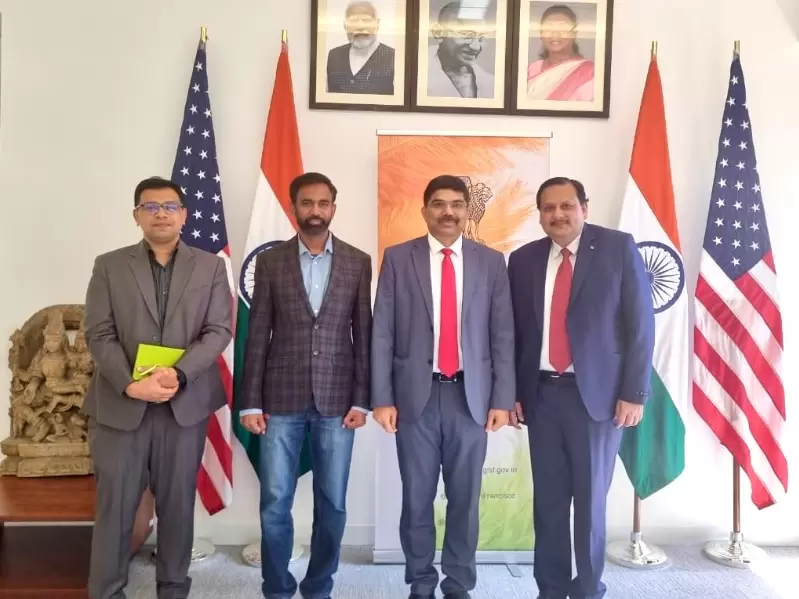 Consul General Srikar Reddy (scond from right) / Courtesy Photo
When Dr. Srikar Reddy arrived as India's Consul General in San Francisco, few could have predicted how profoundly he would reshape India's relationship with Silicon Valley.
His jurisdiction stretched across Silicon Valley, elite research universities, an influential Indian diaspora, and a western United States bound tightly to India by trade and talent. Reddy's wager was simple and ambitious: India's relationship with the American West Coast didn't have to be about protocol. It could be about technology, capital, and people.
A physician by training and a 2001-batch Indian Foreign Service officer, Reddy brought hard commercial experience to the job. As Joint Secretary in India's Department of Commerce, he had overseen trade with Africa and the Middle East and served as New Delhi's chief negotiator for landmark agreements with the UAE and Mauritius. That deal-making instinct defined his San Francisco tenure. He didn't pitch India as a market for American firms so much as a partner in the next wave of global innovation.
Also Read: India's LA mission eyes deeper strategic ties with US
Nowhere was that clearer than in Silicon Valley itself. Artificial intelligence, semiconductors, quantum computing, biotechnology, space, clean energy, digital public infrastructure—these became the recurring vocabulary of his diplomacy. Through CEO meetings, university forums, and industry summits, he pressed the case for deeper collaboration between American technology leaders and India's fast-expanding innovation economy, urging Indian-origin founders to act as a "living bridge" between the two countries.
That work registered at the highest levels of industry. "I have worked with government diplomats from around the world in my role representing the global semiconductor industry, and Dr. Reddy stands out as exceptional," said Ajit Manocha, President and CEO of SEMI. "Exceptional in his collaborative spirit. Exceptional in his dedication. Exceptional in his communication. He has played a key role in inspiring Silicon Valley that India is a trusted partner for the semiconductor industry."
His diplomacy was relentlessly practical. Reddy connected Indian companies and startups directly with Valley investors, venture capitalists, and executives. India Pavilions at marquee events—including the Game Developers Conference in San Francisco—put emerging Indian firms in front of global audiences. The goal was never goodwill for its own sake; it was converting goodwill into investment, partnerships, and signed opportunities.
That operational bent is what peers remember most. "Srikar operationalized the India–Silicon Valley relationship," said Debanjan Saha, CEO of DataRobot. "He knew which founders and CEOs to convene, which delegations to host, and how to open doors for the Valley's Indian tech leaders in both Delhi and India's boardrooms—across AI, semiconductors, and beyond. He made the Consulate a working bridge, not a ceremonial one."
The negotiator's precision showed in how he sold India—pointing not to a growth story but to specific levers, from production-linked incentives and Startup India to the IndiaAI Mission, that American companies could act on. He championed Indian states hunting for West Coast capital across semiconductors, AI, pharmaceuticals, data centers, and advanced manufacturing.
Among the diaspora networks he cultivated, few were more strategic than the IIT alumni community in the Bay Area—one of the densest concentrations of engineering, founder, and investor talent anywhere in the world. Reddy engaged the IIT Bay Area network not as a ceremonial audience but as a working partner, tapping its members to mentor Indian startups, anchor investment conversations, and carry technical expertise back into India's own build-out. That alumni base became one of the sturdiest planks in his living bridge.
His accessibility became something of a signature. "He has been among the most accessible Consuls General—always willing to help at short notice and a true pleasure to work with," said Vinod Dham, the Padma Bhushan awardee known as the "Father of the Pentium Chip," acknowledging Reddy's "distinguished service and invaluable contributions to the India–U.S. business ecosystem."
That same instinct reached far beyond boardrooms. Through the "Consulate @ Your Doorstep" initiative, Reddy carried passport, OCI, and attestation services to communities beyond San Francisco, serving hundreds at single events in Southern California and Nevada. The 2025 opening of a new Consular Application Centre in San Jose brought services to the doorstep of Silicon Valley's Indian population. "Dr. Srikar Reddy leaves behind a remarkable legacy," said MR Rangaswami, Founder of Indiaspora. "From establishing a welcoming new downtown office to creating innovative programs that brought the diaspora closer to the Consulate, he has strengthened India–U.S. ties and made the Consulate a vibrant community hub."
Reddy now departs for another high-stakes posting as India's next Ambassador to Qatar, at a moment when India–U.S. ties are increasingly defined by the very forces he spent his tenure cultivating: technology, investment, and innovation.
The phrase he favored for the diaspora—a "living bridge"—may be the truest description of his own work. He didn't just tend that bridge. He widened it, so it could carry not only culture and community, but ideas, capital, technology, and opportunity.
(The views and opinions expressed in this article are those of the author and do not necessarily reflect the official policy or position of New India Abroad.)
Discover more at New India Abroad.
.
Leave A Comment
Related

ADVERTISEMENT

ADVERTISEMENT
E Paper
Video

Comments
Start the conversation
Become a member of New India Abroad to start commenting.
Sign Up Now
Already have an account? Login