ADVERTISEMENT
ADVERTISEMENT


Budget 2026: Balancing "Kartavyas" of growth and consolidation
The Union Budget 2026-27, the first presented in the newly minted Kartavya Bhawan, arrives at a critical juncture for India’s fiscal strategy.
-
 Badri Narayanan Gopalakrishnan
 - Wed, 04, Feb 2026
- 10:03 EST
- 132
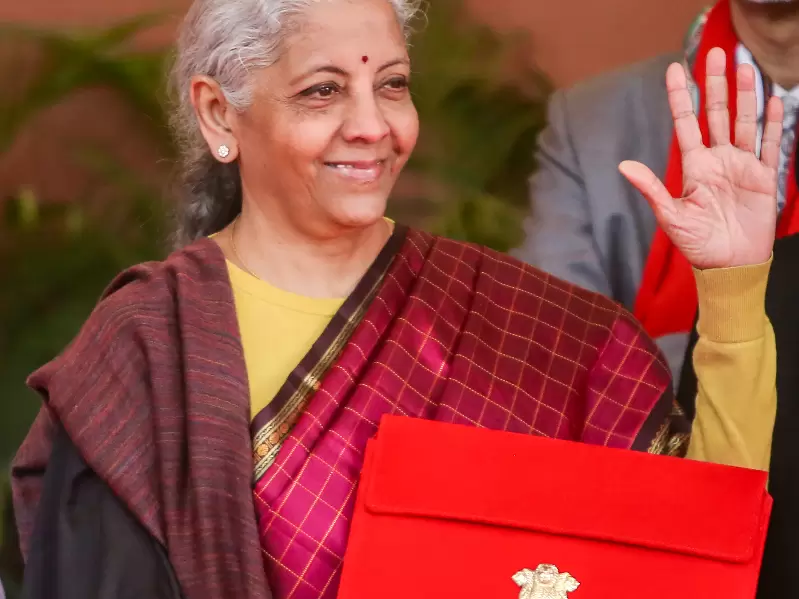 Finance Minister Nirmala Sitharaman / Photo: IANS/Prem Nath Pandey
The Union Budget 2026-27, the first presented in the newly minted Kartavya Bhawan, arrives at a critical juncture for India’s fiscal strategy.
Framed by three core Kartavyas—accelerating growth, fulfilling aspirations, and ensuring inclusive prosperity—the Budget attempts a high-wire act: sustaining massive public investment while signaling a firm, albeit gradual, return to fiscal discipline.
Also Read: Union Budget 2026-27 announces major relief for NRIs, PROIs
Fiscal Strategy: The Credibility of Consolidation
The headline fiscal deficit target for 2026-27 is set at 4.3% of GDP, a marginal but significant reduction from the 4.4% revised estimate for 2025-26. This move reaffirms the government’s commitment to a medium-term glide path, aiming to bring the debt-to-GDP ratio down from 55.6% in the current year to approximately 50% by 2031.
|
Fiscal Indicator |
2025-26 (RE) |
2026-27 (BE) |
|
Fiscal Deficit (% of GDP) |
4.4% |
4.3% |
|
Debt-to-GDP Ratio |
56.1% |
55.6% |
|
Total Expenditure |
₹49.6 Lakh Cr |
₹53.5 Lakh Cr |
|
Capital Expenditure |
₹11.2 Lakh Cr |
₹12.2 Lakh Cr |
By prioritizing this reduction, the Budget seeks to free up resources for future priority sectors by lowering the burden of interest payments, which currently consume nearly 26% of total expenditure.
Revenue and Tax: Modernization over Populism
Despite being an election-proximate year, the Budget largely avoids populist rate cuts. Instead, it focuses on structural modernization through the Income Tax Act, 2025, which replaces the decades-old 1961 Act starting April 1, 2026.
-
Tax Stability: Personal income tax slabs remain unchanged, emphasizing predictability over short-term relief.
- Compliance & Trust: Measures such as rationalizing penalties, decriminalizing minor offences, and extending the time to revise returns signal a shift toward "trust-based" governance.
- Rationalization: The Minimum Alternate Tax (MAT) rate has been reduced to 14% (from 15%) and made a final tax, though the accumulation of new MAT credits will be curtailed to nudge corporations toward the new tax regime.
Welfare and the Rural Economy: Redesigning Entitlements
The Budget navigates the political economy of welfare by shifting focus toward "Yuva Shakti" and productive employment.
Agriculture: Rather than simple transfers, the strategy emphasizes productivity via initiatives like Bharat-VISTAAR, an AI-driven tool for farmers, and dedicated schemes for high-value crops like coconut and cashew.
Social Protection: Substantial outlays continue for food and fuel subsidies (₹2.39 lakh crore for food and public distribution), but the launch of the Education-to-Employment-and-Enterprise (E2E) committee suggests a deeper rethink of the entitlement architecture toward outcome-linked social protection.
Infrastructure: From Physical Rails to AI Sails
The public capex-led growth strategy remains the central engine of the economy, with the allocation raised to ₹12.2 lakh crore. However, the focus is evolving:
- Connectivity: The Budget proposes seven high-speed rail corridors and 20 new national waterways, moving beyond basic highway expansion toward integrated logistics.
- Digital & Strategic: Significant outlays for Semiconductor Mission 2.0 and Biopharma SHAKTI (₹10,000 crore) indicate a pivot toward high-value domestic manufacturing.
- Risk Management: To address the diminishing returns of pure public spending, an Infrastructure Risk Guarantee Fund has been proposed to de-risk private participation and boost PPP models.
A Strategy of Restraint and Reform
Union Budget 2026 reflects a mature fiscal stance. By resisting the urge for electoral giveaways and maintaining a steady capex push, it bets on long-term capacity building over short-term visibility. The central challenge remains implementation: whether the "City Economic Regions" and new manufacturing schemes can translate budgetary outlays into tangible jobs and regional equity.
The writer is a senior economist and affiliate faculty member at University of Washington Seattle.
(The views and opinions expressed in this article are those of the author and do not necessarily reflect the official policy or position of New India Abroad)
Discover more at New India Abroad.
Leave A Comment
Related








ADVERTISEMENT

ADVERTISEMENT
E Paper
Video

Comments
Start the conversation
Become a member of New India Abroad to start commenting.
Sign Up Now
Already have an account? Login