ADVERTISEMENT
ADVERTISEMENT



Beyond the meme moment of “Cockroach”: India’s politically savvy Gen Z
Dipke, who got carried away by the viral momentum of his own joke, eventually backtracked. He admitted that comparing Indian youth to the rioters of neighboring nations is deeply flawed
-
 Vijendra Agarwal
 - Fri, 29, May 2026
- 11:22 EDT
- 248
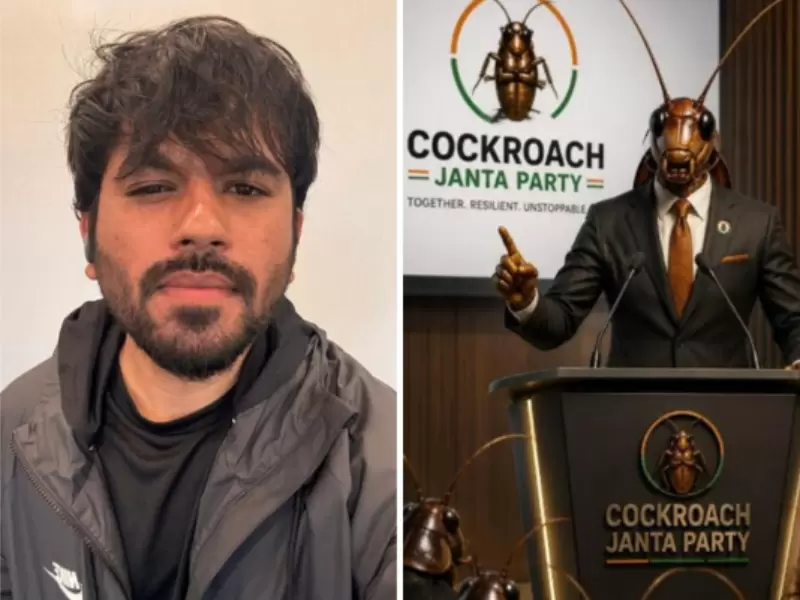 Abhijeet Dipke/ Cockroach Janta Party / Instagram/ Cockroach Janta Party
The sudden outburst of op-eds and articles surrounding the so-called "Cockroach Janta Party" (CJP), spearheaded by a Boston-based student, has predictably sent foreign media houses into a frenzy. Media pundits from London to Washington are salivating at the self-imagined prospect of an Indian "Arab Spring."
They eagerly draw unwarranted parallels between a viral Instagram page and the violent, regime-changing youth unrest recently witnessed in neighboring countries.
However, these commentators fundamentally fail to recognize that India is not Nepal, Sri Lanka, or Bangladesh. It is a stable, resilient, and the world’s largest democracy.
Regrettably, Western analysts suffer from a profound misunderstanding of the New India’s sophisticated youth demographics, within a robust democracy currently experiencing an exuberance of ancient cultural renaissance.
Distorting the Judiciary
The narrative propagated by CJP’s founder, Abhijeet Dipke, a former digital strategist for the Aam Aadmi Party (AAP), is nothing more than a bad-faith distortion of a courtroom remark by Chief Justice Surya Kant.
Also Read: Meet the Boston grad behind India’s viral ‘Cockroach’ youth party
The Chief Justice’s use of the word "cockroach" specifically referenced individuals exploiting the legal system with fraudulent, fake degrees. This targeted critique was deliberately stripped of context and rebranded by internet activists as a systemic insult against all young Indians.
Generalizing the aspirational youth of New India with such a crude caricature is in exceptionally poor taste. It represents a patronizing political strategy utilized by both Dipke and Western media outlets to exploit anxieties surrounding youth employment for their vested digital engagement.
Fortunately, India's Gen Z is the most politically literate and nationalistic generation the country has ever seen. They comprise the backbone of a trillion-dollar digital economy, working purposefully within a democratic framework. Even Dipke, who got carried away by the viral momentum of his own joke, eventually backtracked. He admitted that comparing Indian youth to the rioters of neighboring nations is deeply flawed.
He acknowledged that India's youth prefer peaceful, democratic expressions of dissent. It is a realization that comes better late than never for him.
Ballots Over Burning: The Real Gen Z Electorate
Regrettably, foreign publications like The Economist doubled down on these naive assumptions, implying that Indian youth would tear down the fabric of the world’s fastest-growing economy over an Instagram meme. Today’s Indian youth, even when dissatisfied, do not seek to burn down their own country’s infrastructure. They demand accountability through established democratic mechanisms, legal appeals, and the power of their vote.
New India’s talented youth are building billion-dollar ideas globally, and they choose to settle their political differences at the ballot box, not in the streets. One needs only look at recent election outcomes in states like West Bengal to see how the masses, including the youth, successfully used their political savviness through democratic institutions rather than chaotic unrest.
Prime Minister Narendra Modi’s enduring popularity among youth since 2014 is no accident of history. It is rooted in tangible social reforms, digital transformations, and public infrastructure aligned with global economic standards. India’s development agenda over the past decade is unparalleled in its post-independence history. While youth demands for accelerated job creation and structural education reforms are fully justified, this generation recognizes that economic progression requires stability, not anarchy.
The days are gone when external toolkits or cynical social media campaigns could easily manipulate Indian domestic politics. India's youth are far too intelligent to let their futures be dictated by remote-controlled narratives spun from Boston, London, or Washington. They are the leaders of an ascending global power, shaping India's destiny through creation, evolution, cultural renaissance, and democratic conviction.
A Cautionary Note for Indian Students and Immigrants
This episode offers a case study about Dipke himself, currently pursuing a master’s degree at Boston University. He enjoys a level of privilege that many well-qualified, aspiring Indian students dream of. Unfortunately, when international students weaponize their platforms, even unintentionally, to advance polarizing political agendas, they inadvertently fuel systemic anxieties abroad.
Political posturing by overseas activists, coupled with broader campus unrest, directly contributes to the hardening of domestic political environments and the tightening of visa regulations for future Indian applicants. Not too long ago, Indian students were alleged to be participating in anti-semitism and deported.
There is a vital lesson here for students of Indian origin studying in the United States on F-1 visa status. They are abroad for the primary purpose of obtaining a world-class education and realizing their professional aspirations. Engaging in political propaganda, foreign demonstrations, or inflammatory narratives has the real potential to jeopardize their legal status and disrupt future visa adjustment steps. Some of it equally applies to immigrants holding other types of visa status, like H1B.
A final cautionary note is that there is no way to entirely stop foreign actors and online agitators from creating narratives to fracture India's growth story, but their efforts are likely futile and in vain.
To India’s talented and hardworking youth with genuine ambition: digital antics like the CJP idea must never be mistaken for the future vision. New India’s Gen Z is well-equipped to protect their own future and build the destiny of the world's most vibrant nation. They need no advice from the architects of a viral joke.
Vijendra Agarwal is a Ph.D. physicist from IIT Roorkee.
(The views and opinions expressed in this article are those of the author and do not necessarily reflect the official policy or position of New India Abroad.)
Discover more at New India Abroad.
Leave A Comment
Related








ADVERTISEMENT

ADVERTISEMENT
E Paper
Video

Comments
Start the conversation
Become a member of New India Abroad to start commenting.
Sign Up Now
Already have an account? Login