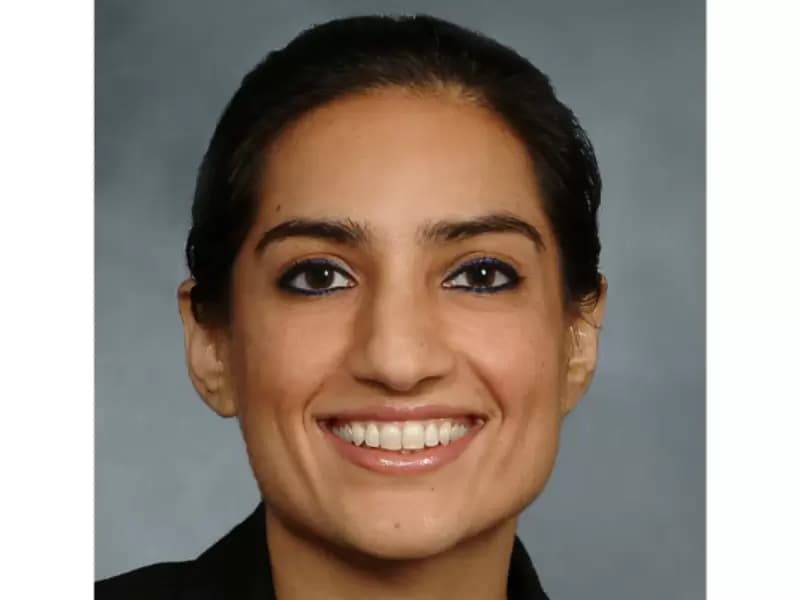
Dr. Gunisha Kaur / sikhspeakersnetwork.org
Dr. Gunisha Kaur’s appointment to the U.S. Commission on International Religious Freedom (USCIRF) by Senate Minority Leader Chuck Schumer marks an important milestone, one worthy of recognition but also thoughtful reflection.
The significance of her appointment is not in question. Dr. Kaur brings an impressive résumé: physician, associate professor of anesthesiology at Weill Cornell Medicine, founder of the Human Rights Impact Lab, and a scholar whose work has focused on refugees, asylum seekers, torture survivors, trafficking, displacement and human rights documentation. She also served as a term member of the Council on Foreign Relations. On merit alone, she presents a compelling case for service on any human rights body, including USCIRF.
ALSO READ: Senator Schumer appoints Gunisha Kaur to USCIRF
Yet appointments in Washington rarely occur in isolation. They emerge from broader ecosystems of advocacy, institutional relationships and narrative formation. Seen through that lens, Kaur’s appointment raises larger questions, not about one individual, but about the increasingly sophisticated role diaspora politics now plays in shaping policy conversations and narratives surrounding India.
For years, USCIRF has occupied a contentious place in India-U.S. discourse. The commission has repeatedly criticized India over religious freedom concerns and recommended that India be designated a Country of Particular Concern (CPC). Successive U.S. administrations, however, have declined to adopt those recommendations. India, for its part, has consistently rejected USCIRF reports as selective, politically motivated and insufficiently grounded in India’s social and civilizational realities.
Critics argue that USCIRF reporting often relies on limited sourcing and lacks adequate appreciation of India’s extraordinary complexity, a nation with immense linguistic, religious, ethnic and political diversity.
Diaspora advocacy organizations in the United States increasingly operate with remarkable sophistication. They publish reports, cultivate media relationships, engage academic institutions, develop policy networks and participate actively in congressional and human rights discussions. In many ways, they have become influential actors within Washington’s policy ecosystem.
Among them, the Sikh Coalition has become increasingly visible, elevating concerns related to discrimination, religious freedom and transnational repression affecting Sikh communities. Like many advocacy organizations, it plays an important representational role.
Earlier this month, the Sikh Coalition submitted a statement to USCIRF raising concerns about transnational repression and broader religious freedom issues affecting diaspora communities. Shortly afterward came Kaur’s nomination.
Drawing a direct causal line between the two would be speculative. However, it would also be naive to ignore the larger reality: Successful advocacy organizations build influence through sustained engagement, long-term relationship building and strategic visibility. Washington rewards persistence.
Many other diaspora organizations operate similarly, often from highly specific ideological frameworks. Some focus on minority-rights discourse; others center on caste, nationalism or identity politics. These perspectives can contribute valuable viewpoints. The concern arises when a relatively narrow advocacy ecosystem gradually begins to shape broader perceptions of India itself.
This perceived representational imbalance increasingly concerns sections of Hindu and Indian American communities. Organizations critical of India often appear institutionally integrated into academia, media and policy circles. By contrast, organizations defending Hindu civilizational perspectives frequently argue that they are viewed primarily through defensive or politicized lenses.
Whether one agrees with that assessment or not, the sentiment exists and deserves acknowledgment.
Supporters understandably celebrate Kaur’s appointment as a historic moment: a Sikh American human rights scholar joining a federal body focused on religious liberty.
Critics of USCIRF, however, interpret the development differently. Some fear that her appointment may reinforce an already established policy ecosystem critical of India, particularly around Sikh issues and discussions of transnational repression.
Let us remain hopeful about Dr. Kaur. She has spoken openly about how the trauma experienced by her family during the violence following the 1984 anti-Sikh riots shaped her interest in human rights work. Her scholarship, advocacy and leadership reflect a sustained commitment to humanitarian issues and civil liberties.
None of that, however, should automatically invite assumptions about ideological affiliations or separatist sympathies.
An important distinction must be emphasized between the Sikh Coalition and Sikhs for Justice. The Sikh Coalition is a civil rights organization founded after 9/11 focused on combating discrimination and defending Sikh civil liberties in America. Sikhs for Justice advocates for a Khalistan referendum and Sikh self-determination.
Publicly available information shows no evidence of direct organizational overlap between the two. While diaspora communities naturally include individuals with varied political beliefs, assumptions by association are both unfair and intellectually unforgiving.
There is no public evidence linking Kaur to separatist advocacy. Her Sikh identity and her family’s experiences during 1984 should not become grounds for ideological projection.
She deserves the same standard applied to anyone entering public service: to be judged by her record and conduct. As an academic myself, I would argue that a scholar like Dr. Kaur is well versed in academic integrity and objective analysis of the issues. Let us hope she uses those standards and skills in her role as a USCIRF commissioner.
For many Hindu Americans, a larger question persists: Why has the world’s third-largest religion, with nearly 1 billion adherents globally, seen such limited representation within institutions like USCIRF? Reportedly, only one Hindu commissioner since USCIRF’s inception.
There may be many reasons. But influence in Washington rarely develops organically. It is built through organization, coalition building, relationship development and institutional sophistication.
There are lessons to be learned for Hindu advocacy organizations not only from the Sikh Coalition but also from long-established Jewish advocacy organizations. The latter have historically demonstrated remarkable cohesion in external engagement despite internal disagreements.
Hindu organizations and individuals across North America may need to invest more deeply in institution building and public engagement to seek broader representation.
Rather than viewing Kaur’s appointment through a lens of suspicion, perhaps this moment can serve as an opportunity to celebrate increasing minority representation while recognizing that influence, representation and narrative building require sustained effort. Hindu groups should engage in introspection and move forward with renewed efforts to get the next commissioner representing the Hindu diaspora.
The lesson may not be about Gunisha Kaur, but a focus on building stronger and more united Hindu advocacy institutions by the community and for the community.
Vijendra Agarwal is a Ph.D. physicist from IIT Roorkee.
(The views and opinions expressed in this article are those of the author and do not necessarily reflect the official policy or position of New India Abroad.)
Discover more at New India Abroad.
ADVERTISEMENT
ADVERTISEMENT
Comments
Start the conversation
Become a member of New India Abroad to start commenting.
Sign Up Now
Already have an account? Login