ADVERTISEMENT
ADVERTISEMENT



Rooted in Bharat, ready for the world
Bhartiya Shiksha Board Chairman Dr. N. P. Singh, a former bureaucrat, says India's government-backed education board is blending ancient wisdom with modern science to nurture globally competitive students rooted in the country's civilizational ethos.
-
 S. Raju
 - Sat, 08, Aug 2026
- 13:53 EDT
- 48
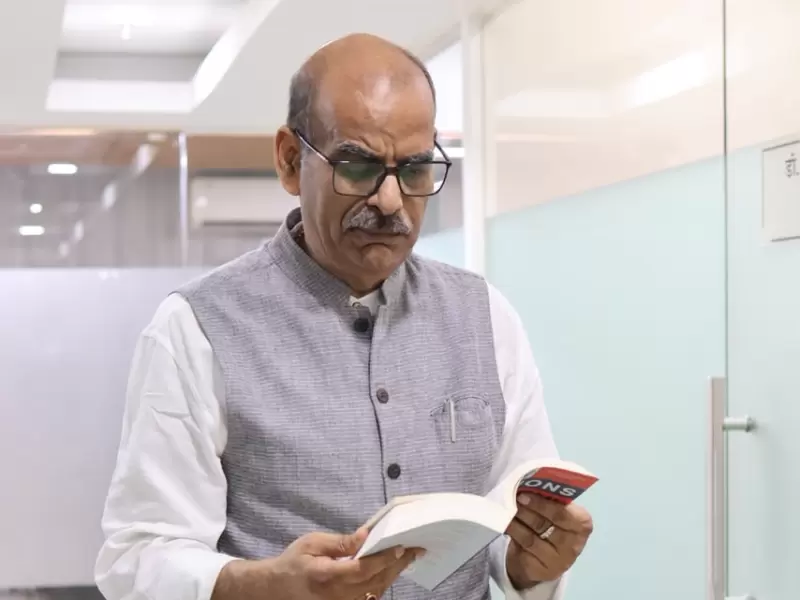 Dr N P Singh, Chairman, Bhartiya Shiksha Board / Handout
As India seeks to reshape its education system for the 21st century, the Bharatiya Shiksha Board (BSB), established by the Government of India, is positioning itself as more than just another education board. It aims to create a new generation of globally competitive students who are equally grounded in India's civilizational wisdom, philosophical traditions and cultural ethos—an educational model that its leadership believes can prepare young Indians not merely to participate in the future, but to lead it.
During an interaction with India Abroad, Bharatiya Shiksha Board Chairman Dr. N. P. Singh, a former bureaucrat, said the Board was created with a unique national mandate to blend the Indian Knowledge System with modern education. "We need global competencies in science, technology and social sciences," he said, adding, "But the wisdom must originate from the womb of Bharatiya philosophy."
Also Read: 3 Ts mark Indian President’s outreach to eastern Europe
According to Dr. Singh, the idea of establishing the Bharatiya Shiksha Board was first proposed in 2015 by the Haridwar-based Vedic Education Research Institute. He said a Model By-laws framework for the Board was subsequently laid under the chairmanship of the then Union Education Minister, paving the way for the Board's formal establishment in 2019, with Patanjali Yogpeeth designated as its non-profit sponsor body.
"The Board was granted equivalence with all recognised education boards on August 3, 2022, and today more than 1,000 schools across India are affiliated with the Bharatiya Shiksha Board," Singh said, describing it as a fast-growing educational model that seeks to harmonise India's knowledge traditions with contemporary learning.
Singh explained that unlike existing education boards, BSB has been entrusted with developing a curriculum that enables students to compete globally without losing their cultural identity. According to him, the objective is not to replace modern education but to enrich it by integrating India's rich intellectual heritage with contemporary learning.
Reflecting on the historical evolution of India's education system, Singh said generations of students had gradually become disconnected from the country's original knowledge traditions.
"We have to decolonize the consciousness of the children of Bharat," he said. "Our objective is to enable students to become global citizens with Bharatiya values, Bharatiya ethos and Bharatiya philosophy."
Rejecting the perception that the Board seeks to promote religious instruction, Singh drew a clear distinction between philosophy and theology. He maintained that Bharatiya Jnan Parampara is rooted in logic, rationality and scientific inquiry rather than ritualistic practices.
"If you are talking about Bharatiya Jnan Parampara, it doesn't mean we are advocating theology or mythology," he said. "We are placing Bharatiya philosophy—not theology—at the core of education. Then the confusion between culture and science automatically disappears."
Singh said the Board's academic framework has been designed to cultivate analytical thinking, curiosity, innovation and evidence-based learning. Instead of relying primarily on rote memorisation, BSB promotes inquiry-based, discussion-oriented and application-driven pedagogy. The curriculum also introduces students to the scientific contributions of Indian scholars such as Brahmagupta and the Kerala School of Mathematics alongside globally accepted concepts in science and mathematics.
"We are trying to design our syllabus, textbooks, pedagogy and assessments in such a way that students master 21st-century skills, especially technology," Singh said. "At the same time, they should know that our ancestors were knowledge creators who offered meaningful solutions to the world."
Speaking about the implementation of the National Education Policy, Singh said BSB translates its vision into classroom learning through experiential education, scientific reasoning and interdisciplinary teaching. He said the Board has moved beyond conventional rote learning by adopting inquiry-based, demonstration-led, discussion-oriented and application-focused pedagogy that encourages students to think critically and innovate.
The Chairman also outlined the Board's long-term global vision. While BSB is currently focused on expanding across India, he said it eventually plans to establish schools overseas to serve the aspirations of the Indian diaspora. Until then, he suggested that Indian families living abroad introduce their children to BSB's books on history, geography, economics, social sciences and India's knowledge traditions, even while pursuing mainstream education in their adopted countries.
"Their competencies may come from the country where they study," Singh said, "but Bharat must be reflected in their personality."
Concluding with a message for millions of Indians living across the world, Singh urged parents to preserve not only India's cultural traditions but also its philosophical foundations.
"We should try to be Bharati with spirit, with soul, with behaviour and with conduct," he said. "If our children understand the scientific spirit and philosophical essence of Bharat, they will confidently represent a civilization that the world increasingly wants to understand."
Discover more at New India Abroad.
Leave A Comment
Related






.jpg)

ADVERTISEMENT

ADVERTISEMENT
E Paper
Video

Comments
Start the conversation
Become a member of New India Abroad to start commenting.
Sign Up Now
Already have an account? Login