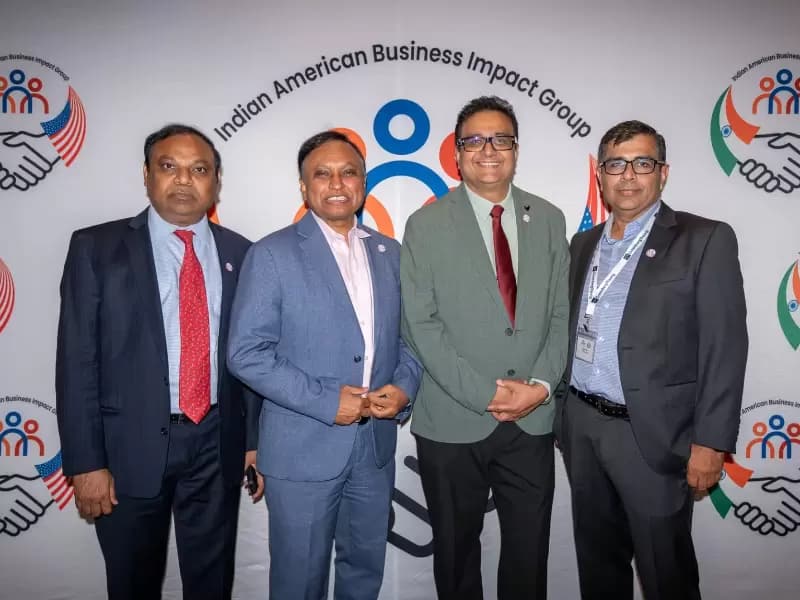
People behind IAMBIG / Courtesy photo
When Ravi Puli arrived in the United States in 1997, he was searching for an opportunity. Years later, after establishing himself as an entrepreneur, he began searching for something else: a room where successful Indian American business owners could meet as peers.
ALSO READ: Indian American entrepreneurs call for better India-US ties
He attended networking programs. He joined nonprofit organizations and served on their boards. Yet something, he felt, remained missing. There was no dedicated platform where Indian-origin founders and chief executives could exchange ideas, develop partnerships and help one another navigate the challenges of building a company.
“As I was myself an immigrant, came in 1997, I was always looking for a platform where I could meet other, you know, successful Indians, so that I can learn, I can also contribute in whatever I knew,” Puli said in an exclusive interview with India Abroad.
That search led to the creation of the Indian American Business Impact Group, whose acronym, IAMBIG, captures something of its growing ambition.
Three years after its first gathering, the Washington-area organization says it represents nearly 200 families. Businesses associated with its members collectively employ more than 10,000 people and represent several billion dollars in value, according to Puli.
The organization is now considering chapters in other cities, an investment fund for start-ups and a permanent entrepreneurship center. Its evolution reflects a broader shift within the Indian American community — from individual professional success toward institution-building, mentoring and collective civic engagement.
For Puli, the idea was not simply to establish another networking organization. He wanted to connect Indian American entrepreneurs with one another while also creating a bridge between businesses in the United States and India.
The engagement with India, he believed, could take several forms. It could involve investment, philanthropy, knowledge transfer or other initiatives, either for profit or not for profit.
Puli approached the Indian Embassy in Washington and organized a gathering with senior officials, including the deputy ambassador and officials handling economic and commercial affairs. The discussion focused on business opportunities in India for Indian Americans.
About 40 to 50 people attended the event at the Tower Club near Washington in May 2023. Puli paid the expenses himself.
“Then everybody loved it. Then they said, Ravi, I think we should continue to do these gatherings,” he recalled.
He organized another meeting. Participants began offering to pay or share the cost, but Puli initially declined to take their money. As attendance and interest grew, however, what began as an informal gathering started assuming the shape of an organization.
Puli approached three businesspeople he knew through earlier initiatives: Anil Sharma, Sandesh Sharda and Ashish Khot. The three had not previously worked together as a group, he said. Puli first met them individually and later brought them together for discussions over lunch and dinner.
Sharma runs 22nd Century Technologies, a government contracting company. Sharda sold his government contracting business and began investing in resorts, golf courses and a senior citizens resort in India. Khot is a serial entrepreneur with a technology background and an interest in helping start-ups expand.
The four examined other community organizations and discussed what their proposed network could do differently. They settled on a selective organization built around company founders and chief executives. But they added an unusual element: Members would be encouraged to bring their families.
The group registered as a nonprofit before holding a Diwali program in 2023. Formal membership began Jan. 1, 2024.
IAMBIG’s logo / XIAMBIG’s membership criteria are intended to preserve its character as a forum for business owners and senior decision-makers.
“The criteria here is that you must have been a founder or a CEO,” Puli said. “Our vision is to work with the founders and CEOs and provide them a platform where they can contribute and they can also learn from each other and collaborate.”
The size of a prospective member’s business is not the determining factor. The organization includes people running small, medium-sized and large companies. Membership, however, is by invitation. Prospective members are first introduced to the group’s mission and vision.
Annual membership costs $7,500 for a couple, according to Puli. A five-year membership is available for $25,000. A lower-priced category permits one person to attend.
The fees have attracted criticism. Some have portrayed the organization as a club for wealthy entrepreneurs or the “big boys,” Puli acknowledged. He said the cost reflected the expense of arranging monthly dinners for members and their families at quality venues.
“It’s not about money, but we wanted serious people who can really come and contribute,” he said.
The organization is also working on public programs that would allow nonmembers and prospective members to attend without paying.
The family component is central to the IAMBIG model. Members may bring their spouses, including those involved in their businesses. Children are also encouraged to participate through youth programs.
Puli said this arrangement separates IAMBIG from professional associations where the relationship ends with an exchange of business cards. At its meetings, formal presentations often give way to conversations that continue until 10:30 or 11 p.m.
Members also hold smaller gatherings at their homes. Some revolve around music, graduations or other family occasions. Even at those events, Puli said, conversations frequently return to business.
As membership expanded, the organization created smaller groups covering government-related business, cybersecurity, health and wellness, golf and women’s activities. A karaoke group and an online “social chowpal” offer room for informal exchanges while the main group remains focused on business matters.
The network’s practical value comes partly from the different stages of business experience represented within it.
A founder attempting to turn a small company into a medium-sized enterprise can meet someone who has already completed that transition. The owner of a medium-sized business can seek guidance from somebody who has built a larger company. An entrepreneur considering a sale can speak privately with a member who has completed an exit and confronted the question of what to do next.
“Small guys are always looking to learn how to become medium and large,” Puli said. “Once they exit, then they want to meet somebody who has already exited. What is the process after that? Right. So it’s a cycle.”
Members have collaborated on business ventures and investment ideas, according to Puli. They have also supported foundations and projects involving kidney health, education and start-ups.
Some of the benefits are less easily measured. Relationships formed through the group have allowed members to seek help during medical emergencies, obtain professional advice and approach senior executives who might otherwise have been difficult to reach.
“You cannot reach out large CEOs, and without knowing, they will not feel comfortable meeting you,” Puli said. “Whereas in our group, they come and they just, you know, take their contact information. They meet.”
Puli sees the organization’s broader purpose as converting individual success into collective capacity. Members are encouraged to contribute their experience and time even if they do not want to contribute money.
“If all together you know contribute to a cause, you know the more impact, and every businessman comes with some kind of, you know, experience and expertise,” he said. “You don’t want to give money, or there is a limit to giving money, but give your time.”
That philosophy is also shaping IAMBIG’s engagement with young Indian Americans.
The organization has established a youth group and conducted a leadership boot camp. Its members want to support young people interested in building businesses, launching nonprofit organizations, entering public life or pursuing international service.
Puli said the children of first-generation immigrants often possess a deeper familiarity with American institutions and society than their parents had when they arrived. The first generation, in turn, can offer experience, professional connections, mentorship and, potentially, investment.
“So my vision is to see that we all collectively try to first create an impact,” he said. “As you know, training these young people in leadership, and not only that, but also invest into their ideas, ideas to start a business, or start a nonprofit.”
IAMBIG also wants young participants to practice leadership rather than merely listen to established businesspeople speak about it. Members can help them refine ideas, understand risk and connect with specialists in areas such as finance, technology, sales and management.
The organization’s longer-term plans include creating a fund that could invest in promising start-ups. It also hopes to identify business ideas emerging in the Washington region and connect their founders with relevant expertise.
Its most ambitious proposal is a permanent entrepreneurship center.
Puli envisions a physical location where aspiring founders could attend workshops and consult experienced businesspeople during designated office hours. Someone developing a product could seek help with sales. Another entrepreneur could obtain advice on marketing or strategy. A founder preparing to sell a company could speak with someone who had already managed an exit.
“And the larger vision is to always have a center,” Puli said. “You know, we buy a physical place where we have an entrepreneurship center where, you know, people can just walk in. We’ll have office hours.”
The idea is to bring together skills that often remain scattered across separate professional networks.
“Some is good in sales, one is marketing, one is strategy, one is exit,” Puli said. “We want to build all of them together now, and we are a force.”
Growth has brought its own challenges.
Hosting a large group every month requires advance planning, new programming and substantial administrative work. Maintaining content that gives members a reason to keep returning is a constant responsibility, Puli said.
The organization has tried different formats, including a one-day cruise with an educational session. It may eventually require an executive office and full-time employees.
Puli said that managing IAMBIG has already become nearly a full-time responsibility for him.
“Taking a lot of my time. I’m almost like full time on this,” he said. “My business has become secondary ever since this was started.”
The group’s reach is also beginning to extend beyond Washington, Maryland and Virginia. Entrepreneurs from Silicon Valley, Utah and New York have joined, Puli said. Some travel to the Washington area for monthly meetings. More than a dozen people from Dallas have expressed interest, while inquiries have also come from India.
IAMBIG is considering chapters in other American cities and, eventually, other countries.
“There is a lot of interest, and we would like to definitely do it because I see greater benefit in this,” Puli said. “Not only in the U.S. but in every country, if these Indians can come together, they can really do wonderful work.”
Puli does not want the organization’s growth to dilute its original purpose. Its members may retain connections with India, but their first obligation, he said, is to contribute to the communities and economies where they now live.
“I say the primary purpose is to contribute to the local economy wherever we live,” he said. “We live a happy life and a better life, but give back to India in whatever form and, you know, means that you can.”
Indian Americans have established a prominent presence in U.S. technology, medicine, hospitality, finance, education and professional services. As the community has grown, its business organizations have increasingly sought to connect entrepreneurial achievement with mentorship, philanthropy and civic participation.
Discover more at New India Abroad.
ADVERTISEMENT
ADVERTISEMENT
Comments
Start the conversation
Become a member of New India Abroad to start commenting.
Sign Up Now
Already have an account? Login