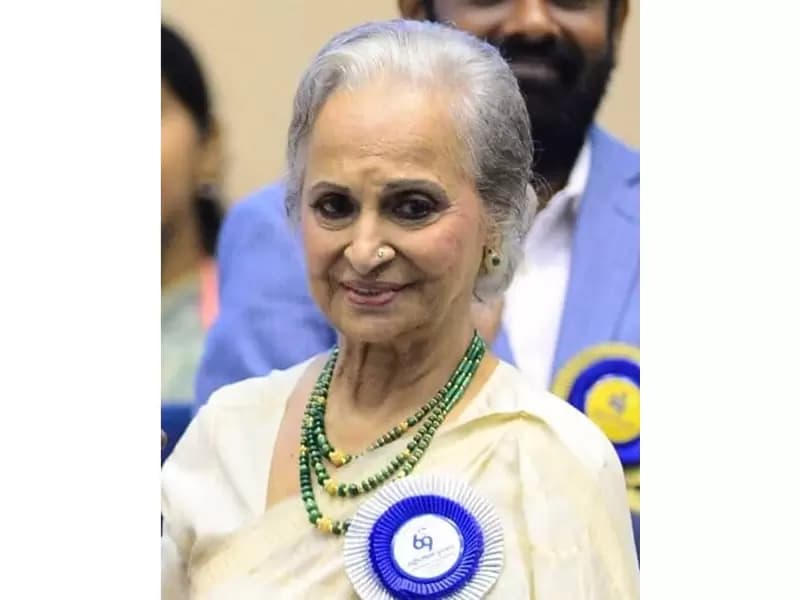
Legendary Bollywood actress Waheeda Rehman / Courtesy: Wikipedia
A luminous presence in Indian cinema's golden era, Waheeda Rehman stands apart from the constellation of actresses who defined the 1950s and '60s. There was something unmistakably self-possessed about her from the very beginning.
From her debut as a fresh-faced newcomer to her evolution into one of Hindi cinema's most cherished performers, Waheeda's journey was shaped as much by her inner resolve as by her on-screen triumphs. At a time when many leading ladies were reduced to ornamental presences—framed beautifully but seldom granted emotional agency—Waheeda's expressive eyes conveyed longing, defiance, tenderness, and quiet resilience, often within the span of a single scene.
Her performances did not clamor for attention; they lingered. We revisit not merely the actress she was, but the woman who navigated art, affection, and autonomy on her own terms—playing muse, heroine, and ultimately, her own guiding force.
ALSO READ: Anti romance is the new romance
Waheeda's first encounter with Guru Dutt marked the beginning of one of the most discussed creative partnerships in Hindi cinema. When she arrived in Mumbai as a teenager, it was Guru Dutt who recognized in her a rare spark—an intelligence behind the beauty and a stillness that the camera adored.
He offered her an early break in CID (1956), and soon after cast her in Pyaasa (1957)—a film that would become one of Indian cinema's most enduring classics. Their collaboration extended to a remarkable string of films: 12 O'Clock (1958), Kaagaz Ke Phool (1959), and Chaudhvin Ka Chand (1960)—the last so closely associated with her that she continues to reference it in her Instagram bio.
It is worth noting that while Guru Dutt directed Pyaasa and Kaagaz Ke Phool, Chaudhvin Ka Chand was directed by M. Sadiq, though produced by Guru Dutt. Under his meticulous creative supervision, Waheeda's emotional depth flourished. It was as if he alone understood how to frame her silences, allowing the camera to rest on her face until the audience felt what her character could not articulate.
She has often acknowledged the discipline he instilled in her—the precision of gesture, the control of voice, and the power of understatement. If Guru Dutt was the poet of despair, Waheeda became the face that gave that despair grace.
Their professional partnership inevitably sparked speculation. There was an unmistakable warmth between them, observed by colleagues and whispered about in industry corridors. Yet Waheeda remained unwavering in her discretion. When asked decades later about the nature of their relationship, she responded firmly: "My private life is nobody's business."
Guru Dutt was married throughout their association, and Waheeda was significantly younger. The dynamics were layered and complex. What remains undeniable is that theirs was a profound artistic synergy.
During the filming of the haunting "Aaj Sajan Mohe Ang Lagao" sequence in Pyaasa, Guru Dutt reportedly encouraged Waheeda to draw upon deeply personal emotions to infuse authenticity into the moment. The result was a performance so raw that it continues to resonate nearly seven decades later.
When her mother passed away around the time of Pyaasa's release, Guru Dutt is said to have ensured that she and her family were comfortably settled in Mumbai. It was an act of care that suggested emotional closeness—yet stopped short of spectacle.
Their last meeting took place at the Berlin Film Festival screening of Sahib Bibi Aur Ghulam (1962), a film directed by Abrar Alvi and produced by Guru Dutt, in which Waheeda played a supporting but memorable role. They never saw each other again. In October 1964, Guru Dutt passed away—a loss Waheeda later acknowledged had affected her deeply.
If Guru Dutt represented intensity, Dev Anand embodied charm. On screen, Waheeda Rehman and Dev Anand formed one of Hindi cinema's most beloved romantic pairings. Their chemistry was effortless and lyrical, culminating in Guide (1965)—widely regarded as one of the greatest Hindi films ever made.
In Guide, Waheeda's portrayal of Rosie was nothing short of revolutionary. Here was a woman who walked out of an oppressive marriage, pursued her art as a dancer, and embraced love despite social censure. It was a role that demanded courage at a time when female desire and autonomy were rarely treated with empathy. Waheeda infused Rosie with dignity and self-awareness, transforming what could have been scandalous into something profoundly human.
Off-screen, Dev Anand's gallant persona extended beyond the camera. Waheeda once recalled his lighthearted flirting—always respectful, always charming. Their rapport was rooted in ease rather than tension. Together, they explored love on screen, not as fantasy, but as growth—complete with longing, joy, and moral complexity.
In 1974, Waheeda Rehman married actor Kamaljeet, born Shashi Rekhi, represented here as Kamaljeet. The two had worked together in Shagoon (1964), and their eventual union was marked not by spectacle but by sincerity. Their life together, blessed with two children—Kashvi and Sohail—unfolded largely away from the relentless glare of publicity. Waheeda stepped back from the frenetic pace of stardom to prioritize family, a choice that reflected her quiet strength rather than retreat.
She once recalled her father's words to her mother: "Take care of her; she will go far." That early affirmation instilled in her a deep sense of self-worth. It was perhaps this grounding that allowed her to navigate fame without being consumed by it. Unlike many contemporaries who became one half of celebrated "power couples," Waheeda chose serenity over spectacle. Her marriage was defined by mutual respect and shared values rather than public performance.
It is tempting to remember Waheeda Rehman primarily as someone's muse, the face that inspired a filmmaker's most poetic frames, and the heroine who embodied romance in its most lyrical form. But to do so would be reductive. She was never merely a muse. She was an artist who instinctively understood the grammar of cinema. She was a woman who maintained dignity in an industry prone to intrusion. She experienced affection, admiration, loss, and grief without allowing any of it to be sensationalized.
Even in later years—whether appearing in character roles or making public appearances—she has carried the same composure that marked her youth. There is little bitterness in her reflections, only gratitude: for the art, for the journey, and for a life lived fully yet privately.
At 88, Waheeda Rehman is not merely a relic of a golden age. She remains one of its most enduring embodiments, a woman who once made hearts flutter on screen and who, off screen, built a life measured not in headlines but in harmony.
Discover more at New India Abroad.
ADVERTISEMENT
ADVERTISEMENT
Comments
Start the conversation
Become a member of New India Abroad to start commenting.
Sign Up Now
Already have an account? Login