ADVERTISEMENT
ADVERTISEMENT



Survivors sidelined as Epstein document release sparks media frenzy, advocates say
According to the panelists, some victims’ names and images were insufficiently redacted in the latest tranche of court-ordered disclosures
-
 Ritu Marwah
 - Mon, 02, Mar 2026
- 15:29 EST
- 90
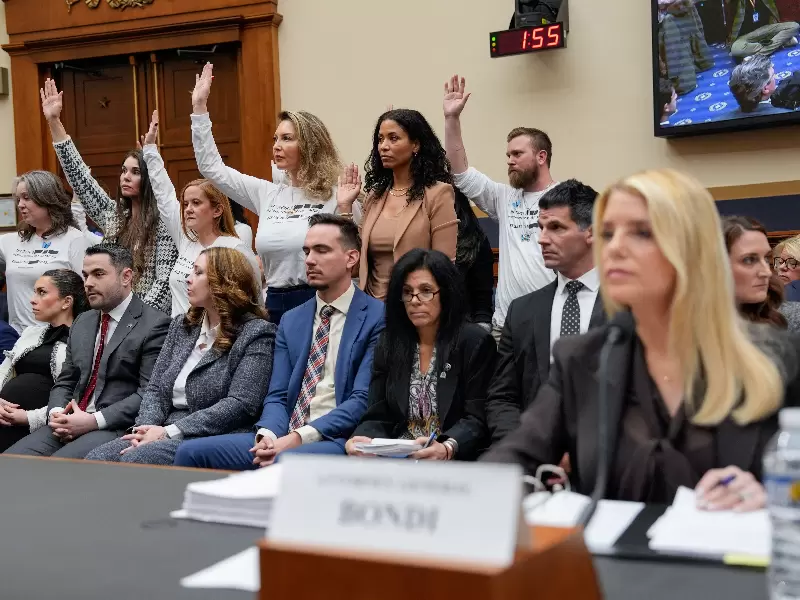 Survivors of Jeffrey Epstein raise their hands after U.S. Representative Pramila Jayapal (D-WA) asked who of them has been unable to meet with the U.S. Department of Justice led by Attorney General Pam Bondi, as Bondi attends a House Judiciary Committee hearing on oversight of the Justice Department to testify, on Capitol Hill in Washington, D.C., U.S., February 11, 2026. / REUTERS/Kent Nishimura
More than one million people are trafficked each year worldwide, the majority of them young women and girls. Yet fewer than 1% of sex trafficking cases are ever prosecuted. The public release of Jeffrey Epstein files, without adequately protecting victims’ identities, reflects a broader history of legal systems failing survivors of sexual violence.
At a briefing hosted by American Community Media, legal scholars, anti-trafficking advocates and a survivor of sex trafficking urged a refocus on the victims of the newly released Jeffrey Epstein files rather than the powerful names dominating headlines.
“The Epstein story should be a gateway to deeper, broader conversations about power and exploitation,” said Dr. Michele Goodwin, professor of constitutional law and global health policy at Georgetown University.
The release of more than 3.5 million pages of documents related to convicted sex offender Jeffrey Epstein has triggered intense media scrutiny, with reporters combing through records in search of prominent individuals mentioned in the files. But speakers at the briefing argued that the public conversation has once again pushed survivors to the margins.
“This has been a long road toward justice because unjust systems have long been in place,” said Dr. Michele Goodwin, a professor of constitutional law and global health policy at Georgetown University.
According to the panelists, some victims’ names and images were insufficiently redacted in the latest tranche of court-ordered disclosures. At a recent Senate committee hearing, speakers said U.S. Attorney General Pam Bondi did not acknowledge or apologize to survivors present in the room, a moment that advocates described as emblematic of the government’s failure to center victims in the process.
A Broader Trafficking Crisis
Panelists stressed that the Epstein case, while high-profile, represents only a fraction of the global trafficking crisis.
linking the case to longstanding structural barriers in U.S. law. She pointed to statutes of limitations that often prevent survivors abused as children from seeking justice decades later, as well as evidentiary burdens that can be nearly impossible for minors to meet.
“What 14-year-old knows to preserve evidence for a future prosecution?” she asked, noting that prosecutors frequently rely on documentation such as police reports or forensic exams that many victims, particularly minors, never obtain.
Legal System as a Tool of Control
Carmen McDonald, executive director of the Survivor Justice Center in Los Angeles County, described how traffickers often weaponize the legal system against survivors. In some cases, she said, traffickers file police reports against victims for crimes they were coerced into committing, such as drug offenses or prostitution-related charges. Others pursue restraining orders or defamation lawsuits to silence those who speak out.
“These actions have a chilling effect,” McDonald said. “Survivors are often afraid not just of their traffickers, but of arrest, deportation or losing custody of their children.”
Immigrant survivors face additional barriers, she added, including fear of immigration enforcement and language obstacles. While protections such as T visas exist for trafficking victims, many remain unaware of their rights or are reluctant to engage with law enforcement amid shifting immigration policies.
Legislative Efforts in Texas
From Houston, Jacqueline Aluotto, co-founder of No Trafficking Zone, detailed legislative efforts in Texas to increase penalties for traffickers. She described state laws establishing “no trafficking zones” around schools, universities and foster care systems, elevating certain trafficking offenses to first-degree felonies punishable by 25 to 99 years in prison.
Aluotto argued that human trafficking has long been treated as a “high-profit, low-risk crime,” allowing networks to operate with limited deterrence. “If justice is a myth,” she said, “we cannot expect victims to keep coming forward.”
Survivor Perspective
Courtney Litvak, a survivor who said she was trafficked at age 17 for nearly three years, emphasized the emotional toll of repeatedly recounting trauma to multiple agencies. Now a consultant to the Department of Homeland Security’s Blue Campaign and a former member of the U.S. Advisory Council to Combat Human Trafficking, Litvak said policy discussions often exclude those most affected.
“Why are we anti-trafficking in the first place?” she asked. “It’s supposed to be for the victims and survivors.”
Speakers repeatedly returned to that theme: that coverage of the Epstein files should prioritize the dignity, privacy and agency of those exploited rather than amplifying speculation about high-profile figures named in court documents.
As the legal and political ramifications of the document release continue to unfold, advocates at the briefing called on lawmakers, prosecutors and the media to adopt what they described as a survivor-centered approach—one that protects confidentiality, strengthens pathways to justice and acknowledges the systemic forces that allow trafficking to persist.
“The real story,” Goodwin said, “is not just who is named in the files. It is whether we are willing to build systems that finally work for the people who were harmed.”
Discover more at New India Abroad.
Leave A Comment
Related










ADVERTISEMENT

ADVERTISEMENT
E Paper
Video

Comments
Start the conversation
Become a member of New India Abroad to start commenting.
Sign Up Now
Already have an account? Login