ADVERTISEMENT

ADVERTISEMENT


India's skies were already sick before the war arrived
The West Asia conflict exposed a vulnerability that is not uniquely Indian. It is the structural tendency of every fast-growing aviation market that optimizes for efficiency at the cost of resilience
-
 Hitanshu Pandit
 - Mon, 06, Apr 2026
- 04:26 EDT
- 23
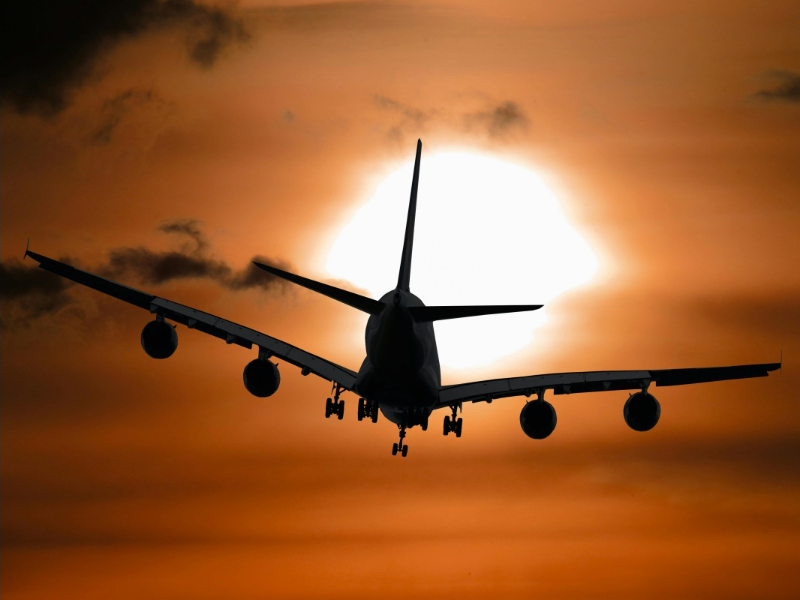 Representative image / Pexels
Consider two patients in the same ward, admitted on the same night, infected by the same virus. One is discharged in a week. The other does not recover so easily. The pathogen was identical. What differed was the condition of the body that received it.
On Feb. 28, 2026, when US-led strikes on Iran triggered the closure of Gulf airspace, every airline in the world caught the same virus. Lufthansa caught it. Emirates caught it. Japan Airlines caught it. The disruption was sudden, external, and nobody's operational fault. But the severity of the illness depended entirely on what each carrier brought to the ward with them.
In the first week of March 2026, India's aviation sector demonstrated, more visibly than any other, what happens when a fast-growing industry optimizes for efficiency and neglects resilience. But the forces that made India so vulnerable competitive pressure eliminating operational buffers, fuel exposure left unhedged, routing geography narrowed to a single corridor are not uniquely Indian. They are the structural tendencies of aviation expansion in any rapidly growing market. India arrived having already been through a difficult season. What that season exposed is a lesson with global reach.
The story of what happened to Indian aviation in the first three months of 2026 is really two stories wearing the same clothes. The first, the IndiGo disruption of December 2025, was a domestic crisis a consequence of staffing models stretched too thin, fatigue regulations that arrived faster than rosters could absorb them, and a market whose concentration meant one carrier's difficulty became everyone's problem. The second, the West Asia airspace crisis of February 2026, was a geopolitical shock that no airline anywhere could have caused or prevented. The temptation is to narrate them as one continuous disaster. That temptation should be resisted. They are different diseases. But the first one had weakened the patient before the second arrived.
India's aviation growth story is genuinely remarkable. From under 60 million domestic passengers a decade ago to 164 million today, the sector has delivered real connectivity to a rapidly expanding middle class. That achievement deserves acknowledgment. What the December and March events revealed is that growth at this pace places exceptional demands on the institutional infrastructure supporting it and that some of those demands have outpaced the supply.
India's largest airline, IndiGo, brought 91 new planes into service between 2022 and 2024 while adding 1,247 pilots roughly 14 pilots per aircraft. Air India, over the same period, hired at a ratio of 23 pilots per aircraft. The difference reflected different judgements about how much operational buffer to carry. When India's aviation regulator enforced new fatigue rules in November 2025, carriers with thinner buffers had less room to absorb the change. The system seized. Nearly 4,500 flights were cancelled in ten days. Fares spiked. The Competition Commission of India later found that the situation had, in effect, created an artificial scarcity affecting over 300,000 passengers at peak demand.
The regulatory response was understandable given the circumstances. On December 5, the DGCA granted IndiGo a temporary exemption from the rules it had just begun enforcing. Six weeks later it imposed a ₹22 crore fine real in form, though modest in scale for a company worth over ₹1 trillion. The exemption came before the fine. That sequence matters not as a criticism of any individual decision, but because of what it communicates to the broader market: that the cost of non-compliance, when it finally arrives, is manageable. Regulatory credibility, once spent, takes time to rebuild. You do not need the economics literature to understand this. You just need to be an airline CFO.
This was the pre-existing condition. Then came the virus. When Gulf airspace closed on February 28, Indian carriers faced a routing geography that had been quietly narrowing for years. Pakistan has kept its airspace shut to Indian carriers since 2019, already adding to westbound journey times. The Gulf corridor was what remained India's primary connection to Europe, North America, and the Gulf diaspora market. When that corridor was severed, alternatives were few. India recorded over 350 international flight cancellations on March 1 alone, with Mumbai Airport accounting for 57 of them. Over 150,000 passengers were repatriated from Gulf countries in the two weeks that followed. Aviation experts estimated the weekly financial damage to Indian carriers at ₹875 crore roughly $96 million.
Contrast this with how the same virus played out in a healthier body. Lufthansa and Air France-KLM had hedged approximately 62 percent of their fuel needs for 2026 before the conflict began. When jet fuel prices jumped by more than 50 percent in the weeks after the strikes, European carriers absorbed much of the cost shock through their hedge books. Air India introduced fuel surcharges of up to $200 on North American routes. Lufthansa's quarterly guidance barely moved. The difference was not fortune. It was preparation made in quieter times.
The routing picture was equally asymmetric. A British Airways flight from London to Singapore lost one corridor and rerouted through Turkey, adding time and cost but arriving. Air India, with Pakistan closed on its left and the Gulf closed ahead, rerouted through Oman and made technical fuel stops in Rome. When you have only one corridor and it closes, there is no workaround. There is only cancellation.
The war arrived without warning and hit every carrier simultaneously. What determined who absorbed it better was the condition each carrier had built for itself over years of quiet decisions. Fuel hedging is not a response to a crisis. It is a decision made in peacetime, years before the crisis arrives, about how much of your cost structure you want insulated from geopolitical volatility. India's carriers, with balance sheets still strengthening and planning horizons necessarily shorter, made rational short-term choices. The long-term cost of those choices became visible in the first week of March 2026.
The deeper lesson extends beyond aviation. Resilience is expensive in normal times and invaluable in abnormal ones. It looks like slack pilots above the regulatory minimum, hedged fuel above the spot price, routing options beyond the most efficient corridor. Every one of these costs’ money in a quarter where nothing goes wrong. Accountants question them. Investors discount them. Airlines under competitive pressure trim them. And then the unexpected arrives, and the carrier that maintained its buffers recovers quickly, while the one that had none does not.
India is not alone in learning this lesson expensively. In December 2022, Southwest Airlines cancelled nearly 17,000 flights over ten days. The same winter storm hit every US carrier simultaneously Delta cancelled 311 flights over the same period. What separated Southwest was that years of under-investment in crew-scheduling technology meant the network could not recover once disrupted. The storm was the trigger. The system's fragility was the cause. The failure mode was identical to IndiGo's: a system optimized for average conditions that had no buffer for tail conditions. Bloomberg Intelligence has identified China's major carriers alongside IndiGo as among the most exposed globally to fuel-price swings the same structural vulnerability, different geography. And the Russia-Ukraine airspace closure of 2022 demonstrated that corridor dependency is a risk every aviation market faces carriers that had pre-negotiated alternative routing arrangements absorbed the shock; those that had not scrambled. The pattern is consistent across markets and decades. In competitive aviation, the investments that build resilience are the first to be questioned in a profitable quarter and the first to be missed when the shock arrives.
India's aviation sector has every reason for confidence about its trajectory. The demand fundamentals are strong, with 164 million domestic passengers last year and 1,700 aircraft on order one of the largest fleet expansions in aviation history. Sustaining that trajectory through the inevitable shocks ahead will require building the institutional depth to match the ambition: a pilot training pipeline scaled to fleet growth, a market structure resilient enough that one carrier's difficulty does not strand the travelling public, and a regulatory framework whose credibility compounds over time.
For India's DGCA, the most immediate step is to publish a minimum pilot-to-aircraft ratio and enforce it before the next delivery cycle begins not as a punitive measure, but as the kind of prudential standard that makes a fast-growing industry durable. But the broader question this episode poses is one that every aviation regulator in a rapidly expanding market must now answer: at what point does the relentless pursuit of efficiency become a systemic risk? The answer, visible in Dallas in 2022 and in Delhi and Mumbai in late 2025 and early 2026, is the same: sooner than the balance sheet suggests, and later than the crisis reveals.
The war did not break India's aviation sector. It held up a mirror at a moment when the sector was still recovering from its own difficulties. The patient was under strain before the virus arrived. The good news is that the conditions which created that strain are institutional, not structural and institutions can be strengthened. That is a lesson India shares with every aviation market still in the early chapters of its growth story.
Sources
2025 IndiGo scheduling crisis-pilot ratios, 4,500 cancellations, FDTL exemption, ₹22 crore fine - Business Standard, Jan 17 2026
CCI investigation - 300,000 passengers, artificial scarcity finding - Business Today, Feb 4 2026
₹875 crore weekly financial impact; Pakistan airspace closure 2019; Air India rerouting via Oman and Rome - The Federal, Mar 1 2026
150,000 passengers repatriated from Gulf, Feb 28 – Mar 11 2026 - Business Today, Mar 13 2026
Lufthansa and Air France-KLM 62% fuel hedged for 2026; IndiGo and China carriers most exposed to fuel swings - Aviation Week / Business Standard (Bloomberg Intelligence), Mar 2026
Air India fuel surcharges up to $200 on North American routes - Air India Newsroom, Mar 10 2026
350 international cancellations on Mar 1; Mumbai Airport 57; Indian airlines seek ATF relief - Business Today, Mar 9 2026
Global airline vulnerability to airspace closures and fuel exposure - Business Standard (Bloomberg), Mar 12 2026
The author is a Postdoctoral Research Fellow at the Dukakis Center for Urban and Regional Policy at Northeastern University in Boston, Massachusetts.
(The views and opinions expressed in this article are those of the author and do not necessarily reflect the official policy or position of New India Abroad.)
Discover more stories on New India Abroad
Related










ADVERTISEMENT

ADVERTISEMENT
E Paper
Video

Comments
Start the conversation
Become a member of New India Abroad to start commenting.
Sign Up Now
Already have an account? Login