ADVERTISEMENT

ADVERTISEMENT



From football to the Moon: Five things to keep an eye on in 2026
The Moon is expected to serve as a crucial stepping stone for future missions to Mars.
-
 AFP
AFP - Fri, 02, Jan 2026
- 02:19 EST
- 13
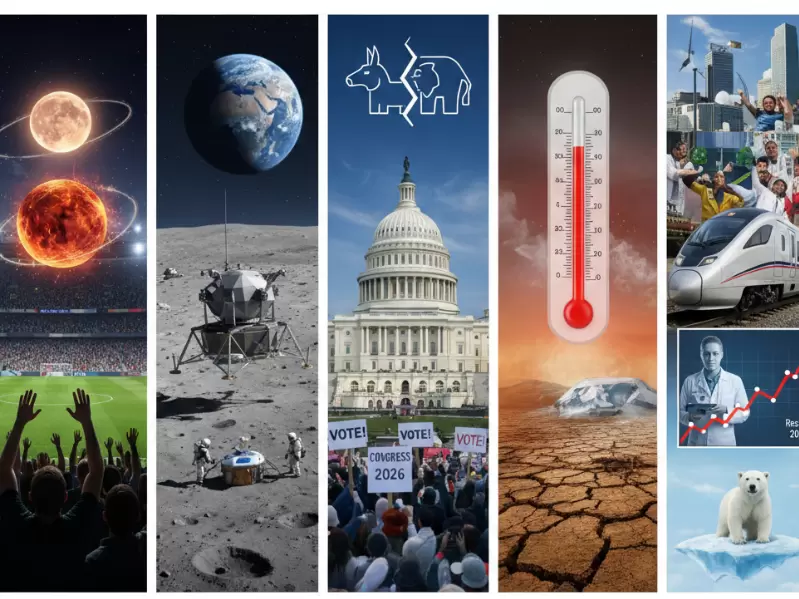 Representative image / AI generated
It is a year set to feature lunar missions, footballing spectacles and a battle for control of the U.S. Congress, among other developments.
Here are five major events to watch in 2026.
Climate: Will the world act?
The world is already experiencing record heat, and conditions are likely to worsen in 2026.
Last year was the warmest on record, but the United Nations says there is an 80 percent chance that at least one year will be even hotter by 2029.
How will nations respond? COP30 in Brazil recently showed that multilateralism in climate action is not dead, despite the U.S. boycott and ongoing geopolitical conflicts.
“2026 must be the year in which international climate diplomacy reinvents itself,” said Rebecca Thissen of Climate Action Network.
“COPs are not an end in themselves but a high point in an international political agenda that desperately needs to get on the same page,” she added.
Attention will also focus on how many countries respond to Colombia’s invitation to the first international conference on phasing out fossil fuels in April.
Aleksandar Rankovic, director of the think tank The Common Initiative, said he was disappointed by COP30’s outcome and questioned whether the “Gen Z-led rebellions that have emerged worldwide will start fighting for climate as well” in 2026.
Biggest football World Cup
The largest World Cup in history will see 48 countries compete in the United States, Canada and Mexico, under the gaze of President Donald Trump.
The world’s most-watched sporting event will unfold over nearly six weeks, from June 11 to July 19, with the U.S. hosting 11 of the 16 venues.
Trump’s tensions with the co-hosts over tariffs and immigration could make the tournament politically charged.
On the pitch, a richly talented French squad led by Kylian Mbappe will be determined to make up for its defeat to Lionel Messi’s Argentina in the 2022 final in Qatar. Spain also has high hopes.
Cristiano Ronaldo, who will be 41 when the tournament kicks off, has said his sixth World Cup will be his last, and he hopes to crown his career with a first global title for Portugal.
Cape Verde, Uzbekistan and the island nation of Curacao are among the countries appearing for the first time.
Fans could face steep costs for high-demand matches due to FIFA’s use of dynamic ticket pricing.
Gaza, Israel and Netanyahu’s future
U.S. pressure led to a ceasefire between Israel and Hamas that took effect Oct. 10, after two years of war.
The truce remains fragile, and Trump’s peace plan for the Gaza Strip leaves many issues unresolved, including the future stages of Israeli military withdrawal, reconstruction of the territory and its governance.
By formally endorsing Trump’s plan, the U.N. Security Council laid the groundwork for deploying an international force in Gaza — an idea fundamentally opposed by both Israel and Hamas.
The Palestinian Islamist movement has refused to disarm under conditions set by Israeli Prime Minister Benjamin Netanyahu, who has threatened to resume fighting if Gaza cannot be demilitarized through diplomacy.
Now 76, Netanyahu, leader of the Likud party, plans to run again in elections due no later than November 2026.
His multiparty coalition, which holds just 60 of 120 seats in parliament, remains fragile.
Netanyahu may be tempted to pursue military action against Hamas in Gaza or Hezbollah in Lebanon to keep far-right allies on board and secure the “total victory” he has promised Israelis.
That could change if Trump — seeking a Nobel Peace Prize and eager to turn the fragile Gaza truce into a broader regional deal — offers Netanyahu a major incentive: normalization of relations between Israel and Saudi Arabia.
Control of the U.S. Congress
As voters brace for the 2026 U.S. midterm elections, the stakes could hardly be higher for Trump, Congress and the nation.
Trump is not on the ballot, but a strong Republican showing would validate his influence beyond the White House. A weak performance would undermine his kingmaker role, expose cracks in his movement and complicate the path for his chosen successor.
For Republicans, control of Congress hangs by a thread.
Their razor-thin House majority and narrow Senate margin depend on defending swing districts and vulnerable incumbents in battleground states such as Michigan, North Carolina and Ohio.
Trump’s strategy — shaping primaries, endorsing loyalists and announcing a midterm convention — reflects concerns about turnout without his name on the ballot.
Democrats see opportunity. The president’s party historically loses seats in midterms, and forecasts suggest Republicans could struggle to hold the House. Democrats are also targeting the four Senate flips needed to gain control.
For Americans, the election is more than a congressional contest; it is a referendum on Trump’s executive reach, economic policy and the future direction of U.S. democracy.
Astronauts around the Moon
Could 2026 be the year astronauts return to the Moon?
NASA’s crewed Artemis 2 mission, carried out with private partners such as SpaceX, has been repeatedly delayed but is scheduled for liftoff early next year, possibly as soon as April.
The mission would be a key step toward Americans once again setting foot on the lunar surface, a goal Trump announced during his first term.
China, which aims to land astronauts on the Moon by 2030, is also advancing rapidly. Its Chang’e 7 mission is expected to launch in 2026 to explore the lunar south pole, and testing of its crewed spacecraft, Mengzhou, is also planned.
India, which landed a robotic mission on the Moon in 2023, is another emerging space power. The Indian Space Research Organisation plans to send an astronaut into orbit in 2027.
The Moon is expected to serve as a crucial stepping stone for future missions to Mars. It will likely be used to install relay bases, test spacesuits, vehicles and energy systems, and to learn how humans can live and work in deep space.
Related










ADVERTISEMENT
ADVERTISEMENT
E Paper
Video

Comments
Start the conversation
Become a member of New India Abroad to start commenting.
Sign Up Now
Already have an account? Login