ADVERTISEMENT

ADVERTISEMENT



Boston University gallery highlights Indian artisans in global fashion
The exhibition is on view inside the Boston University College of Fine Arts building on Commonwealth Avenue.
-
 Malvika Choudhary
 - Mon, 23, Feb 2026
- 13:41 EST
- 22
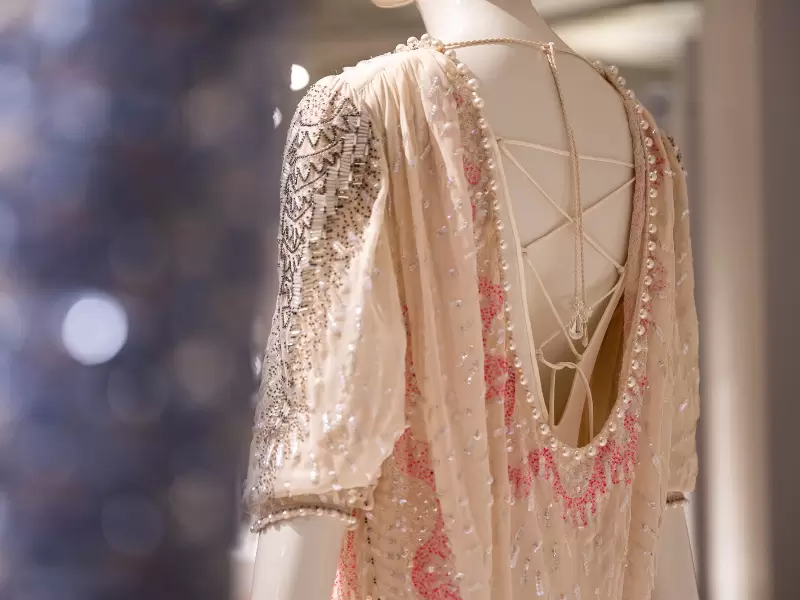 This dress of the New York skyline was created in 1985 by designer Zandra Rhodes. / bu.edu
An exhibition at Boston University’s Faye G., Jo, and James Stone Gallery is drawing attention to the often uncredited Indian artisans whose embroidery and handwork underpin global high fashion.
Titled Labor of Luxury: Embroidery from India to the World, the show presents 25 high-fashion garments made and embroidered in India, highlighting the cultural origins and labor behind luxury fashion.
Also Read: Kunal Nayyar on criticism: South Asian stories are often dismissed
Curated by Annette Becker, director of the Texas Fashion Collection, the exhibition foregrounds Indian craftsmanship that supports fashion houses in cities such as New York, Paris, London, and Milan.
Becker said much of the intricate hand beading and embroidery seen on luxury runways worldwide is produced in India, though the artisans themselves are rarely acknowledged.
A gallery text notes that while many luxury designers have built reputations on these techniques, few people recognize India as the cultural and geographic source of much fashion surface design.
Becker said the exhibition aims to push viewers beyond aesthetic appreciation. “We really want people to think a step deeper about what they’re seeing,” she told the University’s press, pointing to questions of who executes the work, where it is produced, and how those systems developed.
The garments on display span Indian and Euro-American designers, including ASHISH, Oscar de la Renta, Naeem Khan, Mary McFadden, Todd Oldham, Dries Van Noten, and Vera Wang. Individual pieces include a sequined jumpsuit, a pleated and beaded dress, a garment constructed from colorful granny-square motifs, and a bedazzled sweater emblazoned with “USA.”
The works come from the Texas Fashion Collection, an archive of approximately 20,000 garments from five continents. The exhibition also includes materials from Manish Arora, the first Indian designer to present a show at Paris Fashion Week, who donated parts of his runway archive.
Lissa Cramer, director of BU Art Galleries, said the exhibition offers an opportunity to shift attention from brand names to the labor behind the garments. She noted that while designers such as Vera Wang are widely recognized, much of the embroidery and embellishment on their work is executed in India.
The show also challenges assumptions about garment production in India, including the tendency to associate it solely with sweatshop labor. Becker emphasized that India has a centuries-old tradition of fine hand embroidery that continues alongside mass-production models.
The exhibition is part of an exchange between Boston University and the University of North Texas art galleries, which regularly trade shows to share resources and ideas.
Labor of Luxury: Embroidery from India to the World opened Jan. 20, at the Faye G., Jo, and James Stone Gallery, 855 Commonwealth Ave., Boston University, and will be on view through March 6. The gallery is open Tuesdays through Saturdays from 11 a.m. to 5 p.m. during the exhibition run.
Discover more at New India Abroad.
Related
.png)








_(cropped)-1.jpg)

ADVERTISEMENT

ADVERTISEMENT
E Paper
Video

Comments
Start the conversation
Become a member of New India Abroad to start commenting.
Sign Up Now
Already have an account? Login