ADVERTISEMENT
ADVERTISEMENT



Artemis II astronauts safely back on Earth after historic trip around moon
It took NASA and U.S. Navy recovery teams less than two hours to secure the floating capsule and retrieve the four crew members.
-
 Reuters
 - Sat, 11, Apr 2026
- 02:09 EDT
- 26
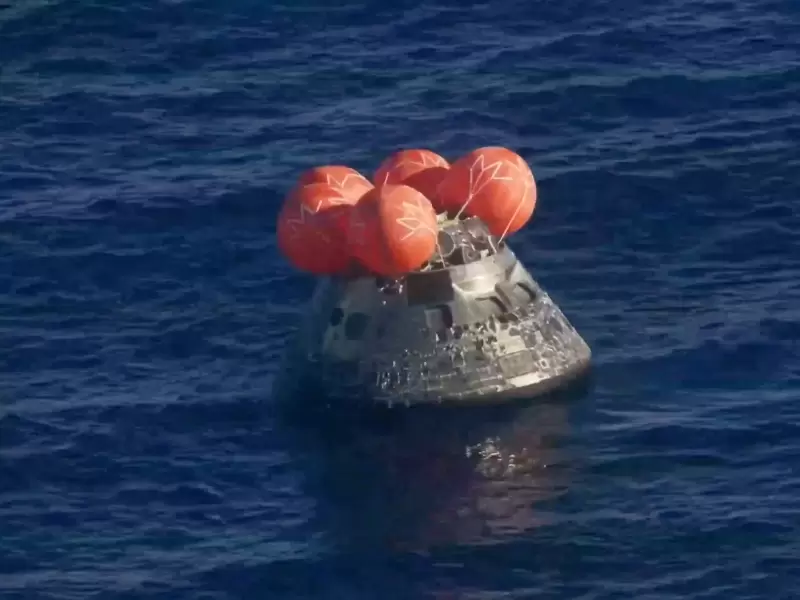 The Artemis II crew capsule floats in the Pacific Ocean following splashdown in this screengrab from a livestream video after the Artemis II crew's flyby of the Moon, April 10, 2026. / NASA/Handout via REUTERS
The Artemis II capsule and its four-member crew streaked through Earth's atmosphere and safely splashed down in the Pacific Ocean on April 10 after nearly 10 days in space, capping the first voyage by humans to the vicinity of the moon in over half a century.
NASA's gumdrop-shaped Orion capsule, dubbed Integrity, parachuted gently into calm seas off the Southern California coast shortly after 5:07 p.m. Pacific Time (0007 GMT on Saturday), concluding a mission that four days prior took the astronauts 252,756 miles away from Earth, deeper into space than anyone had flown before.
The Artemis II flight, traveling a total of 694,392 miles (1,117,515 km) in two Earth orbits and a climactic lunar flyby some 4,000 miles from its surface, was the debut crewed test flight in a series of Artemis missions that aim to return astronauts to the lunar surface starting in 2028.
ALSO READ: Artemis II moon mission breaks record for distance.
'PERFECT BULL'S EYE' SPLASHDOWN
The splashdown under partly cloudy skies was carried by live video feed in a NASA webcast. "A perfect bull's eye splashdown for Integrity and its four astronauts," NASA commentator Rob Navias said moments after the landing.
"We are stable one - four green crew members," mission commander Reid Wiseman radioed just after splashdown, signaling the capsule was upright and that all four astronauts were in good shape.
It took NASA and U.S. Navy recovery teams less than two hours to secure the floating capsule and retrieve the four crew members - U.S. astronauts Wiseman, 50, Victor Glover, 49, and Christina Koch, 47, along with Canadian astronaut Jeremy Hansen, 50.
The crew's homecoming was the riskiest test of the mission and its Lockheed Martin-built Orion spacecraft, proving the capsule's heat shield could withstand the extreme forces of re-entry from a lunar-return trajectory.
The capsule plunged into Earth's atmosphere at 32 times the speed of sound, with atmospheric friction pummeling its heat shield at temperatures of some 5,000 degrees Fahrenheit (2,760 degrees Celsius). A sheath of ionized gas enveloped the vehicle, causing a planned radio blackout of over six minutes at the peak of re-entry stress.
The tension broke as contact was re-established some 40 seconds later than expected, and two sets of parachutes billowed from the nose of the free-falling capsule to slow its descent to about 15 mph (25 kph) before Orion gently hit the water.
Once Navy divers had attached a floating collar to stabilize the capsule, the four astronauts, still wearing their orange flight suits, were helped onto an inflatable raft. From there, they were hoisted one by one to helicopters hovering overhead and flown a short distance to a nearby Navy amphibious transport vessel, the John P. Murtha, for further medical examination.
Glover and Koch smiled broadly and waved toward cameras as they sat on the edge of a helicopter door on the flight deck. The crew was expected to spend the night aboard the ship and be flown on Saturday to Houston, where they will be reunited with family, NASA said.
STEPPING STONE TO MARS
The quartet blasted off from Cape Canaveral, Florida, on April 1 aboard NASA's giant Space Launch System rocket, orbiting twice around Earth before sailing on for a rare journey around the far side of the moon.
In so doing, they became the first astronauts to fly around Earth's only natural satellite since the Apollo program of the 1960s and '70s. Glover, Koch and Hansen also made history as the first Black astronaut, the first woman and first non-U.S. citizen, respectively, to take part in a lunar mission.
The crew's peak distance of 252,756 miles away broke the record of roughly 248,000 miles set in 1970 by the crew of Apollo 13.
"This is an incredible test of an incredible machine," said NASA's associate administrator, Amit Kshatriya.
The voyage, following the uncrewed Artemis I test flight around the moon by the Orion spacecraft in 2022, marked a critical hardware test for a planned attempt later this decade to land astronauts on the lunar surface for the first time since Apollo 17 in late 1972.
NASA is seeking to achieve a crewed moon landing ahead of China, which is aiming to put its own crews there around 2030. The agency more broadly aims to establish a long-term lunar presence as a stepping stone to eventual human exploration of Mars.
In a historical parallel to the Cold War era of Apollo, the Artemis II mission has played out against a backdrop of political and social turmoil, including a U.S. military conflict that has proven unpopular at home.
PUBLIC FASCINATION
For many in a global audience captivated by the latest moon shot, it reaffirmed the achievements of science and technology at a time when big tech has become widely distrusted, even feared. More than 3 million viewers watched the splashdown on NASA's YouTube channel, the streaming service showed.
The return to Earth put the Orion spacecraft through a critical test of its heat shield, which sustained an unexpected level of scorching and stress on re-entry during its 2022 debut test flight. As a result, NASA engineers altered the descent trajectory for Artemis II in order to reduce heat buildup and lower the risk to the capsule and its crew.
Last week's successful launch was a major milestone for the SLS rocket, handing its principal contractors, Boeing and Northrop Grumman, long-sought validation that the launch system more than a decade in development was ready to safely fly humans to space.
President Donald Trump congratulated the astronauts' return in a message posted to his Truth Social platform, saying "the entire trip was spectacular, the landing was perfect and, as President of the United States, I could not be more proud!"
NASA's renewed lunar ambitions have been clouded in recent months, however, by workforce reductions under the Trump administration's federal downsizing efforts that have cut space agency personnel by 20%. The White House last week proposed a 2027 NASA budget that would cut $3.4 billion from its science unit and some 40 science missions.
Compared with Apollo, born of the Cold War-era U.S.-Soviet space race, NASA has characterized Artemis as a broader, more cooperative effort, while hoping to return to the moon before China.
The U.S. lunar program has enlisted commercial partners such as Elon Musk's SpaceX and Jeff Bezos' Blue Origin, which are building the program's lunar landers, and the space agencies of Europe, Canada and Japan.
The flight's conclusion puts NASA's focus on Artemis III, a mission planned for next year involving a crewed docking test in Earth's orbit with both of the lunar landers, before they attempt to land humans on the lunar surface for Artemis IV.
The Artemis III astronaut crew will be announced "soon," Kshatriya told reporters after the Artemis II crew's return. The landers' development, though, have been delayed, likely pushing those missions back.
As Artemis II commander Wiseman and his crew approached Earth's atmosphere for re-entry on Friday, he told mission control: "We got a great view of the moon out window 2, looks a little smaller than yesterday."
"Guess we'll have to go back," replied fellow NASA astronaut Jacki Mahaffey from mission control in Houston.
Related











ADVERTISEMENT

ADVERTISEMENT
E Paper
Video

Comments
Start the conversation
Become a member of New India Abroad to start commenting.
Sign Up Now
Already have an account? Login