ADVERTISEMENT
ADVERTISEMENT


One Valley, Many Voices: How the Kashmir Literature Festival is healing wounds
By its third edition in 2026, KLF has stopped being an experiment and started being a fixture.
-
 Zahack Tanvir
 - Sat, 30, May 2026
- 14:26 EDT
- 170
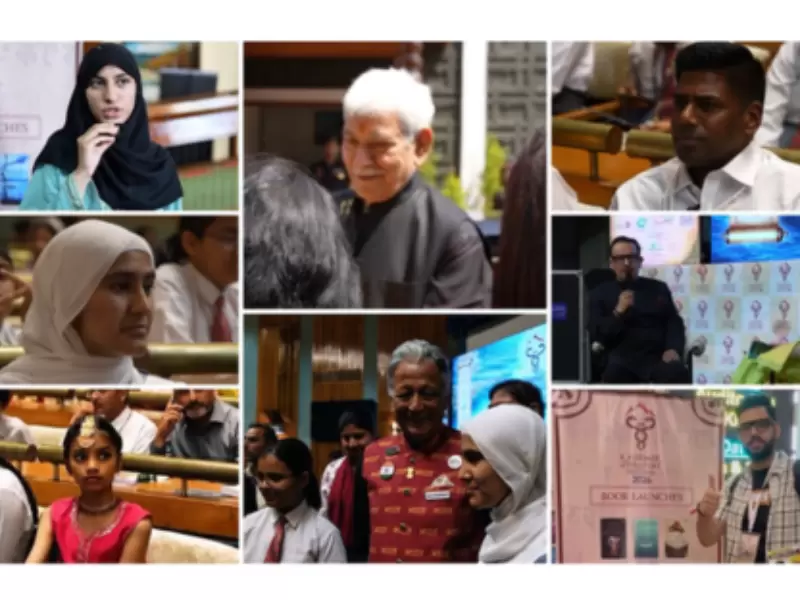 Glimpses from the festival. / Kashmir Literature Festival
When the Kashmir Literature Festival opens its third edition on 30 and 31 May 2026, something worth paying attention to is happening quietly in the Valley. Not a diplomatic breakthrough, not a security announcement—just writers, thinkers, artists, and readers gathering to talk. And in Kashmir, that itself is news.
What the Srikula Foundation started in 2024 has, in just two editions, become one of the more meaningful things happening in Srinagar today. The Kashmir Literature Festival — KLF — has grown from a hopeful experiment into something that people are actually showing up for, year after year.
It Wasn't a Given
When the first edition was announced, plenty of people were skeptical. Kashmir has seen cultural initiatives come and go. Political uncertainty has a way of draining the energy out of even the best-intentioned projects. Would anyone actually come? Would it survive beyond a single event?
It did more than survive. That first edition showed there was real hunger for this kind of space—not political rallies, not televised debates, but actual conversation about books, history, identity, journalism, and ideas. People came because they wanted something different.
The 2025 edition confirmed it wasn't a fluke. More attendees, richer discussions, a clearer sense of what the festival was becoming. By its third edition in 2026, KLF has stopped being an experiment and started being a fixture.
This year's theme is Samudra Manthan—drawn from the ancient Indian story of churning the cosmic ocean to extract both poison and treasure before wisdom can emerge. It is a less polished metaphor than most festivals would choose, which is probably why it works. It acknowledges that good conversations are not always comfortable ones.
More Than a Conflict Story
Most international coverage of Kashmir begins and ends with the same familiar frames—militancy, politics, disputed borders. That coverage is not wrong, but it is incomplete. Kashmir has one of the richest cultural histories in South Asia. It carries 5000 years old history, and centuries of poetry, philosophy, scholarship, and artistic tradition that rarely make it into the headlines.
KLF is helping change that, one edition at a time. It creates a stage for Kashmiris to talk about their own history and identity on their own terms—not as subjects of someone else's analysis, but as participants in their own story.
Since the abrogation of Article 370 in 2019, Kashmir has been going through a significant and contested transition. Alongside the political debate, something else has been happening: young Kashmiris are turning up—at startup programmes, sports competitions, university campuses, and yes, at literary festivals. They want to be part of wider conversations while staying rooted in who they are.
The People Making It Work
Yuvraj Srivastav and the Srikula Foundation deserve credit for keeping the festival grounded. There has been no chasing of controversy, no gimmicks to generate buzz. The approach has been patient and serious—build something credible, keep it consistent, let the work speak.
One of KLF's less obvious but more important features is that it brings Muslim and Hindu voices into the same room for honest discussion. Given Kashmir's history, that is harder to pull off than it sounds. Shared intellectual spaces do not appear by announcement. They require trust that accumulates slowly, and an environment where different people feel genuinely included rather than tolerated. KLF has been building that, quietly, edition by edition.
There is also something valuable in the mix of generations. Young writers and readers get direct access to established historians, journalists, and public figures. Senior thinkers encounter perspectives from people who grew up in a very different Kashmir. That kind of exchange keeps intellectual life from going stale.
Lieutenant General (Retd.) Devendra Pratap Pandey's continued involvement across all three editions reflects a broader point: people from outside the literary world are recognising that cultural confidence and civic engagement are not soft extras—they are part of what makes a society actually function well over time.
Lieutenant Governor Manoj Sinha's Contribution
It would be incomplete to discuss KLF's growth without mentioning Lieutenant Governor Manoj Sinha, who has been in office since 2020. His administration has made a visible effort to close the gap between government and ordinary residents—through public grievance mechanisms, district-level outreach, and direct engagement with communities.
For many Kashmiris who had grown accustomed to feeling unheard by institutions, that shift has been tangible. Cultural events, youth programmes, and public festivals do not happen in a vacuum. They need an environment where open engagement is actively supported rather than merely permitted. Lt. Gov. Sinha's approach has contributed to creating that environment.
What It Actually Means
The Kashmir Literature Festival's success is not really about how many people attend or how prominent the speakers are. It is about what the festival's existence says.
It says that Kashmir is more than its conflict. It says that a generation of Indian nationalists is ready to engage, debate, and create. It says that culture — books, ideas, music, art — has a role to play in how a place heals and moves forward.
Nobody is pretending the hard problems have gone away. The history is too deep, the divisions too real, for anyone to claim otherwise. But progress does not wait for perfect conditions. Sometimes it shows up in the form of a literature festival, now in its third year, still going strong.
The most interesting conversations at KLF may not have happened yet. That alone is reason enough to pay attention.
The writer is the founder and editor of Milli Chronicle Media (UK).
Leave A Comment
Related
ADVERTISEMENT

ADVERTISEMENT
E Paper
Video

Comments
Start the conversation
Become a member of New India Abroad to start commenting.
Sign Up Now
Already have an account? Login