ADVERTISEMENT
ADVERTISEMENT



The Hidden Indian Story Behind the 'Boston Brahmins'
The roots of Boston Brahmins may lie not in New England privilege, but in the global influence of the Bhagavad Gita.
-
 Sharad Wagle
 - Fri, 19, Jun 2026
- 11:59 EDT
- 35
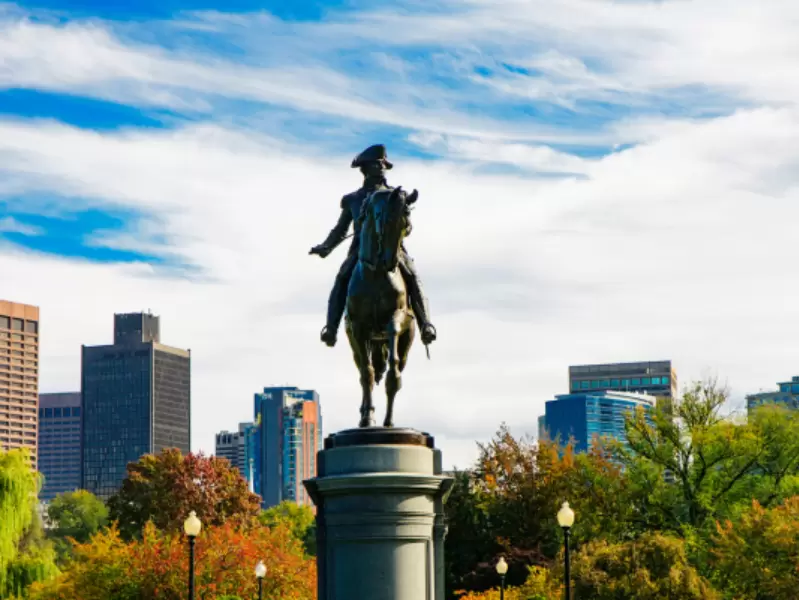 Representative Image / Canva
Have you ever wondered how the name Boston Brahmins came about? It’s a fascinating story.
Having lived in Boston for many years, I’ve asked many local Bostonians and the answer is always along the lines of “Boston Brahmins refers to Bostonians of privilege and affluence—the blue-blooded ones." Wrong!
You’d be very surprised to know that it’s related to India and specifically the Bhagavad Gita.
But let me start with one true story that resulted in the world’s first best-seller. In 1785, a book was written and subsequently translated into every single language in Europe. It changed the lives of many millions of people all over the world.
The book was authored by Sir Charles Wilkins, an Englishman who was fluent in Sanskrit. The book was published in London under the auspices of the British East India Company and was titled “ The Bhagvat-Geeta or Dialogues of Kreeshna and Arjoona in 18 lectures."
Within 5 years of it being translated to English, it continued to be in great demand worldwide. It was translated into French, German and Russian. Then many other languages. All over Europe, centers for the study of Sanskrit and Indian studies were opened.
By 1832, the Gita was translated even into Latin. The world was in so much emotional distress that the teachings of the Gita were eagerly taken in by the populace (even though there was absolutely no explanation of any of the 700 verses in the 18 chapters. Without explanation, many have not understood the meaning. )
How did all this start? It started when Warren Hastings was appointed as the Governor General of all of India, the most powerful position in British-controlled India.
As background, in 1611 the East India Company took permission from the British Government and the Queen to begin trading in India. At that time, and for all of recorded world history before that time, India was the richest country in the world - flush with limitless gold, diamonds, precious stones, textiles, and other valuables.
The East India Company took in so much wealth that a person like Robert Clive of the East India Company became, at age 32, the richest man in the world! Just on what he alone took from India, and there was a fortune still available for the taking. The Company had to give a large percentage of what it took to the Queen and to the British Government. Britain became from a poor country at that time to one of the richest countries in the world just from what it took from India.
Many in the British Parliament raised their voices against such looting from a country that had not waged war against Britain. They said this was not the Christian way.
Soon a law was passed that claimed that if a country was not a Christian country, and was inhabited by heathens and infidels, then it was legal to invade that country, to occupy that country and further to convert such heathens and infidels to Christianity. Those that raised their voices in Parliament against the unlawful invasion and occupation of India were a minority and were silenced by the majority ( which was drunk on the riches that each of them were receiving on a regular basis ).
With this as a background to the appointment of Warren Hastings to the prestigious post of Governor-General of India, we move on. Gov. Genl Warren Hastings was instructed that his mission was to convert as many of the heathens in India to Christianity as possible. Hinduism was not considered a religion, and the Hindu scriptures were considered a “primitive rambling of human civilization in its infancy”.
Warren Hastings was soon to discover the profundity of the Hindu scriptures. So much so that he would not only disregard his orders and not convert the “heathens” but he himself began following the teachings of the Bhagavad Gita! Further he sought out somebody who could translate the Gita into English for the world to benefit from its teachings.
Hastings remained the British Governor-General of India for 13 years—1772 to 1785. During those years, Warren Hastings asked to learn everything he could about the Hindu scriptures.
He was so impressed that he felt that this MUST be translated into English and made available the world over. The first-ever English translation of the Gita was commissioned by Warren Hastings and the East India company. Hastings found a Sanskrit-speaking Britisher known as Charles Wilkins.
The book was published in London in 1785 under the British East India company. Warren Hastings, the British Governor-General, a Christian, wrote, "Long after the British Empire has been wiped out from the face of the earth, the Gita will continue to give consolation and peace to mankind."
On the other side of the world, in the New World, the United States of America, a man who would become a student of the Bhagavad Gita and then rise to be a Father of American Literature was Ralph Waldo Emerson.
He was the minister of the Unitarian Church of Boston. He had severe doubts, he wrote, about administering the sacrament of the Lord's supper. There were three questions about Christianity that haunted him, and he could not answer them when his parishioners asked. He became severely depressed and resigned his post as minister.
He had heard about the Gita's influence in England and about the book written by Charles Wilkins in 1785. He went to London and met with William Wordsworth, Thomas Carlyle, Samuel Coleridge, and Walter Savage Landor who introduced him to Wilkins’ Gita and spoke to him about it. He found that the Gita answered all his questions and he felt relieved.
The Gita, he said, made him a better Christian and did not promote any religion.
Ralph Waldo Emerson was thoroughly influenced by the teachings of the Gita. In 1836, Emerson formed the Transcendental Club in Boston based on the principles that he learned from the Gita. He wrote an essay called Nature in 1836. Emerson's Transcendentalist Club opposed rituals and dogmatic theology.
He promoted 'self-examination,' individualism, beauty, the respect of nature and all living things, and that Divinity permeated all living things. These were the essential teachings of the Hindu scriptures.
Ralph Waldo Emerson would then spread the word to many other American writers and ask them to join him in London to learn about the Gita and to discuss the teachings. Poets like Wordsworth, Blake, Coleridge, Shelley and Keats read Wilkins’ translation of the Gita and also imbibed the spirit of the Gita. Johan Wolfgang von Goethe and Leo Tolstoy emphasized the message of the Upanishads and Gita in most of their writings.
These British and American Poets and writers were Puritans and strict Christians. They were happy that the Gita said that an upright man is a Brahmin—be he of any religion—and that the word "Brahmin" essentially refers to a person who is upright, honest, decent and moral.
One of Ralph Emerson’s friends who came over to London from USA was William Blake (1757–1827). He was one of the greatest poets in the English language.
He had studied art as a boy and became a well-known artist. He drew a series of illustrations to the Bible including 50 tempera paintings and 80 watercolors. He had a catalog from which he sold various paintings. One of his paintings was called “The Brahmin" and showed a white man seated with brown-skinned Brahmins from India, studying. His friends started calling him ‘The Brahmin’ as a tease.
Blake actually loved the nickname and since he was from Boston, the name metamorphosed to “Boston Brahmin." The name was fondly and proudly adopted by all the Bostonian Writers and poets who came back to Boston with that title proudly.
The writers and poets of Britain and of USA were together influenced and learned from each others’ writings and philosophy. The Gita gave them solace and the inspiration to write their poetry. The American poets’ group was called the Boston Brahmins. Others formed similar Vedic groups in the USA called the Transcendentalists, the Concord movement and the New Thought Movement.
The following Founding Fathers of American literature and poetry were influenced by Wilkins’ 1785 translation of the Gita :
Ralph Waldo Emerson 1803 -1882
Henry Thoreau 1817 -1862
Amos Bronson Alcott 1799- 1888
Sarah Fuller 1810- 1850
Walt Whitman 1819- 1892
Henry Longfellow 1807- 1882
Oliver Wendel Holmes 1809 - 1894
James Russell Lowell 1819- 1891
Also, Wordsworth, Blake, Coleridge, Shelley, Keats, Von Goethe and Tolstoy.
In his journal, Emerson wrote in 1845 that he was reading the Gita and essays on the Vedas. He said further, "I owe a magnificent day to the Bhagavad Gita. it was the first of books, as if it were an empire spoke to us, nothing small or unworthy, but a large serene consistent voice of an old intelligence which in another age and climate had pondered and thus disposed of the same questions which exercise us."
The writer is a psychiatrist, educator, author, and the founder of the Arise Arjuna Foundation.
(The views and opinions expressed in this article are those of the author and do not necessarily reflect the official policy or position of New India Abroad.)
Discover more at New India Abroad.
Related




.jpg)






ADVERTISEMENT

ADVERTISEMENT
E Paper
Video

Comments
Start the conversation
Become a member of New India Abroad to start commenting.
Sign Up Now
Already have an account? Login