ADVERTISEMENT
ADVERTISEMENT



Texas Diaries captures Ramesh Shah's Indian-American legacy
The second episode highlights early Houston Indian diaspora community-building and volunteer networks.
-
 Ankita Baidya
 - Thu, 02, Jul 2026
- 03:43 EDT
- 30
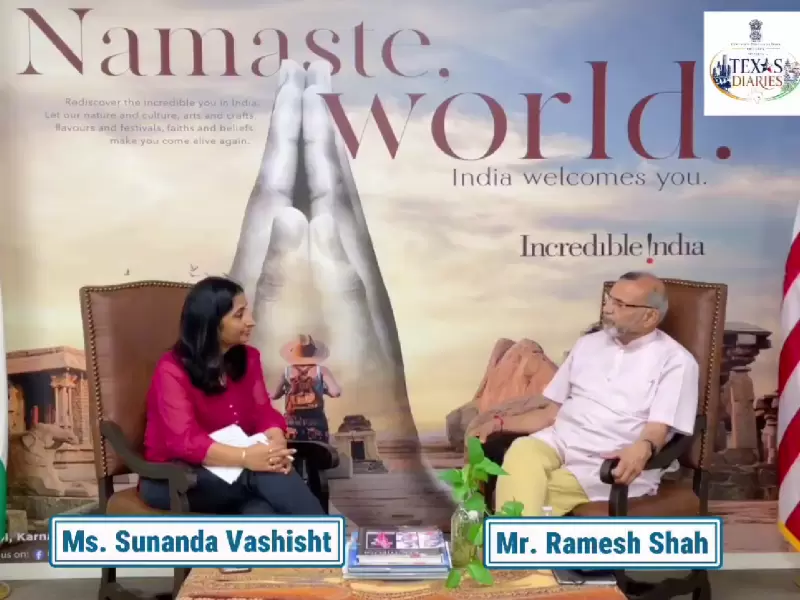 The Consulate General of India in Houston has released the second installment of its "Texas Diaries" series. / X/@cgihou
Indian-American community leader Ramesh Shah says the greatest measure of immigrant success is not wealth but service, reflecting on a lifetime of community building, philanthropy and diaspora activism in the second episode of the Consulate General of India's "Texas Diaries: Oral History of the Indian Diaspora" series.
Through a conversation with political commentator Sunanda Vashisht, Shah recounts his journey from a village in Gujarat to becoming one of the most prominent Indian-American community leaders in Texas.
Also read: American Eagle names Ravi Thanawala as next CFO
Introduced by the Consulate as a tribute to members of the Indian diaspora whose lives have shaped Indian-American communities, the episode highlights Shah's contributions to community building and volunteer service. The Consulate notes that Shah, a former Global President of the Ekal Vidyalaya Foundation, received the Pravasi Bharatiya Samman Award, India's highest honour for overseas Indians, for his contributions.
During the interview, Shah recalls growing up in a village about 60 kilometres from Ahmedabad, completing engineering studies at M.S. University, Baroda, and working in Surat before immigrating to the United States after changes in U.S. immigration policy opened opportunities for Asian professionals. He initially arrived alone with a single plane ticket, worked a series of jobs in New York, and later moved to Houston in 1976 for an engineering position, with his wife and two daughters joining him two years later.
️ Texas Diaries – Oral History of Indian Diaspora
— India in Houston (@cgihou) July 1, 2026
Episode 2: The Story of Shri Ramesh Shah
The Consulate General of India, Houston is pleased to release the second episode of Texas Diaries: Oral History of Indian Diaspora, our ongoing initiative to document and preserve the… pic.twitter.com/gKDWUmobkm
The early years were difficult. Despite being an engineer, Shah took up a series of odd jobs in New York before securing an engineering role in Houston in 1976. He notes that many highly educated immigrants of that period accepted whatever work was available while waiting for roles aligned with their qualifications.
The conversation also revisits his involvement in diaspora activism during India’s Emergency. While in New York and New Jersey, he helped set up organisations such as Indians for Democracy and Friends of India International, bringing together overseas Indians concerned about developments in India before later moving to Texas.
A large part of the episode focuses on Houston’s emerging Indian-American community in the 1970s and 1980s, when there was no Indian consulate and community institutions were still developing. Shah recalls organising festival and national day celebrations where families cooked and shared meals, gradually building stronger ties across regional and religious lines.
He also describes leading efforts to save Houston’s Gandhi Center during a financial crisis. By going door to door to raise funds, Shah helped prevent its takeover, calling it one of his most fulfilling experiences. His volunteer work later expanded through organisations including the India Culture Center, Sewa International and Swadhyay.
The episode also explores Shah's long association with the Ekal Vidyalaya Foundation, which supports one-teacher schools in rural and tribal India. Shah recounts helping establish the foundation's U.S. chapter in 2000 and expanding it to roughly 70 chapters nationwide while continuing to visit villages in India to monitor educational initiatives.
Throughout the conversation, Shah speaks about volunteerism, community service, and maintaining ties with both India and the United States. Encouraging younger Indian Americans to contribute wherever they live, he says service, education, and helping others provide lasting satisfaction beyond professional success.
Asked how he hopes to be remembered, Shah says, “Money is a tool.” He adds that the greatest reward is not wealth or recognition, but using resources to educate, empower and serve others—a philosophy he says has guided his life and legacy.
Discover more at New India Abroad.
Leave A Comment
Related


.jpg)
ADVERTISEMENT

ADVERTISEMENT
E Paper
Video

Comments
Start the conversation
Become a member of New India Abroad to start commenting.
Sign Up Now
Already have an account? Login