ADVERTISEMENT
ADVERTISEMENT



Mark Carney commemorates 1914 Komagata Maru immigration tragedy
Carney recounted how 376 Sikhs, Muslims and Hindus of South Asian origin arrived in Vancouver aboard the ship seeking “a better life for themselves and their families.”
-
 Pranavi Sharma
 - Mon, 25, May 2026
- 02:57 EDT
- 22
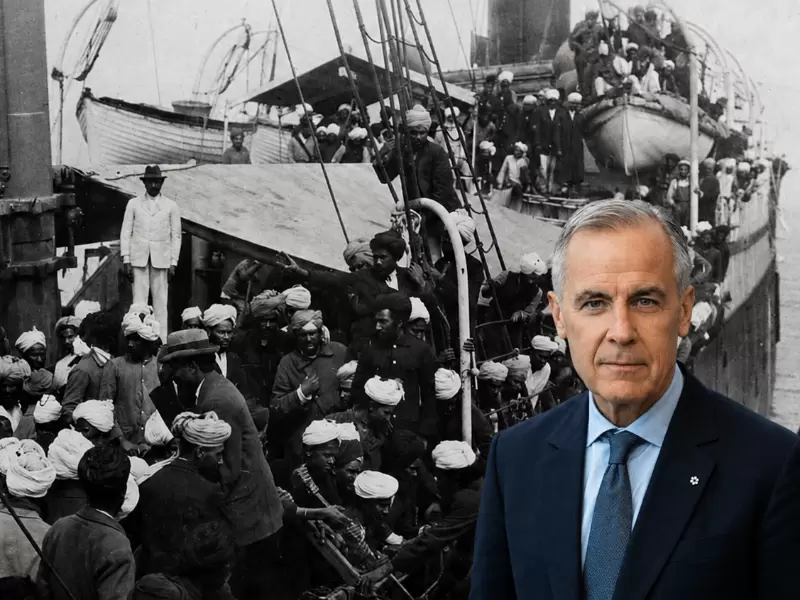 Representative image / AI Generated
Canadian Prime Minister Mark Carney on May 22 described the Komagata Maru incident as “one of the darkest chapters” in Canada’s history, marking the anniversary of the 1914 immigration tragedy in which hundreds of South Asian passengers were denied entry into the country.
In a statement commemorating the incident, Carney said Canada had failed to uphold its values when authorities turned away passengers aboard the Japanese steamship Komagata Maru after it arrived in Vancouver harbor on May 23, 1914.
“The Komagata Maru tragedy is one of the darkest chapters in our history — a moment where Canada failed to uphold our values, with horrific consequences,” Carney said.
He said the government was honoring “the memory of all the passengers, their descendants, and their communities who suffered.”
Carney recounted how 376 Sikhs, Muslims and Hindus of South Asian origin arrived in Vancouver aboard the ship seeking “a better life for themselves and their families.”
Instead of being allowed to enter Canada, nearly all passengers were denied entry by Canadian authorities and forced to remain aboard the vessel for two months with limited access to food, water and medical care, he said.
“When the Komagata Maru was forced to return to India, then under colonial rule, many of its passengers were imprisoned or killed,” Carney said.
The Komagata Maru incident began when the ship arrived in Vancouver carrying 376 passengers from Punjab province in British India. Although they were British subjects, most were barred from entering Canada under the country’s ‘continuous journey regulation,’ an immigration policy introduced in 1908 that effectively restricted South Asian migration.
Under the regulation, immigrants were required to arrive through a continuous journey from their country of birth or citizenship and possess through tickets purchased before departure. The policy prevented most Indians from immigrating because no direct shipping route existed between India and Canada.
Only 24 passengers were permitted to disembark in Vancouver. The ship was forced to leave Canada under naval escort on July 23, 1914.
After the Komagata Maru returned to India, British colonial authorities attempted to arrest some of the passengers near Budge Budge, close to Calcutta, now Kolkata, on Sept. 27, 1914. Violence broke out after police opened fire, killing 20 passengers. Others were arrested or imprisoned.
The incident later became a symbol of Canada’s racially discriminatory immigration policies in the early 20th century and has been the subject of public memorials, scholarship and official apologies.
In his statement, Carney said the tragedy “reminds us of the appalling repercussions of discrimination and racism.”
“We are building a Canada that is not just strong, but good. A Canada that is not just prosperous, but fair,” he said.
“A Canada that is not just for some, most of the time — but for all, all of the time.”
Discover more at New India Abroad.
Related










ADVERTISEMENT

ADVERTISEMENT
E Paper
Video

Comments
Start the conversation
Become a member of New India Abroad to start commenting.
Sign Up Now
Already have an account? Login