ADVERTISEMENT

ADVERTISEMENT



Khalsa Srijana Divas and celebrations worldwide
Global conflicts and rapidly changing geopolitical scenes notwithstanding, the Sikh community is upbeat about the ensuing Vaisakhi celebrations.
-
 Prabhjot Paul Singh
 - Wed, 08, Apr 2026
- 13:52 EDT
- 15
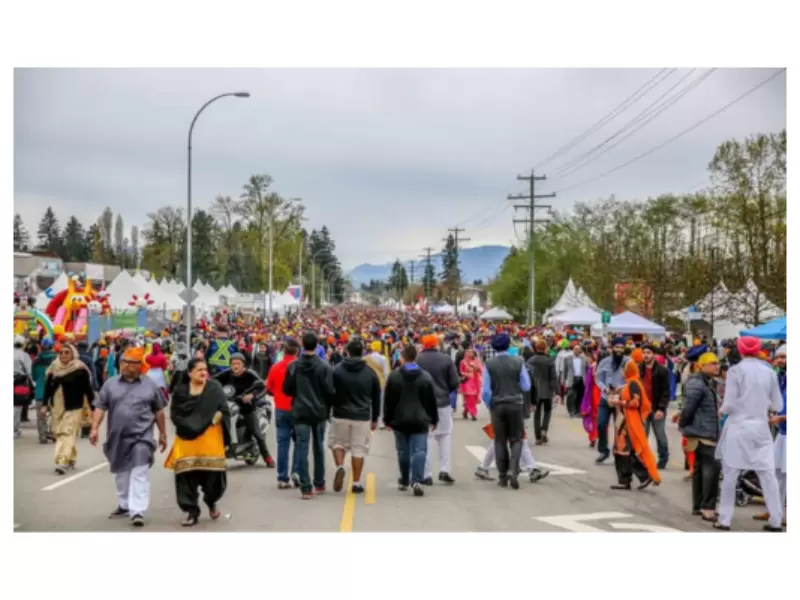 Nagar kirtan / dasmeshdarbar.ca
For Punjabis worldwide, Vaisakhi is not only a religious or seasonal festivity but also much more. Though many other South Asian communities, including Tamils, Malayalees, Biharis, and Bengalis, celebrate this mid-April festival with traditional fervor and gaiety, it continues to be acknowledged as a true Punjabi festival in general and a Sikh religious festival in particular.
If there is any Indian festival other than Diwali that has universal appeal, it is Vaisakhi. Punjabis or Sikhs, like potatoes, are a universal commodity. Wherever they go, they carry with them not only the sacred Sikh scriptures, including Sri Guru Granth Sahib, but also their favorite pastime endeavors—playing Kabaddi to remain physically and mentally fit and field hockey, a sport that essentially is of British origin but dominated by the Punjabis worldwide.
Also Read: Surrey Police issue advisory for Vaisakhi parade
As a universal community, overseas Punjabis have carved for themselves a distinct socio-economic-cultural identity. Vaisakhi, or the first day of the month of Vaisakh in the Vikram Samvat calendar, has affable religious overtones as it marks the birth anniversary of the Khalsa, the pure. Otherwise, it has traditionally been correlated to the start of the harvesting season (of the wheat crop) in North India, reflecting in the process great socio-economic strides the farming community of the north has made. Besides, for many Indian communities, it marks the start of summer.
Global conflicts and rapidly changing geopolitical scenes notwithstanding, the Sikh community is upbeat about the ensuing Vaisakhi celebrations.
Vaisakhi celebrations and holding of kabaddi tournaments worldwide are traditionally and conventionally linked. This Vaisakhi, however, is going to be different. The Kabaddi community worldwide, except for India and a few more places, decided early this year not to hold any event throughout the year till the "house" is set in order. The community wants to introduce discipline, frame rules and regulations, and monitor the holding of tournaments, besides introducing registration of players.
Other than Kabaddi, certain developments, including the assassination of Hardeep Singh Nijjer in Surrey a couple of years ago, led to a huge spat in bilateral relations between India, the original home of the Sikhs, and Canada, the new or second home of the youngest and most affluent minority community. Animosities grew and touched a new high that started impacting the normal life of the Indian community in Canada. Protests at Indian diplomatic missions in Canada grew louder besides turning violent at times.
The holding of “Vaisakhi” celebrations, too, could not evade the impact of the strained India-Canada relations. Interestingly, the Indian mission in Toronto, in collaboration with Virasat-e-Khalsa, is holding a major event to mark Diwali celebrations. There will be a live music program by Jagjit Jeet Bhinder on April 12 at a Brampton banquet house. Otherwise, in the recent past, the only time when “Vaisakhi” celebrations got subdued was because of the covid pandemic.
After the Covid pandemic subsided, major public events, including commemorating Vaisakhi through city parades or Nagar Kirtan processions, resumed in 2023. They could not be organized in 2021 and 2022. Instead, special gatherings were held at Sikh temples—gurdwaras—by following the safety protocols of wearing face masks and maintaining a physical distance. Punjabis.
In 2024, Nagar Kirtan was replaced by a special congregation in Toronto. Other cities in North America also held special “Vaisakhi” celebrations by following the official guidelines.
The religious significance of Vaisakhi for Sikhs dates to 1699 when the 10th Sikh Guru, Sri Guru Gobind Singh, chose the historic town of Sri Anandpur Sahib in Punjab for the launch of the Khalsa. Though main religious celebrations are held at Takht Sri Kesgarh Sahib (Sri Anandpur Sahib), Golden Temple (Amritsar), and Takht Sri Damdama Sahib (Talwandi Sabo), the Sikhs mark the festivities by holding special congregations in gurdwaras in a global show of their progress in social, political, art, culture, sports, and economic fields as followers of one of the most recent and modern religions.
Since Sikhism had its origin in Pakistan—Nankana Sahib, the birthplace of the first Sikh Guru, Sri Guru Nanak Dev—groups of the devout also visit Sikh shrines there as part of Vaisakhi celebrations that are held in the second week of April every year. After almost 230 years of the birth of Guru Nanak Dev, Sri Guru Gobind Singh had given the Sikhs new identity of the Khalsa by introducing the concept of Saint Soldier.
Vaisakhi celebrations’ global significance is marked by ever-expanding numbers of cosmopolitans and metropolises that reverberate to the beats of bhangra and display the traditional martial art of Gatka as part of Nagar Kirtan processions or Sikh parades. Sikhs pride in claiming themselves to be one of the most affluent minorities in the world
The major focus remains on Sikhs in Europe (UK, Germany, Italy, France, Greece, the Netherlands, and Sweden), the Americas (USA and Canada), Australia and New Zealand, Africa (Kenya), and Asia (Malaysia, Thailand, and Fiji). Some Commonwealth nations—England, Canada, Australia, and New Zealand—and others have accorded recognition to major Sikh festivals, including Vaisakhi.
In 1999, when the world celebrated the tercentenary of the Khalsa, Canada became the first country other than India to take out a commemorative stamp to mark the event. Vaisakhi celebrations are now held at Parliament Hill in Ottawa, besides those of several provincial parliaments in other Commonwealth nations.
Historically, the Sikhs had to struggle hard not only to shrug off the blot of “second-rate citizens” in many parts of the erstwhile Commonwealth but also had to fight hard democratically for their rights and absorption in the mainstream of their new countries of abode.
The concept of the Nagar Kirtan processions—the Sikh parade—has been an effective tool for the overseas Sikh community to introduce itself as a peaceful and hard-working group that has no qualms about making countries of their present abode their homes.
This commitment has helped the community to script an unprecedented success story the world over. Though the Sikhs—initially described as Hindus – started reaching Canada in early 1900s, they had no voting rights in British Columbia from 1907 onwards. They had to wait for 40 long years to win the right to vote. In 1947, the requirement to be a voter was changed to Canadian citizenship in addition to being a British subject. In 1950, the first Sikh—Naranjan Garewal—was elected to the City Council of Mission in British Columbia.
The first-ever Sikh Parade was organized on January 19, 1908, along Second Avenue in Vancouver. On August 28, 1912, Hardial Singh Atwal became the first Canadian-born Sikh.
Each Nagar Kirtan procession comprises, among other things, a tastefully decorated truck trailer that carries the sacred Guru Granth Sahib in a golden or silver palanquin, five baptized Sikhs (Panj Piaras) who carry Kesari flags (Nishan Sahibs), and Gurbani reciting groups or “Prabhat Pheris” besides Bhangra and Gatka players.
The scale at which the Nagar Kirtan processions are now organized in North America started in 1978 when the Sikhs organized a massive procession to mark the 500th birth anniversary of Guru Amar Dass, the fourth Sikh Guru. Since then, the holding of the Sikh Parade has become an annual feature.
Many historians and social scientists believe that the Nagar Kirtan, or Sikh parades, paved the way for the consolidation of the Sikh community as a strong political force that ultimately saw a turbaned Sikh—Gurbax Singh Malhi—in the Canadian House of Commons in 1993. It was he who, six years later, persuaded the then Liberals to hold a big celebration on Parliament Hill to mark the tercentenary celebrations of the Khalsa on Vaisakhi Day. In May 1999, Canada issued a 49-cent special commemorative stamp to mark the tercentenary of the Khalsa.
Discover more at New India Abroad.
Related







ADVERTISEMENT

ADVERTISEMENT
E Paper
Video

Comments
Start the conversation
Become a member of New India Abroad to start commenting.
Sign Up Now
Already have an account? Login