ADVERTISEMENT
ADVERTISEMENT



Experts link Mahavir philosophy to ethical AI governance today
The discussion was being held as a part of this year’s Mahavir Jayanti celebrations,
-
 Shinjini Ghosh
 - Fri, 01, May 2026
- 00:46 EDT
- 11
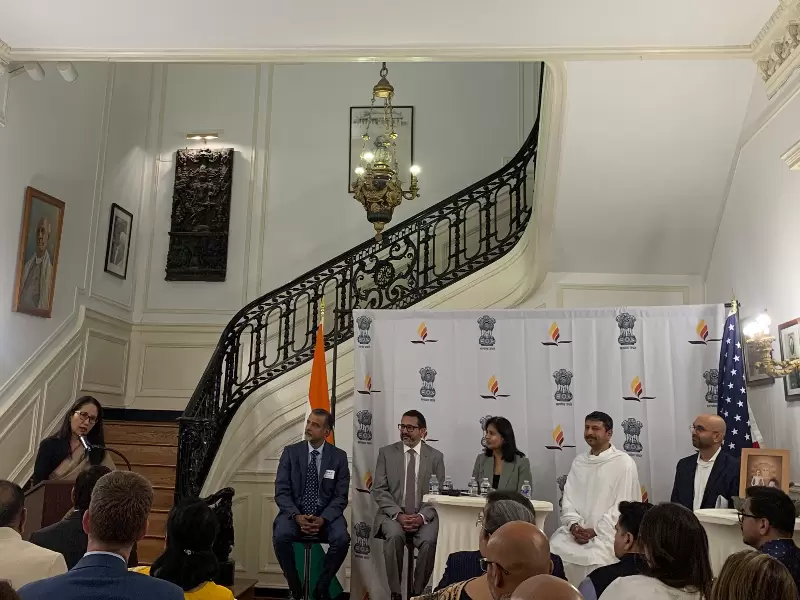 Photo (from left): Khampa, Padmanabhan, Jani, Shah, Rakshit, Miheer Kona (SRMD) / Shinjini Ghosh
In a rapidly changing world ridden with conflicts, fast-paced lives and emerging technologies, Bhagawan Mahavir’s teachings and principles continue to guide modern life, experts from various disciplines said April 27 at the Embassy of India.
The discussion was a part of an event organized by the Shrimad Rajchandra Mission Dharampur (SRMD), United States of America (USA) in partnership with the Embassy of India in Washington, D.C.
Addressing the gathering, Namgya C. Khampa, deputy chief of mission (DCM), said that society worldwide is going through a “moment of immense disruption and flux” and it was important to “look more closely and more critically at the founding principles, thought systems and beliefs.”
“I think it is incumbent on all of us, as Indians and proud descendants of that heritage, to amplify conversations and to engage on conversations around what these values and ideals and principles are in the secular world…how we can engage with them, how they are not abstract and how they can be practical,” Khampa said, adding that on a daily basis, policies and approaches are guided “by this heritage that is ours.”
ALSO READ: The Human Cost of Terror: Pahalgam, 9/11 attacks
The discussion, which was being held as a part of this year’s Mahavir Jayanti celebrations, included speakers like Atmarpit Rakshit, senior renunciate, SRMD; Hemang Jani, senior advisor, World Bank; Aarti Shah, board member of NVIDIA and Northwestern Mutual; and Balaji Padmanabhan, associate dean of strategic initiatives, University of Maryland.
Highlighting Mahavir’s principle of “ahimsa,” or nonviolence, Rakshit said that it’s important how things are viewed and approached to in one’s life.
“So be it artificial intelligence (AI) today, will it enable mankind or will it lead to such sophisticated wars and mayhem…the second concept is the multiplicity of views,” Rakshit emphasized.
From nonviolence and multiplicity of views to ethical deployment of AI to the relevance of Mahavir’s principles in modern public policy and decision-making processes, the speakers laid out various instances that are in play.
Speaking about how ancient wisdom can intermingle with modern technologies like AI, Padmanabhan said that while there is concern about AI being based on Western data, it can also be trained across cultures.
Highlighting the concept of “alignment,” which indicates that AI can be trained in distinct ways, Padmanabhan said, “How you get the difference is by alignment (and) is by aligning the AI to values. And it's a very interesting thought, right? So potentially, now we can train AI to be aligned with our spiritual values, and you can create an AI that's exactly that. And if you do that, you then satisfy people who need it, right? So technologically, we have the ability to do that, and I certainly see that happening.”
Discover more at New India Abroad.

ADVERTISEMENT

ADVERTISEMENT
E Paper
Video

Comments
Start the conversation
Become a member of New India Abroad to start commenting.
Sign Up Now
Already have an account? Login