ADVERTISEMENT

ADVERTISEMENT



17 year old Neha Sharan’s Girls4Chess calls for more girls on the board
Neha Sharan's journey from feeling out of place at a Bay Area tournament to leading Girls4Chess shows that big impact starts small and that trying is always worth it.
-
1759163132.png) Anushka Pathak
Anushka Pathak - Sun, 25, Jan 2026
- 03:34 EST
- 21
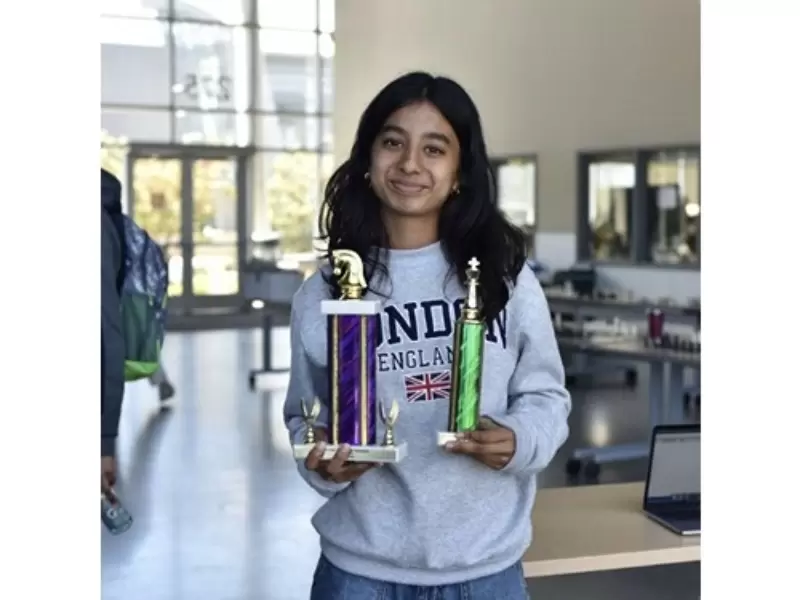 Neha Sharan, founder of Girls4Chess / Courtesy: Neha Sharan
Neha Sharan, a 17-year-old high school junior from Saratoga, California, was once just another chess enthusiast—until a Bay Area tournament as a ninth grader changed everything. Scanning the room, she saw 59 boys and realized she was the only girl. The isolation she felt in a game she loved highlighted the stark underrepresentation of females in competitive chess and sparked her resolve to act.
In an exclusive interview with New India Abroad, Sharan shared how this defining moment inspired her to found Girls4Chess, a nonprofit that creates inclusive spaces where young players—especially those from the Indian American diaspora—can build confidence, thrive, and truly belong.
ALSO READ: Kiran Desai calls immigration fear a wake-up call for Indians
A defining moment sparks action
Sharan explained that she started Girls4Chess to empower more girls to play competitive chess, having noticed, as a player herself, how few girls attended events. As an Indian American, her connection to the game runs deep. She recalls playing chess with her grandparents in India, especially with her grandfather, and continuing to play online with family even after growing up in the United States.
She explained that her Indian roots definitely shaped her early love for chess. This cultural tie, combined with her tournament experiences, fueled her mission. In the interview, she reflected on the pivotal experience: "I was the only girl out of 50 participants... So that is what caused me to start this organization."
Building momentum through persistence
The organization began modestly. Early tournaments drew small crowds—sometimes only around 12 participants—requiring persistent advertising and effort. Sharan emphasized that family support proved crucial from the start: her parents helped purchase chessboards and trophies and secure venues, enabling the student-led initiative to take off.
Over time, participation surged to the point that recent events had to close registration early due to high demand. Parents have donated generously, and the nonprofit now hosts monthly low-fee tournaments (around US$15–$25) open to K–12 players of all genders, with a special focus on and prizes for girls to boost involvement. Branches have expanded to California, Texas, and Nevada.
Girls still encounter barriers in U.S. competitive chess, Sharan noted. The primary issue is a lack of representation, which can make tournaments feel uncomfortable even when safe, as players miss seeing friends or familiar faces. High costs at many events—often US$50 to $75—also deter families, particularly for younger children. She keeps fees accessible to counter this, explaining, "There's definitely just the lack of girls. That's why... Also, those chess tournaments can be pretty expensive... So, that's why we tried to have $20, $15, $25 tournaments..."
Vision, balance, and a call to action
Sharan draws inspiration from figures like Viswanathan Anand and values mentors, including U.S. coaches, one from South Africa, and Bay Area tournament directors who offer guidance freely. Balancing high school demands with nonprofit leadership remains challenging, but she manages through strong support from parents, volunteers, and a routine: weekdays for school, weekends for coordination.
Looking ahead to college, Sharan envisions Girls4Chess growing further—hosting larger all-girls tournaments, training others to organize local events, and potentially expanding internationally while prioritizing accessibility.
She has also partnered with University of Illinois Urbana-Champaign Professor Inki Kim on research exploring chess's cognitive benefits, including for aging adults, using EEG and eye-tracking—insights she applies to building resilience in young players.
Her message to young chess players and aspiring mentors is encouraging: starting something big can seem impossible, but it becomes achievable with effort and the right people around you. She urged, "If you have a goal or something that you want to do, just try." She added that nothing is impossible "if you [put in] the time, effort, and if you are surrounded by the right people... you can definitely do anything."
From one girl's isolating experience to a movement reaching hundreds, Girls4Chess demonstrates that youth-led change can reshape spaces and inspire belonging on and off the board.
Discover more at New India Abroad.
Related









ADVERTISEMENT
ADVERTISEMENT
E Paper
Video

Comments
Start the conversation
Become a member of New India Abroad to start commenting.
Sign Up Now
Already have an account? Login