ADVERTISEMENT
ADVERTISEMENT



H-1B faces scrutiny as U.S. weighs enforcement shift
Given that Indians constitute the majority of H-1B recipients, any tightening of rules or expansion of enforcement will be felt most acutely by Indian applicants.
-
 Vijendra Agarwal
 - Wed, 03, Dec 2025
- 00:19 EST
- 598
.png) Representative Image. / Canva
Representative Image. / Canva
The U.S. immigration system, particularly the H-1B visa, has been debated for decades, but it now appears to be entering one of its most turbulent eras. Recent coverage in New India Abroad and major Indian news outlets highlights mounting regulatory enforcement, lawsuits, and heightened scrutiny around recruitment transparency and wage parity.
While only time will reveal the truth behind the allegations and counter-claims, one fact is already clear: the unprecedented H-1B fee proposal of $100,000 for new visas signals a structural shift that will reshape what has long been seen as the default pathway for India’s high-tech talent.
An analysis of current H-1B trends shows a clear realignment. U.S. Big Tech companies, including Meta, Google, Amazon, and Microsoft, continue to employ global talent on a significant scale. In contrast, the H-1B footprint of outsourcing-heavy Indian firms is contracting. This occurs alongside increased federal monitoring of wage standards, job advertising requirements, and investigations into whether American workers are being bypassed.
Given that Indians constitute the majority of H-1B recipients, any tightening of rules or expansion of enforcement will be felt most acutely by Indian applicants and the companies that sponsor them.
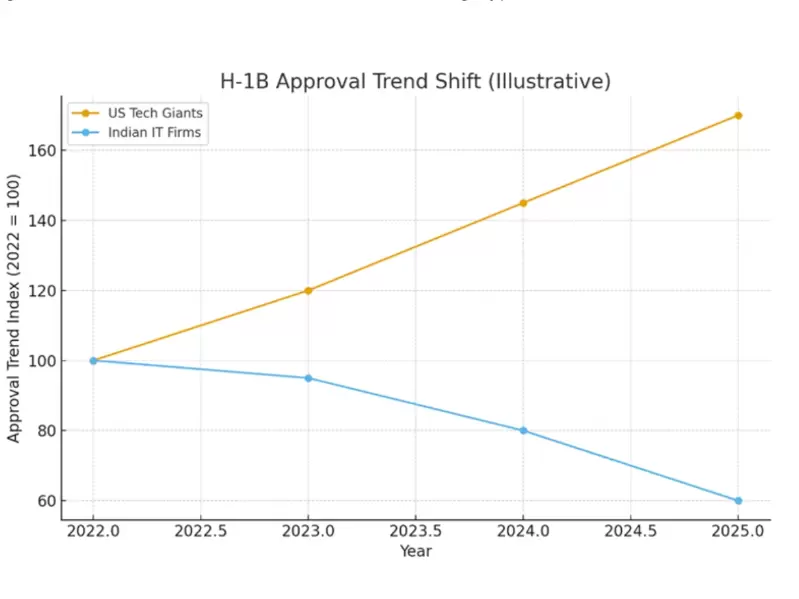 An analysis of current H-1B trends shows a clear realignment. / Vijendra Agarwal
Project Firewall: regulation or retrenchment?
Multiple U.S. federal agencies — DOL, EEOC, USCIS, and DOJ — have intensified investigations under what insiders refer to as Project Firewall. Their focus includes alleged layoffs of American workers followed by rapid H-1B hiring, discrepancies between promised and actual wages, and preferential selection of foreign workers over qualified U.S. applicants.
Critics argue that some employers have exploited the H-1B program to reduce labor costs, resulting in lawsuits and allegations of discrimination. Supporters counter that the enforcement is necessary to preserve program integrity rather than to discourage global talent.
The central question is whether Project Firewall will ultimately lead to meaningful reform or an era of restriction.
The U.S. has both the right and responsibility to regulate misuse without racializing it. India has a dual responsibility as well: to defend fairness for its citizens abroad and to acknowledge and correct instances where employers have exploited loopholes.
Advocacy organizations such as the Hindu American Foundation have challenged claims of regional targeting — particularly accusations aimed at Chennai — as lacking evidence and perpetuating harmful stereotypes. H-1B scrutiny focuses on employer practices, not on the individual Indian professionals who overwhelmingly follow the rules.
Rhetoric or reality?
In the broader immigration climate, political rhetoric is blurring the lines between isolated security concerns and sweeping policy proposals. President Trump recently directed agencies to intensify visa investigations for individuals from “dozens of developing countries,” following an incident involving an Afghan-origin individual near the White House. While national security must be taken seriously, the breadth of the proposed measures risks conflating criminal behavior with entire populations.
USCIS has also announced stricter scrutiny for green-card holders, raising questions about how retroactive such reviews might become. At the far end of the spectrum, a Texas legislator has proposed halting immigrant visas altogether, an idea with limited legal grounding but significant political noise.
Amid this environment, Elon Musk publicly emphasized the “immense contributions made by Indians to America’s rise as a tech leader.” It is a warning that abrupt visa restrictions would endanger U.S. innovation at a time when global competition in AI, biotech, and advanced manufacturing is accelerating.
The key challenge is distinguishing evidence-based policymaking from reactionary rhetoric. Immigration enforcement must address legitimate abuses but should not stereotype Indian nationals or other immigrant groups, nor jeopardize a talent pipeline essential to America’s technological competitiveness.
The way forward
The U.S. immigration system has long resembled an alphabet soup of categories, such as family-sponsored visas, employment-based visas, temporary work permits, student visas, exchange visas, and others. Reform will require systematic modernization rather than ad-hoc directives. A credible path forward includes streamlining and modernizing visa categories, targeting employer abuse rather than immigrant talent, replacing reaction with strategy, and preserving the talent pipeline that drives U.S. innovation.
Restricting H-1B visas or international student enrollment, especially in STEM, would have irreversible consequences. U.S. universities and research ecosystems already report declining international applications due to policy uncertainty and rhetoric. Cutting this pipeline will weaken the very sectors the country seeks to strengthen.
There is also a geopolitical dimension. After India resisted certain tariff demands from the Trump administration, immigration appears to have become a pressure point, intentionally or not. Yet using visas as leverage in unrelated diplomatic disputes is shortsighted and harms both nations.
Conclusion
The H-1B program needs reform, not abandonment.
Correcting misuse, improving transparency, and ensuring wage fairness are essential. But overcorrection or politically motivated restrictions will undermine the United States’ ability to attract the world’s best talent and weaken a foundational pillar of American innovation.
For India, the stakes are equally high. The U.S. remains a crucial destination for skilled professionals, and any disruption to that pathway will reshape the aspirations of millions and influence India’s own economic strategy.
The choice before policymakers is not between a crackdown and open-door leniency. It is between rhetoric-driven policy and strategic, evidence-based correction. The future of U.S.–India mobility and America’s technological leadership depends on choosing the latter.
(The views and opinions expressed in this article are those of the author and do not necessarily reflect the official policy or position of New India Abroad.)
Leave A Comment
Related









ADVERTISEMENT

ADVERTISEMENT
E Paper
Video

Comments
Start the conversation
Become a member of New India Abroad to start commenting.
Sign Up Now
Already have an account? Login