ADVERTISEMENT

ADVERTISEMENT



World Meditation Day marked in New York with global call for calm
The New York observance reflected a broader international push to address rising mental health challenges through preventive and non-pharmacological approaches
-
 IANS
IANS - Sun, 21, Dec 2025
- 21:44 EST
- 16
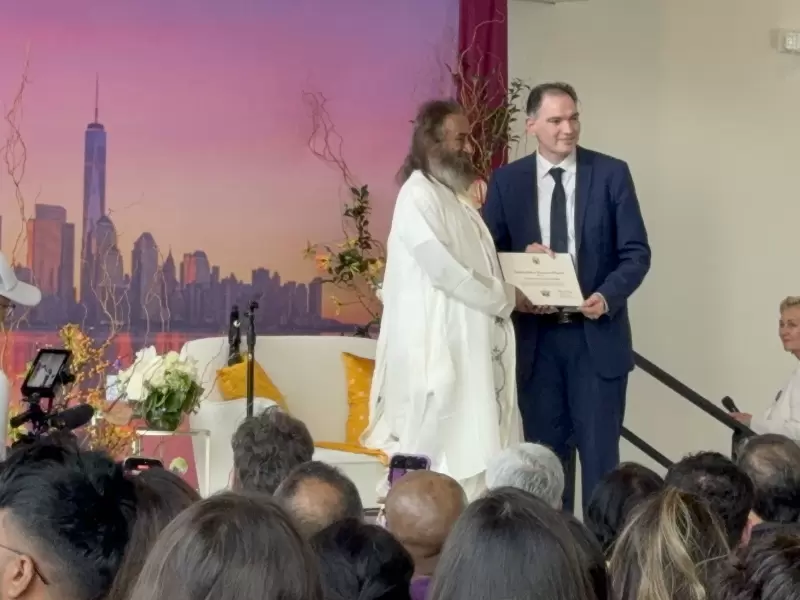 World Meditation Day marked in New York / Lalit K Jha/IANS
A prolonged hush settled over a packed Lower Manhattan hall as hundreds of people closed their eyes, relaxed their shoulders and followed their breath, joining millions across continents in a synchronized meditation led by Art of Living founder Gurudev Sri Sri Ravi Shankar to mark the second World Meditation Day.
The event, attended in person by more than 600 participants and watched by hundreds of thousands online, formed part of a worldwide observance linking dozens of countries, over 50 US cities and multiple levels of government. Speakers described the moment as both symbolic and practical, placing meditation at the centre of a growing global conversation on mental wellbeing.
Guiding the audience gently into stillness, Gurudev Sri Sri Ravi Shankar told participants that meditation did not require eliminating desires or forcing the mind. “You have some passion, you have some desires, but fine, still you can meditate,” he said, urging people to “keep them aside for now” and bring attention softly to breath and body.
ALSO READ: Heartfulness Institute to celebrate World Meditation Day 2025
As the meditation unfolded, he described the practice as a gradual inward journey. “Meditation is a journey from sound to silence, from movement to stillness. From limited awareness to unlimited awareness,” he said, asking participants to relax, smile and simply observe sensations, thoughts and breath without resistance.
Following the 30-minute meditation, several speakers reflected on its contrast with the pace here and the noise of daily life outside.
One speaker noted the striking difference between the calm inside the hall and the “chaos and noise” outside in New York City, noting that rising anxiety and stress have become measurable trends worldwide.
In a major announcement, it was revealed that Art of Living has entered into a partnership with Gallup that a global effort would begin to systematically track wellbeing and meditation across 140 countries, aiming to complement existing measurements of political, economic and social stress with what speakers described as data on “silence” and inner calm.
Organisers said they had received proclamations from nearly 50 cities, with participation happening in over 130 cities across dozens of states. Congressional recognitions were presented to acknowledge Sri Sri Ravi Shankar’s decades-long work in meditation, wellness, and humanitarian service.
One congressional message from Indian American Congressman Raja Krishnamoorthi read into the record designated December 21 as World Meditation Day, citing meditation as “a practical tool for mental wellbeing and peace” and encouraging a nationwide moment of stillness led by Gurudev Sri Sri Ravi Shankar.
Another message described his work in stress management and breathing techniques as having benefited hundreds of millions of people worldwide.
Addressing the audience later, Gurudev Sri Sri Ravi Shankar broadened the message beyond the event.
“Meditation is mental hygiene,” he said, calling it “no longer a luxury” but “a necessity of the time we are in.” He linked inner unrest to wider social conflict, arguing that peace within individuals was essential for harmony in families, communities and nations.
He encouraged participants to act as “ambassadors for meditation,” urging conversations at home, in schools and in communities, and pointing to programs aimed at students, veterans and others under stress. “A few minutes of meditation every day can make a whole lot of difference,” he said.
The United Nations designated World Meditation Day to highlight meditation as a secular, accessible practice for mental wellbeing, resilience and peace.
The Art of Living Foundation, founded by Sri Sri Ravi Shankar in 1981, operates in more than 180 countries, offering programs in meditation, breathing techniques, education and humanitarian relief.
The New York observance reflected a broader international push to address rising mental health challenges through preventive and non-pharmacological approaches, as governments, civil society groups and global institutions increasingly place wellbeing alongside economic and security concerns in public discourse.
Related



ADVERTISEMENT
ADVERTISEMENT
E Paper
Video

Comments
Start the conversation
Become a member of New India Abroad to start commenting.
Sign Up Now
Already have an account? Login