ADVERTISEMENT

ADVERTISEMENT



Winter storm, sub-freezing cold descend on US, from Rockies to Atlantic Coast
Forecasts called for heavy snow, sleet and freezing rain, accompanied by dangerously frigid temperatures, to sweep the eastern two-thirds of the nation, threatening to upend travel and spawn widespread power outages.
-
 Reuters
 - Sat, 24, Jan 2026
- 01:44 EST
- 28
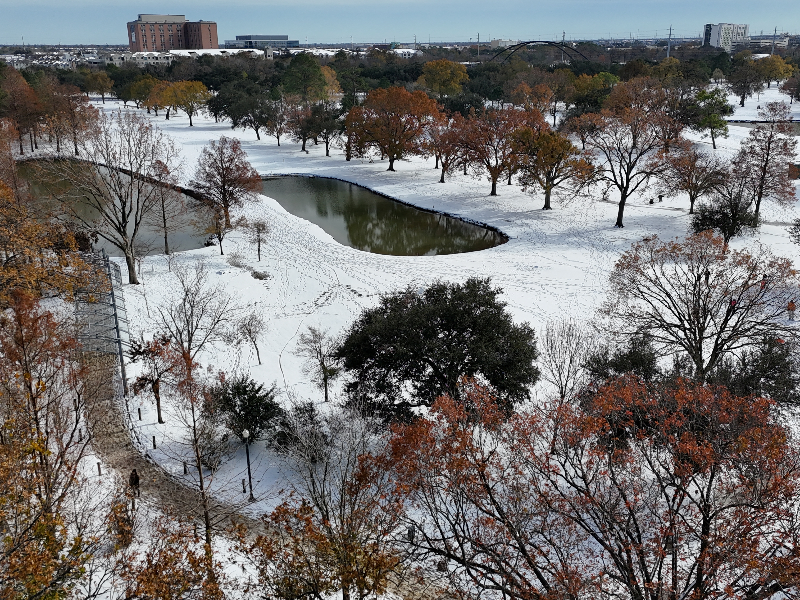 A drone picture shows snow covering Hermann Park in Houston, Texas, U.S. January 21, 2025. / REUTERS/Evan Garcia
Snow fell over parts of Texas, Oklahoma and Kansas on Jan. 23 in a frosty prelude to a monster winter storm expected to converge with bitter Arctic cold and engulf much of the United States over the weekend from the Rockies to the Eastern Seaboard.
Forecasts called for heavy snow, sleet and freezing rain, accompanied by dangerously frigid temperatures, to sweep the eastern two-thirds of the nation, threatening to upend travel and spawn widespread power outages.
At least 14 states and the District of Columbia declared weather emergencies as of Jan. 23 morning, and major U.S. airlines warned passengers to stay alert for abrupt flight changes and cancellations.
"This is a mean storm," said Jacob Asherman, a meteorologist at the U.S. Weather Prediction Center in Maryland, calling it the biggest so far this season in terms of intensity and scope.
'Catastrophic ice storm
Government warnings and advisories for winter storm conditions, ice storms and extreme cold were posted from the southern Rockies east to the mid-Atlantic Coast and New England, encompassing well over 200 million Americans.
ALSO READ: Winter Storm Ezra snarls US travel as meteorologists warn of 'bomb cyclone'
Snowfall totals were likely to exceed a foot in the hardest-hit areas of the Rockies, the Plains, the mid-Atlantic and the Northeast, according to the National Weather Service.
Along the southern fringe of the storm's snow belt, sleet and freezing rain were expected to glaze the southern Plains, the lower Mississippi Valley, Tennessee Valley and the Southeast with "catastrophic" ice accumulations, forecasters said.
The worst was predicted for parts of Louisiana, Mississippi and Tennessee, where ice up to an inch thick was likely to coat tree limbs, power lines and roadways, Asherman said.
Two streams of moisture
Snow began to fall on Jan. 23 over the southern-central Plains and was expected to expand eastward across a broad front, fed by two streams of dense moisture - one blowing in from the Pacific and one welling up from the Gulf of Mexico.
At the same time, a zone of near-record high pressure was migrating out of the Rockies, pulling an Arctic air mass into the U.S. combined with gusty winds, Asherman said.
By Jan. 23, life-threatening wind-chill readings had plunged to below minus 50 degrees Fahrenheit (minus 45 degrees Celsius) in the Dakotas and Minnesota, he said, warning that exposure to such cold without proper clothing "can lead to hypothermia very, very quickly."
"Even in areas where you expect cold weather in January, this is a really dangerous Arctic blast," Asherman said.
Sub-zero conditions were expected to reach as far south as the southern Plains, lower-Mississippi Valley, Ohio Valley and mid-Atlantic into early next week, shattering some record-low temperatures in those regions, forecasters said.
Officials warned that the bone-chilling cold and ice were likely to cause major travel and power disruptions in some areas unaccustomed to heavy winter weather.
'Treacherous very quickly'
"Dallas could see a half-inch of ice," said Brandon Buckingham, a meteorologist with private forecasting company AccuWeather. "This is going to become treacherous very quickly."
Residents should prepare for "power outages lasting at least several days" in areas where ice accumulates, even though the storm is expected to dissipate by early Jan. 26, Buckingham said.
In Oklahoma City, which could see up to 12 inches of snow and a glaze of ice before the weekend is over, Morgan Mayo, a manager at the Not Your Average Joe cafe, said customers were packing in on Jan. 23 morning to escape the frigid outdoors, where the low hit 8 degrees Fahrenheit on Jan. 23 .
"We're going to do our darndest to stay open," even on Jan. 24, when the high was expected to be just 10 degrees, Mayo said. "We have several employees who live in walking distance and are willing to brave the storm."
The forecast in Texas was reminiscent of a 2021 ice storm that cut power to nearly 40 percent of the state's energy grid and left more than 2.7 million people without electricity for days. That storm was blamed for more than 200 deaths, most due to exposure to the cold.
The state’s largest electrical grid operator, the Electric Reliability Council of Texas (ERCOT), said it is ready for this weekend's storm and expects “sufficient generation to meet demand this winter.”
In the nation's capital, with 4 to 8 inches of snow forecast, D.C. Mayor Muriel Bowser asked the National Guard to provide high-clearance vehicles to ensure first responders could effectively move through the District.
The storm represents the first major test for New York City Mayor Zohran Mamdani, who took office just weeks ago. He told local news station NY1 on Jan. 23 the city's sanitation workforce would transform into "the nation’s largest snow-fighting operation" in advance of the heavy snowfall expected on Jan. 25.
Discover more at New India Abroad.
Related










ADVERTISEMENT
ADVERTISEMENT
E Paper
Video

Comments
Start the conversation
Become a member of New India Abroad to start commenting.
Sign Up Now
Already have an account? Login