ADVERTISEMENT

ADVERTISEMENT



When political power dressed differently in New York
New York’s new power couple quietly disrupted political style, from an Assam silk tie to archival coats.
-
1759953093.png) Staff Reporter
Staff Reporter - Sun, 11, Jan 2026
- 00:00 EST
- 14
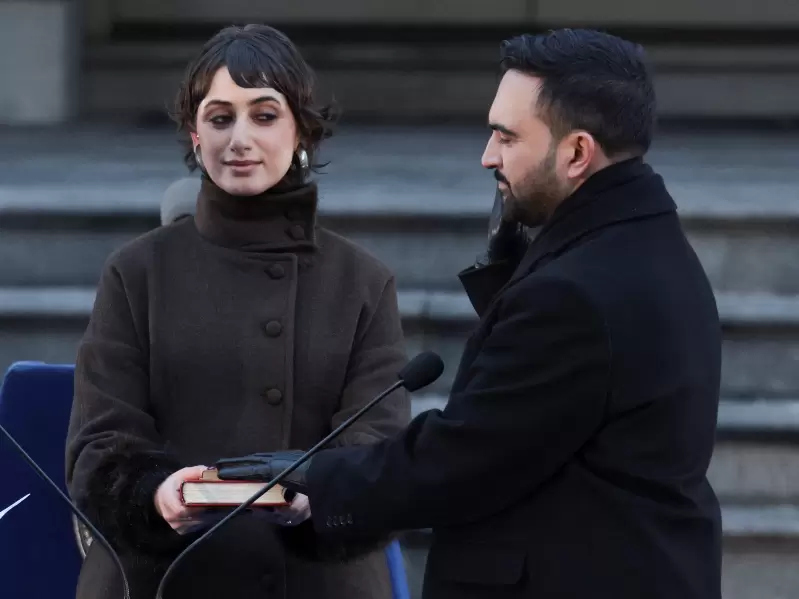 New York City Mayor Zohran Mamdani and his wife Rama Duwaji speak during his inauguration ceremony in New York City, U.S., January 1, 2026. / REUTERS/Kylie Cooper
For decades, American political power has dressed itself in certainty. Think Italian silk ties, heavy Windsor knots, red or navy as shorthand for authority. From Italo Ferretti to Brioni to Ralph Lauren, the look is designed to reassure: tradition intact, hierarchy respected. That visual language is so entrenched that when it changes—even subtly—it can feel seismic.
That’s why the first moments of Zohran Mamdani’s mayoralty landed with such unexpected fashion electricity. Yes, there was the tie: a handwoven silk jacquard from Assam, created by 26-year-old New Delhi–based designer Kartik Kumra under his label Kartik Research. The floral motif nodded quietly to history, craft, and immigrant lineage, not status signaling. But the real gasp came from someone standing beside him.
Rama Duwaji, New York’s new first lady, didn’t just dress differently. She reframed what political fashion could mean.
As Vogue reported, Duwaji’s New Year’s Day looks were rooted in “her own authentic personal aesthetic and values, drawing from vintage and independent designers,” with credits that carried an unusual but pointed note: “On loan.” For the intimate midnight swearing-in at the Old City Hall subway station, Duwaji wore a vintage funnel-neck wool Balenciaga coat rented from Albright Fashion Library, paired with sculptural gold earrings from New York Vintage. She grounded the look with wide-leg shorts from The Frankie Shop and lace-up Shelley boots from London-based brand Miista.
For the public inauguration later that day, the tone shifted but the intention remained. Duwaji stepped out in a chocolate-brown, faux-fur–trimmed funnel-neck coat by Renaissance Renaissance, designed by Palestinian-Lebanese designer Cynthia Merhej. The piece was a custom reworking from the label’s fall 2023 collection, styled with coffee-brown lace-up boots and simple silver hoop earrings. As Gabriella Karefa-Johnson, Duwaji’s stylist, put it succinctly: “Regal in the punkest way.”
Karefa-Johnson later explained that while Duwaji “doesn’t technically need a stylist,” her role was to help “translate her” for a moment of public symbolism. That translation leaned into renting, borrowing, and archival pulls—standard practice in fashion, but rarely made this explicit in political life.
Vogue underscored the significance of that transparency, noting that the emphasis on borrowing and renting “tells a story” about sustainability, circular fashion, and support for small, independent businesses. It also preempted the familiar backlash that greets women in public life over cost and consumption.
Together, Mamdani and Duwaji offered a subtle, but profound shift in power dressing. Instead of authority expressed through ownership and excess, their style spoke in the language of intention, history, and shared culture. It didn’t shout. It resonated—and for American politics, that quiet confidence may be the most disruptive look yet.
Related









ADVERTISEMENT
ADVERTISEMENT
E Paper
Video

Comments
Start the conversation
Become a member of New India Abroad to start commenting.
Sign Up Now
Already have an account? Login