ADVERTISEMENT
ADVERTISEMENT


Makalkandi Massacre: A Hindu Village Destroyed in 1971
The village was attacked on August 18, 1971, while its Hindu residents were gathered for the worship of Manasa and Chandi. More than a hundred people were killed, women were subjected to sexual violence, homes were looted and burned, and the community's temple became one of the principal sites of the massacre.
-
 Dr. Vinay Nalwa
 - Sun, 23, Aug 2026
- 01:14 EDT
- 40
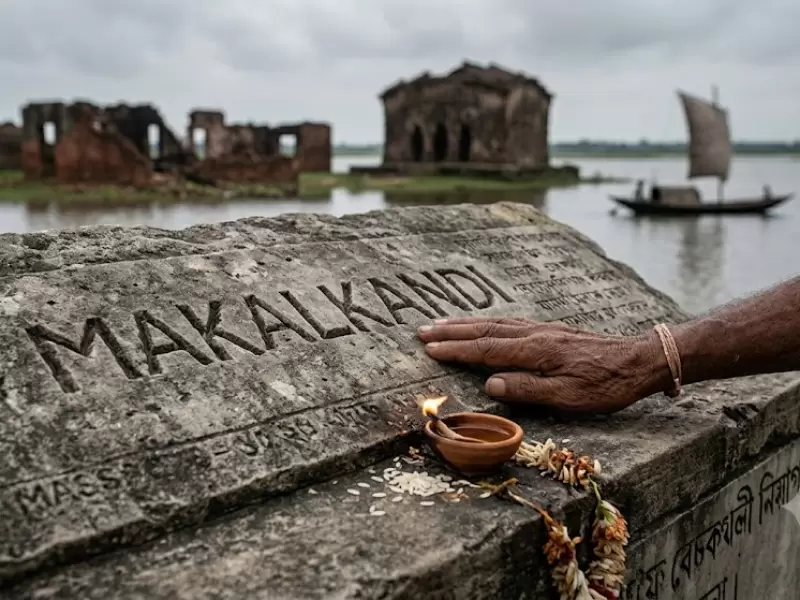 Representative Image / Generated using AI
The killings of Hindus in Bangladesh continue to surface in reports from different parts of the country, decades after the Liberation War. During the first six months of 2026, the Bangladesh Hindu Buddhist Christian Unity Council reported 257 incidents of communal violence, including 44 deaths, 62 attacks involving places of worship, and 47 attacks on homes and business establishments.
The council said its figures were compiled from media reports and its own documentation. Other authorities and observers have differed over how particular incidents should be classified, and not every crime involving a Hindu victim can automatically be described as communal. Yet the continuing debate over classification does not erase the larger question of how violence, insecurity, displacement and property loss affect a religious minority over time.
That question gives the history of Makalkandi a contemporary relevance. The village was attacked on August 18, 1971, while its Hindu residents were gathered for the worship of Manasa and Chandi. More than a hundred people were killed, women were subjected to sexual violence, homes were looted and burned, and the community's temple became one of the principal sites of the massacre.
What followed was not simply the loss of lives. Displacement, the destruction of property and the weakening of the surviving community continued long after the shooting stopped.
Makalkandi was situated within Kagapasha Union of Baniachang Upazila in present-day Habiganj District. The settlement lay within a large marshland, or haor, covering roughly thirty-five square miles. The surrounding waters extended approximately seven miles from north to south and five miles from east to west. For the village's Hindu residents, this geography appeared to provide a natural barrier against the violence spreading across East Pakistan. Around 1,500 Hindus lived there, joined by displaced families from neighbouring hamlets and the family of regional legislator Gopal Krishna Maharatna.
Makalkandi was also a comparatively prosperous and educated community. Accounts of the village describe a literacy rate of around thirty-five percent and residents who included engineers, doctors and professors. Its houses were predominantly permanent structures, with no thatched huts reported in the settlement. Agriculture, education and economic stability had given the community a strong social foundation. Its physical isolation and relative prosperity contributed to the belief that its residents could remain where they were rather than attempt the dangerous journey to India.
That confidence was strengthened by assurances from local leadership. Syed Fazlul Haque, a prominent figure from nearby Baniachang who headed the regional Peace Committee and was associated with the Razakar auxiliary force, reportedly assured Hindu residents that they would remain safe. Trusting these assurances, many villagers chose not to leave. According to accounts of the massacre, however, Haque subsequently met Pakistani military commanders on August 17 and encouraged an attack on Makalkandi. The following morning, Pakistani soldiers led by Major Durrani, accompanied by local personnel including Zainal Abedin and Haque himself, navigated forty to fifty boats through the Suta River toward the village.
The attack began at about nine in the morning. Residents were preparing for Manasa and Chandi Puja, while worshippers at the century-old Chandi Mandap were cleaning the brass deities and children were gathering flowers. The approaching boats opened fire on the settlement. Soldiers entered the temple courtyard, seized families and lined villagers up near the Mandap. In one group of twelve people, eleven were killed. Kangsa Mohan Das survived after being shot four times and was left unconscious beneath the bodies of those around him. The violence then spread from house to house as fleeing civilians were pursued and attacked. Women were subjected to rape and physical violence, homes were looted, and the settlement was eventually set on fire. Contemporary accounts describe the troops as having machine-gun fire erupted directly from the approaching fleet into the defenseless crowd. The original account also records that the troops doused the entire prosperous settlement in petrol and set it ablaze, reducing ancestral homes to ashes.
The human cost of the massacre was severe. More than 140 people were reportedly killed during the assault itself. Among the individual cases was that of three-month-old Kanu, who was taken from his mother Minati Rani Chowdhury, shot and stabbed with a bayonet before being thrown into the surrounding waters. Minati suffered profound physical and psychological trauma. Gopal Ranjan Chowdhury reportedly lost eleven members of his family. Around forty villagers escaped by swimming through the marshes despite gunshot and bayonet wounds, while others died before receiving medical treatment.
The suffering continued after survivors reached India. More than three hundred displaced villagers who made their way to refugee camps reportedly died from cholera, exposure and severe malnutrition. When survivors returned after the war, they encountered the remains of a community that had been physically and spiritually devastated. Karuna Sindhu Chowdhury reportedly found unburied and uncremated human remains scattered around the desecrated temple grounds. Members of the surviving community collected the remains and placed them together in a mass grave. For a Hindu community, the absence of cremation and the condition in which the dead were found added another dimension to the destruction.
Makalkandi was part of the much wider violence that accompanied the 1971 war. The scale of the conflict has been documented in judicial proceedings, contemporary international reporting and memoirs of Pakistani military leaders.
The International Crimes Tribunal-1 recorded extensive findings concerning killings, sexual violence and mass displacement of civilians. Contemporary accounts cited in those proceedings included reporting from the Washington Evening Star and statements in the United States Congressional Record by Senator Edward Kennedy. The historical record has also been discussed in Pakistani military memoirs, including General Niazi's The Betrayal of East Pakistan and Ayub Khan's Friends Not Masters. The scale of the broader conflict should not, however, obscure the specific experience of communities such as Makalkandi, where the violence acquired a distinctly local character.
The destruction did not end with the war. In the years following independence, land belonging to families who had been killed or displaced became vulnerable to appropriation. The surviving owners faced intimidation, economic hardship and the practical difficulty of recovering property in a transformed local environment. Some eventually sold ancestral holdings for nominal amounts and left permanently. The massacre therefore produced consequences extending beyond the immediate death toll: it weakened the economic base that could have enabled the community to rebuild and contributed to the long-term dispersal of its survivors. For thirty-seven years, there was no formal monument marking the tragedy. In 2008, a memorial pillar was erected with the assistance of local administrator Noor-e-Alam Siddiqui, bearing a modest memorial pillar bearing eighty-five confirmed victim names.
The demographic history of the surrounding region provides another layer of context. According to official government data from the 2022 Census of Bangladesh, Hindus constitute 15.86 percent of Habiganj District's population, numbering 374,104 out of 2,358,886 residents. Sylhet Division has a Hindu share of 13.51 percent, higher than the national average. Yet the national proportion of Hindus has declined sharply over the past century. Census figures cited in the article place the Hindu share at 33 percent in 1901 and 28 percent in 1941, before recording approximately 13.5 percent in 1974, 8.54 percent in 2011 and 7.95 percent, or 13.13 million people, in 2022.
The significance of Makalkandi can therefore be understood beyond the number of people killed on August 18, 1971. Violence against a minority community can have several layers. There is the immediate destruction of life, followed by displacement, the loss of homes and property, the destruction of religious institutions and the weakening of family and community networks. When these consequences persist, the effect can become demographic as well as physical. A community may survive in individual families while gradually losing the economic, social and geographic foundations that once enabled it to remain concentrated in its ancestral locality.
Makalkandi also demonstrates the vulnerability created when trust in local protection becomes a substitute for physical security. The villagers believed that their isolation and assurances from local leaders would shield them from the war. Instead, the same local networks that appeared to provide protection became part of the mechanism through which the attackers reached the settlement. The destruction of the Chandi Mandap, the burning of homes and the subsequent loss of land meant that the attack affected not only bodies but also the physical and symbolic landscape in which the community had lived.
More than five decades later, reports of violence against Hindus in Bangladesh give the history of Makalkandi renewed relevance. The point is not to equate every present-day crime with a 1971 massacre, nor to assume that every killing of a Hindu has a communal motive. The distinction matters. But continuing reports of killings, attacks on places of worship, damage to homes and businesses, threats and alleged land grabbing make it necessary to examine minority security not only through individual criminal cases but also through their cumulative effect on a community. The Bangladesh Hindu Buddhist Christian Unity Council's 2026 figures, for example, include not only deaths but attacks on places of worship, homes, businesses and property. Its 2026 report should therefore be understood as the council's documented account rather than as an uncontested government classification of every incident.
That is ultimately why Makalkandi deserves to be remembered beyond the date of August 18. The massacre was a moment of extreme violence, but its consequences unfolded over years through displacement, bereavement, loss of property and the weakening of a once-established Hindu settlement. Remembering the victims therefore requires more than recording how they died. It requires asking what happened to their homes, their temple, their land, their families and the community that survived them.
Makalkandi is consequently not only a story about how Hindus were killed in 1971. It is also a story about what happens after the killing: who remains, who leaves, who loses ancestral land, who restores the sacred space, and whether the next generation can continue to live where its ancestors lived for generations. In that sense, the village remains part of a much larger history of minority vulnerability in Bangladesh, a history whose consequences are still visible today.
(The views and opinions expressed in this article are those of the author and do not necessarily reflect the official policy or position of New India Abroad.)
Discover more at New India Abroad.
Leave A Comment
Related







ADVERTISEMENT

ADVERTISEMENT
E Paper
Video

Comments
Start the conversation
Become a member of New India Abroad to start commenting.
Sign Up Now
Already have an account? Login