ADVERTISEMENT
ADVERTISEMENT



Avtar "Tari" gifts Sikh Union Club brand new deep blue synthetic surface
Acknowledged the world over as a “Sikh icon of global hockey”, Avtar is known to think, eat, sleep and live with hockey.
-
 Prabhjot Paul Singh
 - Fri, 08, May 2026
- 17:34 EDT
- 415
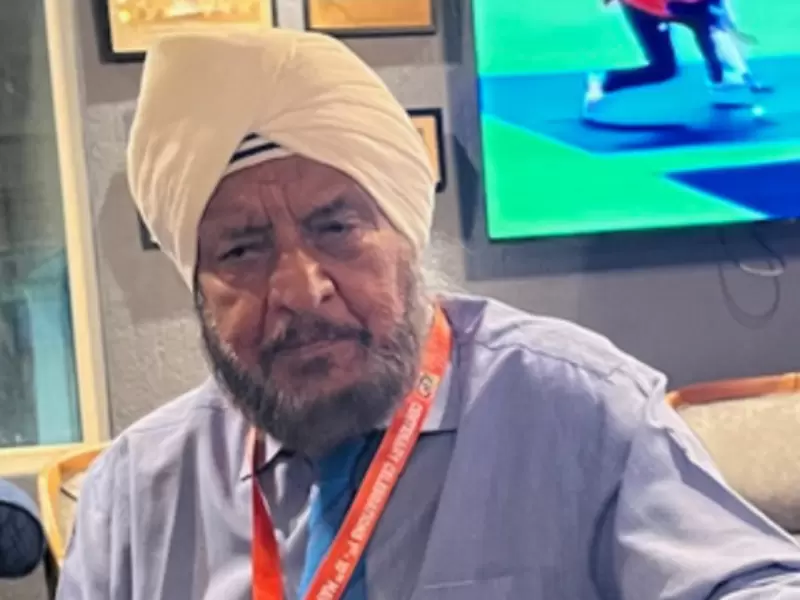 Avtar Singh Sohal / Maninder K. Chandhoke
The word “Avtar” or "avatar" comes from the Sanskrit word “Avatara”, meaning "descent." It is formed from the Sanskrit prefix ava ("down") and the root tar ("to cross over"). In its original Indian context, it refers to the physical manifestation of a deity, like Vishnu, a principal deity in Hinduism, worshipped as the preserver and protector of the universe, descending to Earth.
In 1938, a healthy and robust baby boy was born to Pyara Singh and Parmesari Kaur in Nairobi, they named him “Avtar” without ever realizing that this boy would dominate the world hockey horizon, not only as an Olympian, as a Coach, as an Umpire, as a Technical Official or Judge, but also true to mythological meaning of the word, as a great protector or promotor of the game.
Also Read: New documentary to follow world’s first desi basketball team
Hockey, though of British origin, has always witnessed Sikh domination. Balbirs, for example, were on the centre stage from the time India got independence in 1947. The tallest of the seven Balbirs who played for India, Balbir Singh Dosanjh, or Balbir Singh Senior, whose record of scoring the maximum number of goals in an Olympic final is still intact.
Incidentally, eight-time Olympic champion India had players with names starting with each of the letters of the alphabet, but to date, only one Avtar Sinh, a judoka, has represented India in Olympic Games but not with worth mention performance. No other Avtar Singh has donned the Indian colours in the Olympic Games.
And Avtar Singh Sohal happens to be one of three “Avtars” who won laurels at the global level. Avtar Singh Bhurji played for Uganda in the 1972 Munich Olympic Games. Unfortunately, we lost him some months ago. The third Avtar represented Malaysia in the 1976 Montreal Olympic Games. Incidentally, it was in Montreal that the Kenyan hockey team had to walk out of the Olympic village in protest against the participation of “apartheid” South Africa.
Incidentally, he was born in proximity of the historic Sikh Union Club in Nairobi. His father, who served Royal Air Force, encouraged him to take up sports. Initially, Avtar, “Tari” to his friends, fiddled with the idea of playing cricket.
Tall and lanky with powerful wrists, his hitting prowess made him the first choice both as a batter in cricket and a deep defender in hockey.
Avtar Singh, who was at his peak in the late 60s and early 70s, witnessed, after the Montreal Olympic Games, complete – Moscow 1980 – to partial – Los Angeles 1984 – boycotts. These boycotts did impact his Olympic career. Otherwise, his Olympic legacy would have been unsurpassable. But for these boycotts, he could have extended his playing career.
His love and passion for hockey could not keep him away from the ground.
Acknowledged the world over as a “Sikh icon of global hockey”, Avtar is known to think, eat, sleep and live with hockey. No day is complete when he is not going to the hockey ground. What else could substantiate his love and passion for hockey that, after a record representation in six Olympic Games – four as a player, once as a coach of the Kenyan Olympic team (1984) and once as a Technical Judge (1988) – he has hardly missed any major FIH global event, be it Olympics or World Cups. All these years, at least for last over 50 years, his wife, Ripudaman Kaur of Chandigarh, was his solid support.
As ill luck would have it, he lost his life companion some weeks ago. He had taken her to India for treatment, he may have returned home empty-handed but still with a cause very dear to his heart – a deep blue brand new surface at Dasmesh Hockey Stadium of Sikh Union Club. Come what may, Avtar Singh Tari is there every day working with those undertaking the installation work.
This brand new surface has been made possible by donations from my friends the world over. No one could imagine that millions of dollars would pour in for this project that would help and take Kenyan hockey far ahead in coming years and decades, says sentimental Avtar Singh Tari.
At times, he gets emotional, failing to conceal his anguish, pain and loneliness, saying “we thought after the deep blue surface project, we would retire from hockey and live a retired life. We were wrong. God wished otherwise and has put me a greater test. I hope I keep my commitment to my wife and get the new surface operational in this centenary year of Sikh Union Club.”
He recalls that initially many suggestions came that an old deep blue surface would be ideal for the Club as the new surface would need tonnes of money. But our trust and faith in Gurdwara Reetha Sahib and our hardcore friends saw us accomplish this project in style. “Now it is there for all to see,” says Avtar Singh Tari, standing next to the new surface getting final touches.
He gets little sad as a former International Hockey Federation (FIH) chief, Leandro Negre, was forced to cancel his programme to attend the inauguration of deep blue surface because of illness of his wife. “He has been a great friend and I wanted him to come,” regrets Avtar Singh Tari.
Also Read: Cricket Canada appoints Monty Desai as men’s team head coach
Some other legends he specially invited for the inaugural ceremony included Indian stars of yesteryears, including Harbinder Singh and Ajit Pal Singh, besides a few friends from Pakistan. “Age is catching with them all. Some regretted because age does not allow them to travel long distances. They all, however, have been my support and sent their best wishes to the success of this mission.”
A book on life and achievements of Avtar Singh Tari has been compiled by his trusted lieutenant Daljinder (Del) Mudher. Though it was initially scheduled to be released with along with the inauguration of the new surface. Now, it will be released at a separate exclusive function. It contains articles by longtime friends, associates and hockey writers who have seen and remained associated with his nearly seven-decade long hockey journey.
Coming to his early days, he started playing hockey at City Primary School in Nairobi at the age of 7, and 10 years later, as a budding youngster, he was blooded into the Sikh Union Club. Two years later, he got his first international cap when he represented British Kenya against South Africa in Nairobi.
When he turned 21, he played a key role in creating the history of the Sikh Union Club. He played a key role in the maiden title triumph of his parental Club in the M.R. D’Souza Gold Cup.
Recognition of his talent as one of the best deep defenders came in 1960 when his Olympic journey started in Rome. His first game for British Kenya was against Pakistan. In 1962, his leadership abilities were recognised as he was chosen to lead British Kenya against Pakistan.
He then went on to lead Kenya in the 1964 Tokyo Olympic Games, the 1968 Mexico Olympic Games (this was one Olympic Games, where a maximum number of Sikh players participated) and played his fourth consecutive Olympic Games in Munich in 1972. This was his third as captain.
He retired from international competitive hockey in 1978 at the age of 40 but continued his association with the game, first as a Coach and later as an umpire. After boycotts rocked the Olympics in 1976, 1980 and 1984, Avtar Singh Sohal took over as Chief Coach of the Kenyan Olympic hockey team in the Los Angeles Olympic Games. Four years later, he was back at the Seoul Olympic Games, his sixth, this time as an FIH Judge.
Avtar Singh Sohal also holds the distinction of coaching national teams of Kenya, Indonesia, and Zimbabwe.
Synonymous with Olympics and hockey, Avtar Singh Sohal, even in his late 80s, remains seriously devoted to a game that made him rub shoulders with some of the greatest hockey Olympians of not only the 60s, 70s and 80s but also of the present times. He recalls playing with some of the greatest Indian players - Prithipal Singh, Gurbux Singh Kohli, Leslie Claudius, Joginder Singh, Harbinder Singh – and Pakistani hockey legends like Tanveer Dar, Shahnaz Hussain, Islah Uddin, Akhtar Rasool and Hassan Sardar.
His only regret has been that he never got on the podium as the team led by him before the 1972 Olympic Games had beaten some of the best teams of the time, including Germany, India and Pakistan. He was close to getting a World Cup medal in 1971 when Kenya played the losing semi-finalist game against India and lost 0-1.
He has donated all his belongings – from his playing uniform, sticks, trophies, medals and other paraphernalia -- to a section of the Sikh Union Club where it is being preserved as the Avtar Singh Sohal gallery.
As a devout Sikh, Avtar and his wife had taken upon themselves the onerous task of doing “Sewa” at Gurdwara Reetha Sahib in India, where they spend a couple of months every year. After she died in a Chandigarh hospital, her Antim Ardas was solemnised at Gurdwara Reetha Sahib in Uttarakhand, India.
Discover more at New India Abroad.
Leave A Comment
Related







ADVERTISEMENT

ADVERTISEMENT
E Paper
Video

Comments
Start the conversation
Become a member of New India Abroad to start commenting.
Sign Up Now
Already have an account? Login