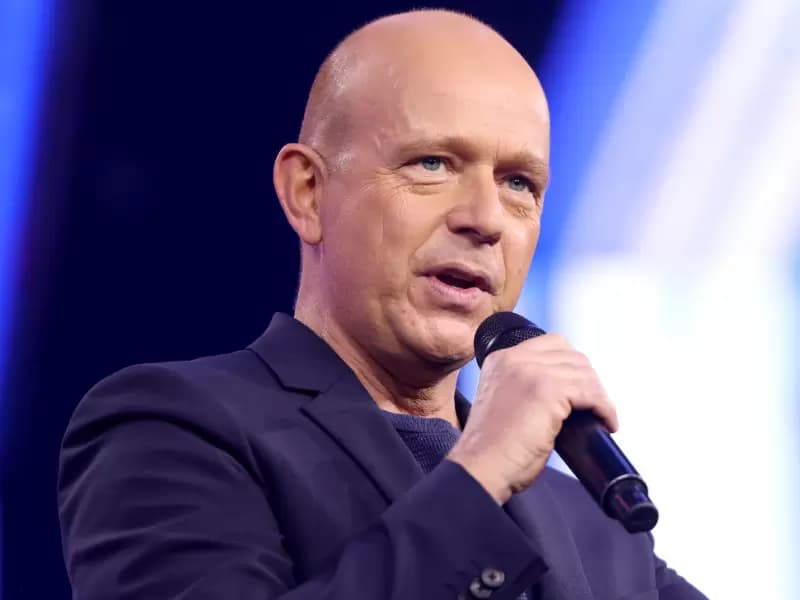
Steve Hilton / Wikipedia
Steve Hilton, the Republican candidate for governor, speaks urgently about enforcing laws and fighting crime. Hilton sees the everyday consequences of California becoming “soft on crime.”
The exhausted store owner who stops reporting theft because nothing happens.
The mother afraid to let her child take public transit alone.
The police officer who feels unsupported.
The immigrant family that worked hard to build stability, only to watch neighborhoods deteriorate around them.
“This is really about restoring the ladder of opportunity,” Hilton said during a one-on-one conversation with ethnic media journalists organized by American Community Media. “We need to deter crime and prosecute crime very strongly.”
He connected hate crimes directly to the broader crime debate.
“My policy against hate crimes is my policy against crime,” he said.
In Hilton’s view, California’s approach has become dangerously permissive. He argued that prison closures, overcrowded county jails, weakened sentencing, and low morale within law enforcement have created a cascading system failure.
Consequences have disappeared.
He painted a picture of a state where consequences have disappeared.
“When law enforcement feels that nothing’s going to happen,” he said, “what’s the point in actually going after criminals?”
But for Hilton, law enforcement does not stop at state crime policy. It extends directly into immigration enforcement and California’s relationship with the federal government.
On immigration, Hilton drew a sharp distinction between legal and undocumented immigration,
On immigration, Hilton drew a sharp distinction between legal and undocumented immigration, repeatedly describing himself as “a candidate of the legal immigrant community.”
An immigrant himself, born in England to Hungarian refugee parents, Hilton spoke about growing up in a working-class immigrant household and about the opportunities he believes California once offered immigrant families.
But he also argued that California should not obstruct federal immigration enforcement.
“The laws must be peacefully enforced,” Hilton said. “We will not obstruct the implementation of federal immigration law.”
That position could place him in direct contrast with California’s sanctuary-state policies and years of political resistance to federal immigration crackdowns.
Hilton framed the issue not simply as politics, but as constitutional order.
“The question for the next governor of California is,” he said, “are you going to actively work against the results of the 2024 election when it comes to immigration policy or not?”
He argued that immigration enforcement is fundamentally a federal responsibility and suggested California’s current confrontational approach has deepened public division and instability.
At the same time, Hilton rejected the idea that stricter enforcement means being “against immigrants.”
“We are pro-immigration,” he said, “but it has to be legal immigration.”
That distinction, between support for immigrants and support for undocumented immigration, appears central to his political strategy.
For many Californians, especially within immigrant communities, the issue is deeply layered and emotionally complicated.
California’s farms, restaurants, warehouses, construction sites, and caregiving industries depend heavily on undocumented labor. During the discussion, one journalist pointed out that a large percentage of California’s agricultural workforce is undocumented and questioned what mass deportations would mean for the state economy.
Hilton responded by arguing that California has normalized an unhealthy dependence on illegal labor while millions of working-age Californians remain unemployed or outside the workforce.
“We have between four and five million California adults who could be working but are not working,” he said.
He also pointed toward automation in agriculture as part of California’s future and criticized regulations that, in his view, slow technological modernization.
Still, it was clear that Hilton sees immigration enforcement and crime enforcement as connected parts of the same larger philosophy: that laws must carry consequences in order for society to function fairly.
In countless ethnic communities across California, safety is not an ideological issue. It is deeply practical.
It is the grandmother who no longer feels comfortable walking to the temple before sunrise.
It is the Sikh gas station owner installing another layer of security glass.
It is the Korean shopkeeper calculating whether repeated thefts are still survivable.
It is the Latino family wondering whether their children are safer staying indoors than playing outside.
These are not culture-war debates. They are quality-of-life calculations.
Hilton spoke about “the California dream,” but his definition is less romantic than economic: stable neighborhoods, functioning schools, affordable housing, and confidence that laws matter.
Hilton’s crime agenda focus on rehabilitation and repeat offenders
Hilton's argument is that none of those things survive if public safety collapses, or if the government selectively enforces laws.
But Hilton’s crime agenda is not solely punitive. Some of his strongest comments focused on rehabilitation and repeat offenders.
“A large proportion of crime is repeat crime,” he said. “That’s why we need proper rehabilitation in our system.”
He cited California’s high recidivism rates and contrasted them with states like Virginia, where repeat offense rates are significantly lower. He also raised issues rarely heard in conservative law-and-order speeches, including undiagnosed dyslexia and educational failure among prison populations.
“We need to be tough on crime and tough on the causes of crime,” Hilton said, borrowing a phrase from former British Prime Minister Tony Blair.
That combination, punishment alongside rehabilitation, may become central to how Hilton tries to broaden his appeal in a state where Republicans have struggled statewide for years.
Still, his proposals are certain to ignite fierce opposition.
Hilton wants to reverse prison closure policies. He argues that moving inmates into overcrowded county systems has weakened local enforcement and reduced accountability. Critics will almost certainly argue that California’s incarceration history already disproportionately harmed Black and Latino communities and that expanding prison capacity risks repeating old mistakes.
His immigration positions are also likely to intensify debate in a state where many mixed-status families already live with fear and uncertainty.
But Hilton’s political calculation appears clear: Californians are exhausted.
Exhausted by retail theft videos.
Exhausted by fentanyl deaths.
Exhausted by rising insurance costs, encampments, vandalism, and the sense that basic order is slipping away.
And Hilton is betting that voters, including immigrant voters, may now prioritize safety, order, and affordability over ideology.
Throughout the discussion, one theme quietly surfaced beneath all the policy arguments: dignity.
Hilton repeatedly described a California where people who work hard feel invisible while systems reward dysfunction. Whether speaking about welfare dependency, failing schools, illegal immigration, or crime, he returned to the same emotional framework, fairness.
“If you work really hard,” he asked at one point, “why should you subsidize somebody else not to work?”
Discover more at New India Abroad.
ADVERTISEMENT
ADVERTISEMENT
Comments
Start the conversation
Become a member of New India Abroad to start commenting.
Sign Up Now
Already have an account? Login