ADVERTISEMENT
ADVERTISEMENT



How Curtis Chin Uses Food to Bridge American Divides
Chin discussed his celebrated memoir, Everything I Learned I Learned in a Chinese Restaurant, in a recent media briefing hosted by American Community Media Services
-
 Ritu Marwah
 - Fri, 29, May 2026
- 03:27 EDT
- 88
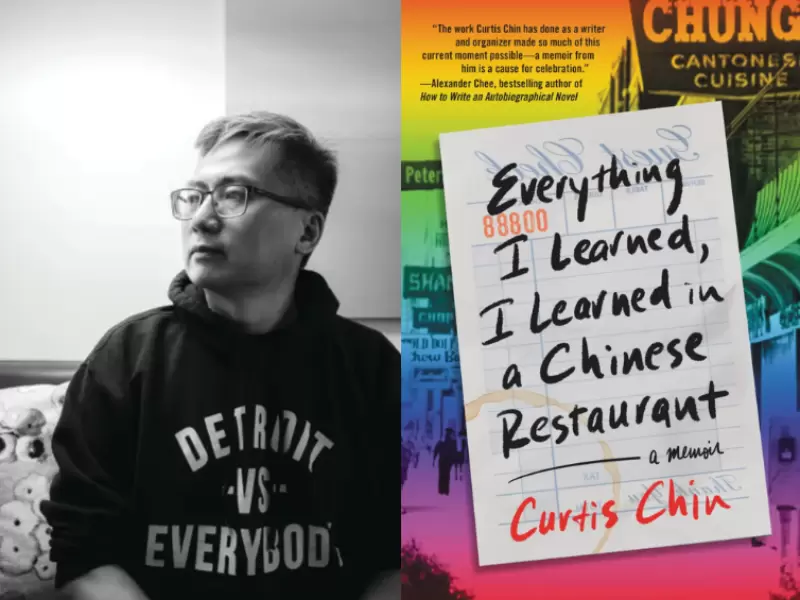 Curtis Chin and the cover of this book / Hachette
In an era deeply fractured by political silos and cultural divisions, filmmaker and author Curtis Chin believes the antidote to America’s social ailments might just be found at your local Chinese restaurant.
Speaking at a recent media briefing hosted by American Community Media Services, Chin discussed his celebrated memoir, Everything I Learned I Learned in a Chinese Restaurant. The book chronicles his experience growing up gay and Chinese American in 1980s Detroit while working at his family’s iconic restaurant, Chung’s Cantonese Cuisine.
Using his family’s multi-generational immigration saga as a lens, Chin offers a timely, humorous, and incisive reflection on who gets to define the American identity.
A Detroit Institution Built on 10 Million Egg Rolls
To understand Chin’s perspective, one must understand the sheer scale of Chung’s Cantonese Cuisine’s presence in Detroit. Founded in 1940, the restaurant was a culinary and cultural anchor in the inner city for decades.
"I start off my presentations by asking people to guess how many egg rolls you think we sold in the 65 years we were open," Chin shared. The staggering answer? Over 10 million egg rolls, all meticulously handmade by his grandmother, mother, and aunties.
But while life inside the restaurant was filled with the savory aromas of plum sauce, barbecue pork, and almond cookies, the world just outside its doors was grappling with immense trauma. The 1980s in Detroit were defined by the decline of the American auto industry, the crack cocaine epidemic, the devastating onset of the AIDS crisis, and rampant urban violence.
"I personally knew five people murdered by the time I was 18 years old," Chin noted. Yet, amidst the turmoil, his parents managed to raise six children in a sanctuary of hospitality. "Writing the book is a thank you to my parents... but it's also a hat tip to my hometown of Detroit. I wanted to show that Detroit was still capable of producing good things like me."
Deep Roots in the American Midwest
A central mission of Chin's memoir is rewriting the geography of Asian American history, which popular culture frequently confines to the West Coast or New York. Chin’s great-great-grandfather, Gong Le Chin, arrived in the United States in the late 1800s. After a brief, misguided stop in Canton, Ohio, erroneously hoping to find fellow Chinese immigrants, he migrated north to Detroit.
Faced with severe discrimination that barred him from working in the emerging auto factories, he opened a hand laundry business. This entrepreneurial pivot proved historic. When the U.S. enacted the Chinese Exclusion Act of 1882, the first federal law restricting immigration based explicitly on nationality, it carved out rare exceptions for students and business owners. Because Gong Le Chin owned his laundromat, he was legally permitted to sponsor his child and grandchild, anchoring the Chin family in Michigan for over a century.
"We were in Detroit before there was a Ford Motor Company, before there was Motown music," Chin explained. He notes that sharing this deep Midwestern lineage fundamentally shifts how people perceive him on his tours, disrupting the perpetual stereotype of Asian Americans as "foreigners."
From the Murder of Vincent Chin to Modern Coalitions
Growing up in Detroit also meant witnessing one of the most foundational catalysts of the modern Asian American civil rights movement: the 1982 murder of Vincent Chin (no relation).
Vincent Chin, a young Chinese American, was brutally beaten to death with a baseball bat by two white auto workers who blamed him for the economic anxieties caused by the rise of Japanese automakers. The killers were famously let off with a $3,000 fine and zero jail time.
When asked whether the U.S. has failed to retain the painful lessons of 1982 in light of the recent surge in anti-Asian hate crimes, Chin offered a nuanced view. While the xenophobic rhetoric remains frustratingly identical, he argues the community's internal infrastructure has transformed exponentially.
"Back then, there were no Asian American journalists out there saying, 'This is an important story to cover.' It took the media 12 whole days before they wrote about that story in Detroit," Chin said. "Nowadays, we have Asian American journalists in newsrooms uplifting stories... We have Asian American politicians, nonprofits doing victim advocacy work, and celebrities using their platforms."
Rather than viewing the aftermath of the Vincent Chin murder as a sudden "turning point," Chin characterizes it as an acceleration of an existing pan-Asian coalition that had already been quietly building solidarity through shared business and cultural networks in Detroit.
"Come for the Egg Rolls, Stay for the Talk on Racism"
Currently traveling through a 30-city tour as part of The Great Michigan Read program, Chin has taken his book across the United States and to 10 countries abroad. The tour has forced him to navigate America's complex political landscape, moving from majority-Black urban spaces like Detroit to rural, deeply conservative regions.
Chin intentionally structures his book to mirror Chinese numerological traditions of luck, dividing it into three sections of eight stories each (888). Through these narratives, he balances heavy themes of structural inequality with a lightness of spirit designed to engage the "curious middle" of the American electorate.
"When someone hears there's a book about a gay Asian in Detroit, a third of the country goes 'Yay!' and a third goes 'Ban that book,'" Chin joked. "But there’s a third of the country in the middle. They’re curious... I want to talk to those people and say, 'Look, you have a choice to make.' I’m presenting a multicultural vision of America where people are grappling with difficult issues of how do we get along, but at the end of the day coming together in love, support, and respect."
For Chin, the ultimate symbol of this democratic potential remains the humble dining booth. In a segregated society, the Chinese restaurant operates as a rare, egalitarian clearinghouse where diverse socio-economic, racial, and religious groups sit under one roof.
"If we could just take that opportunity to lean across the table and ask the person next to you, 'Hey, what are you eating?' It’s these small conversations that I think our country needs to start having," Chin concluded. "Come for the egg rolls, but stay for the talk on racism... In some ways, I like to think that Chinese restaurants are going to save America."
Discover more at New India Abroad.
Leave A Comment
Related








ADVERTISEMENT

ADVERTISEMENT
E Paper
Video

Comments
Start the conversation
Become a member of New India Abroad to start commenting.
Sign Up Now
Already have an account? Login