ADVERTISEMENT

ADVERTISEMENT

Penn State recognizes Indian American scholar’s 50-year tenure

He credited much of his success to the support of his wife, Sreedevi Komarneni.
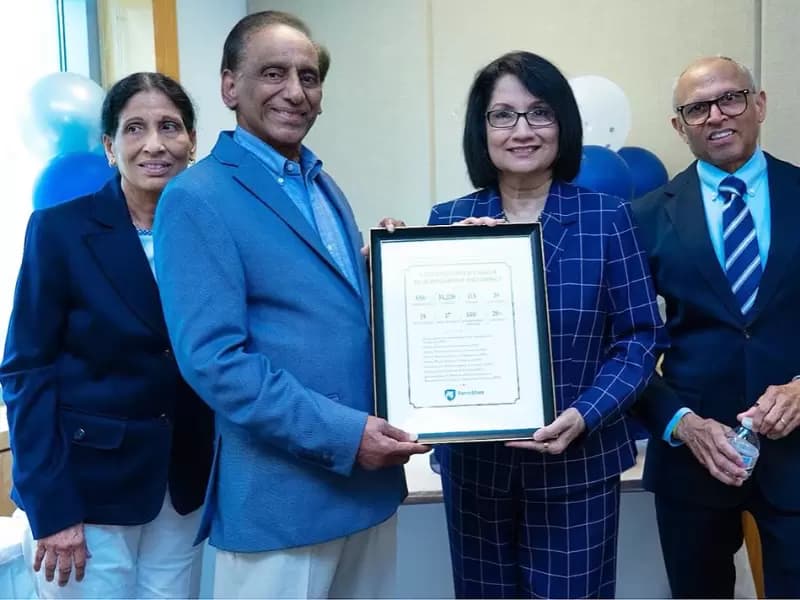
  Sridhar Komarneni, distinguished professor of clay mineralogy, accepts a memento from Penn State President Neeli Bendapudi in recognition of his 50 years service in the College of Agricultural Sciences.  Sridhar Komarneni, distinguished professor of clay mineralogy, accepts a memento from Penn State President Neeli Bendapudi in recognition of his 50 years service in the College of Agricultural Sciences. / Penn State

Indian American scientist Sridhar Komarneni, a distinguished professor of clay mineralogy at Penn State, was recognized March 1 for 50 years of service in the College of Agricultural Sciences, marking a career that has spanned five decades of teaching, research and student mentorship.

Komarneni, who joined Penn State in 1976, received a memento from Penn State President Neeli Bendapudi during the recognition ceremony. His wife, Dr. Sreedevi Komarneni, and Bendapudi’s husband, Venkat Bendapudi, were also present.

Reflecting on his career, Komarneni  his academic work gave him opportunities to travel internationally and deliver invited lectures.

“I visited many countries to give invited lectures and made many friends,” he said. “Because I traveled so much for work, I never took a sabbatical. That is how much I love working for Penn State and living in State College.”

In addition to his research activities, Komarneni continues to teach undergraduate and graduate courses in soil science.

Over the course of his career, he advised or co-advised 15 master’s students and 17 doctoral students. He also produced more than 850 peer-reviewed journal articles, authored 11 books and developed nine patents.

Komarneni said joining Penn State shortly after earning his doctorate from the University of Wisconsin-Madison in 1973 proved to be a defining career decision.

“After getting my Ph.D. in 1973 from the University of Wisconsin-Madison under the tutelage of Professor M.L. Jackson, a world-famous soil clay mineralogist and member of the National Academy of Sciences, I moved to Penn State,” he said. “This was my best decision, career-wise.”

Troy Ott, Peter and Ann Tombros Dean of the College of Agricultural Sciences, said Komarneni’s contributions have had a lasting impact on the college and university.

“Dr. Komarneni’s academic contributions to the college and his representation of the university both at home and abroad have long been exemplary,” Ott said.

Ott described him as an international leader whose research has helped advance scientific discoveries into practical applications. He also praised Komarneni’s record of mentoring young scientists.

Fred Cannon, professor emeritus of environmental engineering, said he collaborated with Komarneni for two decades on research projects, including work related to foundry processing and drinking water treatment.

“It was always such a breath of fresh air collaborating with Dr. Komarneni,” Cannon said.

Komarneni said he has witnessed significant changes in research priorities during his career, ranging from environmental studies in the 1970s and 1980s to energy-related materials research in the 21st century. He also highlighted the growing emphasis on interdisciplinary research at Penn State.

As he continues working with visiting scholars and research collaborators, Komarneni said he is not focused on retirement.

He credited much of his success to the support of his wife, Sreedevi Komarneni.

“The old saying ‘behind a successful man, there is a successful woman’ does not apply here,” he said. “Rather, the saying should be ‘by the side of a successful man there is a successful woman.’”

Discover more at New India Abroad.

Comments

Related