ADVERTISEMENT
ADVERTISEMENT



Indian-origin postdocs earn Argonne performance awards
The awards highlight contributions across energy systems, artificial intelligence and high-performance computing.
-
 Pranavi Sharma
 - Sun, 03, May 2026
- 02:26 EDT
- 499
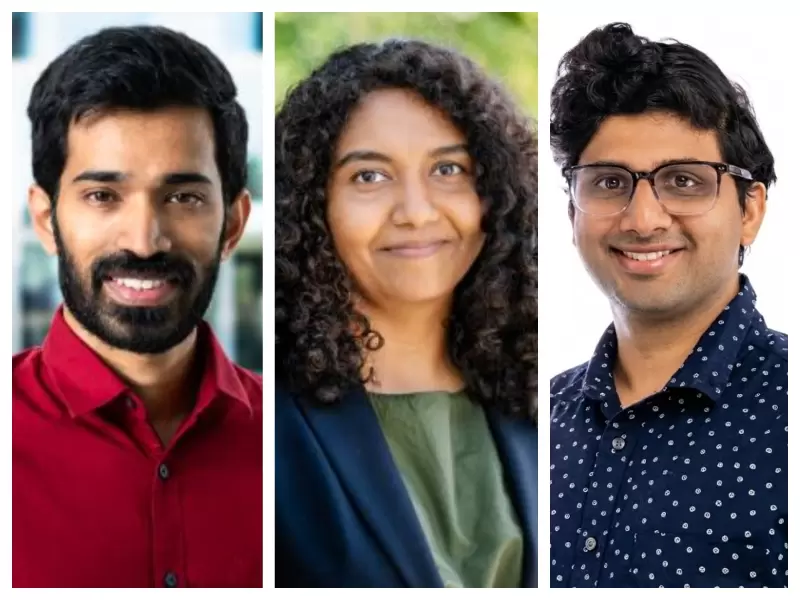 Kiran Kumar Yalamanchi, FNU Shilpika and Krishna Teja Chitty-Venkata / Argonne National Laboratory
Three Indian-origin postdoctoral researchers — Kiran Kumar Yalamanchi, FNU Shilpika and Krishna Teja Chitty-Venkata were awarded Postdoctoral Performance Awards at Argonne National Laboratory, recognizing contributions to research, collaboration and leadership aligned with U.S. Department of Energy missions.
The awards honor postdoctoral researchers who demonstrate problem-solving ability, collaborative leadership and measurable impact in their fields, while reflecting Argonne’s core values.
“Our postdocs are exemplars of innovation and dedication in their fields, which span basic and applied research,” said Tina Henne, Argonne early-career development lead. “Their exceptional contributions are all about collaboration, ingenuity and commitment to addressing the pressing challenges of our time, advancing both scientific progress and societal well-being.”
Big breakthroughs don’t happen without bold early-career scientists.
— Argonne National Lab (@argonne) May 2, 2026
Congratulations to Argonne’s Postdoctoral Research Performance Awardees. Your curiosity, creativity and drive power everything we do - https://t.co/zrvoCi1IlN pic.twitter.com/TgqEGyHury
Yalamanchi, an associate research scientist, develops artificial intelligence and machine learning methods for combustion, fuels and high-performance energy systems. His research combines physics-based models with data-driven techniques to address challenges in modeling reacting flows and fuel design.
His work includes developing foundation models for fluid dynamics, generative approaches for molecular design and machine learning tools that account for uncertainty in predictions. He has also worked with large-scale simulation and experimental datasets and built scalable workflows on high-performance computing systems, including collaborations with industry and energy-sector partners.
Shilpika, a postdoctoral appointee at the Argonne Leadership Computing Facility, focuses on data analysis and visualization of high-performance computing systems and improving interpretability in AI-driven scientific workflows.
She develops tools to monitor and manage large computing systems, including methods to analyze system logs, detect inefficiencies and support decision-making. Her work includes building explainable AI models and real-time data pipelines for system performance monitoring. She has also contributed to a digital twin of the Aurora supercomputer, used to diagnose issues and test system changes.
Her research examines system behavior across multiple scales to improve scheduling, performance evaluation and fault detection, with an emphasis on making results explainable and reproducible.
Chitty-Venkata, a former postdoctoral researcher, worked on improving the efficiency of large AI language models on supercomputers. He developed an open-source benchmarking tool, LLM-Inference-Bench, and optimization techniques to reduce memory bottlenecks and improve processing speed, achieving faster response times and higher throughput on major computing systems.
Discover more at New India Abroad
Leave A Comment
Related







ADVERTISEMENT

ADVERTISEMENT
E Paper
Video

Comments
Start the conversation
Become a member of New India Abroad to start commenting.
Sign Up Now
Already have an account? Login