ADVERTISEMENT
ADVERTISEMENT



Arkansas professor Nitin Agarwal's AI paper reaches NeurIPS
Conference is widely regarded as the world's premier AI and machine learning gathering.
-
 Ankita Baidya
 - Tue, 21, Jul 2026
- 03:34 EDT
- 57
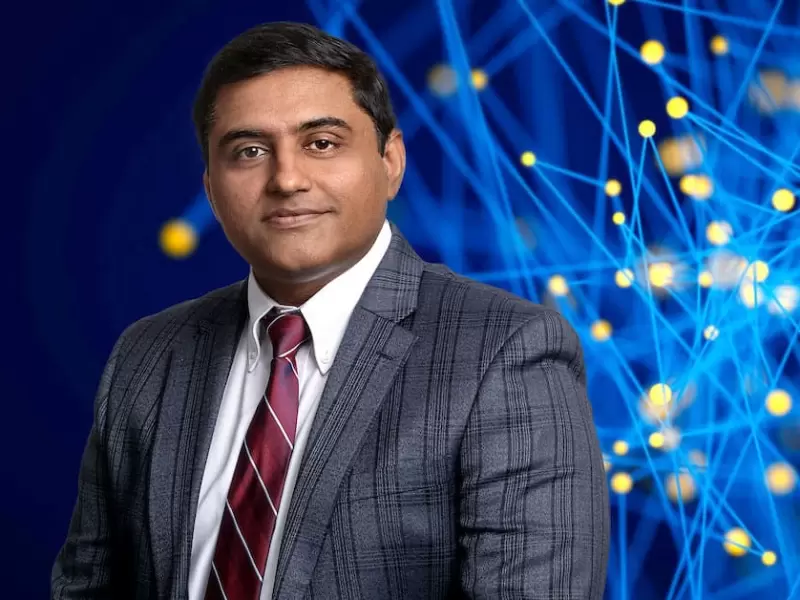 Professor Nitin Agarwal co-authored an AI research paper accepted for presentation at NeurIPS 2026. / UALR
Indian-origin computer scientist Nitin Agarwal, a professor at the University of Arkansas at Little Rock, has co-authored a research paper accepted for presentation at the 39th Annual Conference on Neural Information Processing Systems (NeurIPS), widely regarded as the world's premier conference for artificial intelligence and machine learning research, according to a university announcement.
Also read: Satchin Panda exits Salk Institute amid misconduct investigation
Agarwal serves as director of the Collaboratorium for Social Media and Online Behavioral Studies (COSMOS) Research Center at the University of Arkansas at Little Rock. He also holds the Maulden-Entergy Chair and is a Donaghey Distinguished Professor of Information Science, according to the university. Arkansas Business reported that he earned his bachelor's degree from the Indian Institute of Information Technology before completing a doctorate in computer science at Arizona State University.
The paper was co-authored with researchers from the University of Arkansas, Fayetteville, and the University of Florida, according to the university announcement.
"NeurIPS is where many of the most influential advances in AI are first introduced," Agarwal said in the announcement. He added that acceptance indicates the research underwent a rigorous peer-review process and was recognized by leading experts as a meaningful contribution to the field.
The research introduces a new framework called MANGO, short for Multimodal Attention-based Normalizing Flow Approach to Fusion Learning, which is designed to improve how artificial intelligence systems combine and learn from multiple forms of data, including images, text and other information sources.
According to the university, many existing AI models merge different types of data without distinguishing their relative importance. MANGO instead evaluates which information sources are most relevant and how they relate to one another, enabling more accurate and reliable decision-making by AI systems.
Agarwal said the framework has potential applications across multiple sectors. In healthcare, it could help physicians integrate medical images with patient records and clinical notes to support diagnosis and treatment. In autonomous vehicles, it could improve how AI systems interpret information collected from cameras, sensors and other inputs to enhance navigation and safety.
The framework could also strengthen national security and public safety efforts by helping researchers analyze social media content to detect coordinated influence campaigns and other forms of online manipulation, Agarwal said.
His research in cognitive security has previously received recognition from the U.S. Department of Defense, NATO, the Five Eyes intelligence alliance and the World Health Organization, according to the university. He is also a fellow of the Arkansas Academy of Computing and the Arkansas Research Alliance, and a Distinguished Visitor and Senior Member of the Institute of Electrical and Electronics Engineers (IEEE).
"This publication further demonstrates that UA Little Rock is producing AI research that is recognized at the highest international level," Agarwal said, according to the university announcement.
Discover more at New India Abroad.
Leave A Comment
Related








ADVERTISEMENT

ADVERTISEMENT
E Paper
Video

Comments
Start the conversation
Become a member of New India Abroad to start commenting.
Sign Up Now
Already have an account? Login