ADVERTISEMENT
ADVERTISEMENT



What happens to the India-US trade deal after Court strikes Trump’s tariffs?
The Supreme Court’s opinion may marginally recalibrate the negotiating dynamics, but it does not substantially alter the underlying distribution of leverage.
-
1758210324.png) Sital Kalantry
Sital Kalantry -
 Robert Kossick
 - Mon, 23, Feb 2026
- 13:41 EST
- 151
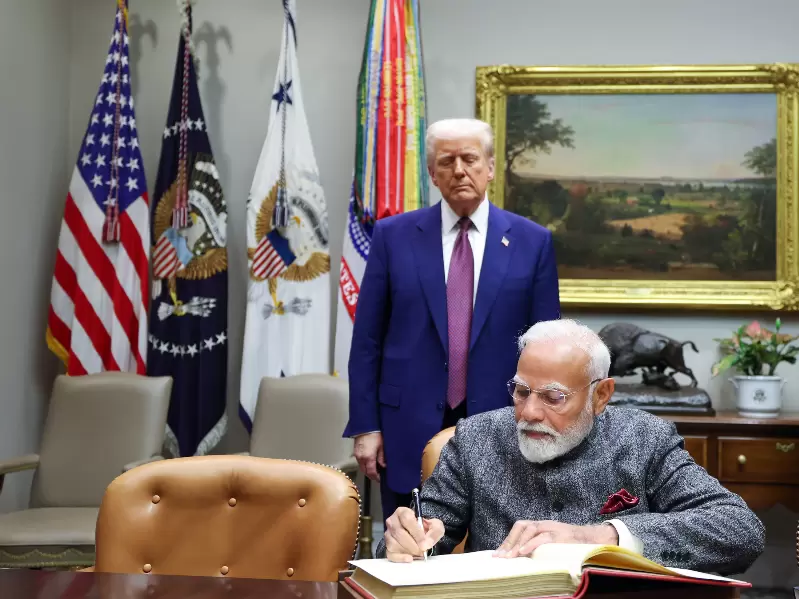 Indian PM writing his remarks in the visitor book at White House in Washington DC, USA on February 13, 2025 / PIB
Some commentators have incorrectly assumed that the U.S. Supreme Court opinion in Learning Resources, Inc. v. Trump guts President Trump’s authority to impose tariffs unilaterally on other countries.
Rather that decision removes only one pathway for Trump to impose tariffs—the Court found that the President lacked authority only under the International Emergency Economic Powers Act of 1977 (IEEPA) to impose tariffs. However, multiple other pathways remain for Trump to impose additional tariffs on India.
Also read: Trump warns countries that 'play games' with U.S. trade deals will face higher tariffs
Indeed, after the decision, the President invoked Section 122 of the Trade Act of 1974 to implement a global 15 percent tariff as a substitute for the measures previously imposed under IEEPA. While this measure is effective immediately, tariffs imposed under this authority cannot exceed 15 percent and, absent Congressional action, lapse after 150 days.
While Republicans currently hold majorities in both chambers of Congress, support for broad-based tariffs is not uniform, particularly given concerns about consumer costs and inflationary pressures. Moreover, the mid-term elections could potentially change the balance of power in Congress. Shortly after this announcement Trump reassured India that this new tariff would not apply to their negotiated trade deal.
Another critical tariff authority the President retains is Section 232 of the Trade Expansion Act of 1962, which authorizes tariffs if there is a finding of a threat to national security by the U.S. Commerce Department. This provision has already been used to impose sector-specific tariffs on steel, aluminum, autos, and copper.
Investigations are open in the pharmaceutical and aviation industry. There is no upper limits on tariffs under this section and it is not time-bound. In Roundglass India Center’s recent episode of The Hypen: Indian-American Dialogues, we discuss how the aviation industry could be impacted by these tariffs with Salil Gupte. Head of Boeing in South Asia and India.
Additionally, Section 338 of the Tariff Act of 1930 permits tariffs of up to 50 percent against countries found, pursuant to a prior investigation, to discriminate against U.S. commerce or to impose unreasonable charges.
Finally, Section 301 of the Trade Act of 1974 authorizes trade measures in response to unreasonable, discriminatory, or burdensome foreign practices, although that mechanism requires an investigation and formal determination, rendering it procedurally more time consuming.
For President Trump, tariffs function as instruments of negotiation. The Supreme Court took away one bargaining chip from him, but he has many others and he has already deployed one of them. The Supreme Court’s opinion may marginally recalibrate the negotiating dynamics, but it does not substantially alter the underlying distribution of leverage.
The trade agreement ought to be seen within a broader strategic framework encompassing defense cooperation, technology partnerships, and shared geopolitical interests in the Indo-Pacific.
Sital Kalantry is a Professor of Law at Seattle University School of Law and Founding Director of the Roundglass India Center.
Robert Kossick is an international trade lawyer at a Washington-based international trade law firm.
(The views and opinions expressed in this article are those of the author and do not necessarily reflect the official policy or position of New India Abroad.)
Discover more stories on New India Abroad.
Leave A Comment
Related










ADVERTISEMENT

ADVERTISEMENT
E Paper
Video

Comments
Start the conversation
Become a member of New India Abroad to start commenting.
Sign Up Now
Already have an account? Login