ADVERTISEMENT
ADVERTISEMENT



The Hindu temple flag: presence, protection, and continuity
Historically, temple towns treated the dhwaja-stambha the tall pillar before the sanctum as a moral threshold.
-
 Dr. Vinay Nalwa
 - Sun, 30, Nov 2025
- 22:19 EST
- 189
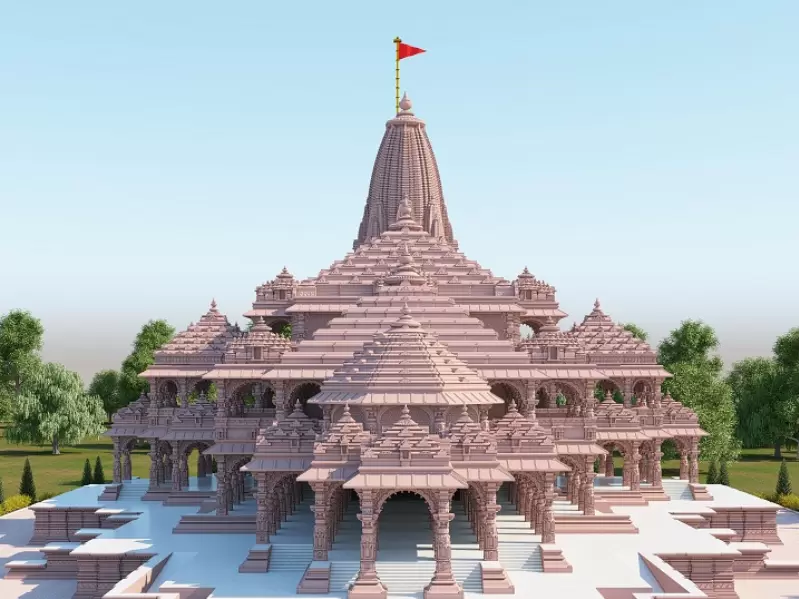 Ram Mandir. / Wikipedia
Across centuries and sacred geographies, the Hindu dhwaja, the temple’s sacred flag has remained a timeless emblem of presence, protection, and identity. Rising above mandirs from the Himalayas to the ocean coast, it signals not authority but sanctity, not conquest but consecration. The hoisting of this flag, known as Dhwaja-ārohaṇa(hoisting), continues to stand as one of Hinduism’s most enduring ritual acts, preserving a lineage that seamlessly links ancient scriptures, temple culture, art, metaphysics, and lived devotion.
The dhwaja is not a mere banner. It is a declaration of sacred space, a vertical axis that connects the terrestrial with the cosmic. Its cloth may be simple, but the worldview behind it is vast. Understanding this tradition requires entering the domain of the ancient Hindu scriptures like Purāṇas, the Āgamas, temple-architecture treatises, and philosophy texts that together construct a coherent system in which the dhwaja protects, empowers, and sacralises.
In recent times, the ceremonial Dharmadhwaja hoisting at Ayodhya’s Śrī Rām Mandir after the prāṇa-pratiṣṭhā(consecration ceremony) in January 2024 renewed global attention to this ancient practice. The sight of the saffron flag rising above the restored temple resonated deeply, marking not only a ritual moment but the reappearance of a civilizational memory long interrupted. To understand the symbolic power of this act, one must understand the philosophy of the dhwaja itself.
Scriptural Foundations
The Purāṇas, the vast compendia of ritual, cosmology, and sacred geography provide early attestations to the dhwaja’s sanctity. The Agni Purāṇa lists the dhwaja among the essential markers required for a mandir to attain ritual completeness. The Matsya Purāṇa explains that beholding a temple’s dhwaja brings auspiciousness and dissolves obstacles, while the Skanda Purāṇa describes it as radiating the protective presence of the deity.
The Āgamas like Śaiva, Vaiṣṇava, and Śākta liturgical corpora offer technical details regarding the dhwaja-stambha(flag post): its design, proportions, consecration, materials, and mantras. Across these sources, the expectation is consistent: the dhwaja is not ornamental but functional, a ritual extension of the deity’s presence.
The Dhwaja as a Protective and Energetic Field
A consecrated temple is traditionally understood as a śakti-kṣetra, a field of concentrated spiritual energy and the dhwaja acts as its outermost boundary-marker. Purāṇic and Āgamic literature describe it variously as:
- vāyu-yantra – a medium through which prāṇa and sacred vibrations travel
- dik-rakṣaṇa-sūcaka – an indicator of the deity’s protection over all directions
- tejas-prabhāra – a sphere through which divine radiance spreads
The Agni Purāṇa calls the dhwaja ‘devānāṃ prītikārakaṃ’, means pleasing to the gods and capable of invoking their protective grace. The Padma Purāṇa states: dhvajadarśanamātreṇa pāpānāṃ nāśanaṃ bhavet meaning the mere sight of the flag removes negativity.
Historically, temple towns treated the dhwaja-stambha the tall pillar before the sanctum as a moral threshold. It was understood as a space governed by dharma, where violence and adharma were forbidden. These theological ideas correspond to a deeper philosophical insight: sacred space radiates, and symbols can transmit aura.
The Dhwaja-Stambha: Axis of Temple Space
In classical temple architecture, the dhwaja-stambha stands directly before the garbha-gṛha(sanctum santorium), forming a sacred triad with the gopuram and the vimāna. This alignment represents ascent from the outer world, through the aspirational pillar, into the sanctum of truth.
The stambha is clad in copper, brass, or gold-plated metal sheets, symbolising purity and the conductivity of spiritual energy. Its installation requires days of prāṇa-pratiṣṭhā, with mantras, fire rituals, and consecration rites that infuse it with sanctity. Through this process, the dhwaja-stambha becomes an axis mundi, the symbolic spine of the temple.
Dhwaja-Ārohaṇa: The Ritual of Sacred Hoisting
The ceremonial hoisting of the temple flag marks the commencement of festivals, the invocation of divine presence, and the renewal of spiritual energy. The ritual includes Vedic and Āgamic mantras, invocation of the dikpālas, worship of the stambha, and offerings of flowers, lamps, incense, and water, culminating in the hoisting of the flag amid drums and conches.
The Suprabheda Āgama notes that during this act, the deity’s grace extends beyond the sanctum, symbolically radiating across the community.
Functional and Scientific Dimensions
Beyond its scriptural and ritual meaning, the dhwaja had practical and scientific functions in India’s temple tradition.
- Navigation and Orientation: The dhvaja-stambha was usually the tallest structure in a settlement. Travellers located the sacred centre by spotting the high rising flag—an architectural principle consistent with the Śilpaśāstras(architecture), which position temples as visual anchors of community life.
- Meteorological Indicator: A freely fluttering flag reveals wind speed, direction, and approaching weather changes. Agrarian and coastal societies relied on such cues, and Vāstu texts acknowledge the importance of vāyu-vega (wind patterns) in environmental assessment.
- Natural Lightning Protection: Poles of copper, brass, or pañcaloha disperse electrical charge, functioning like early lightning conductors. A tall, grounded metal pillar reduced risks to temple structures. Śilpaśāstra tradition already regarded metals as agents of purification, protection, and stability; the dhwaja-stambha applied this principle in architectural form.
In this way, the dhwaja embodied a fusion of sacred meaning, environmental awareness, and technical intelligence.
Contemporary Significance and the Ayodhya Dharmadhwaja
The consecration of the Śrī Rām Mandir at Ayodhyā in January 2024 stands as one of the most important civilizational moments in recent times. Among the post-consecration rites, the hoisting of the Dharmadhwaja held special significance. Its ascent represented:
- the restoration of a sacred landscape
- the revival of a tradition interrupted for centuries
- the reaffirmation of a living cultural memory
As the flag rose above the newly consecrated temple, it echoed Purāṇic descriptions of the dhwaja as the first visible manifestation of sacred presence. After centuries during which the mandir stood absent, the re-emergence of its dhwaja proclaimed continuity—dharma renewed, not rediscovered.
At its conceptual heart, the dhwaja embodies three intertwined functions:
- Presence (sannidhya): A visible sign of the deity’s nearness.
- Protection (rakṣaṇa): A shield of auspiciousness acknowledged in multiple Purāṇic references.
- Identity (ākhyāna): A marker of sacred boundaries announcing not territorial ownership but moral character.
A Living Symbol of Civilizational Memory
The power of the dharmadhwaja lies in its calm, unassertive dignity. It rises with centuries of memory encoded in its movement. In a world of shifting identities and hurried lives, the dhwaja remains a reminder of continuity—of traditions that endure through rhythm, not rhetoric.
It externalises an inner truth central to Hindu thought: life must rise like udhyatam towards clarity, steadiness, and light.
Conclusion: A Flag That Breathes Dharma
Across Purāṇas, Āgamas, temple architecture, and living practice, the Hindu dhwaja emerges as a symbol of profound depth. It is grounded in scripture, indispensable in ritual, resilient in history, and luminous in meaning. It stands upright not merely on temple towers but in the collective memory of a civilisation that continues to transmit its values through sacred acts both ancient and immediate.
(The writer is an author and columnist)
(The views and opinions expressed in this article are those of the author and do not necessarily reflect the official policy or position of New India Abroad.)
Leave A Comment
Related





.png)





ADVERTISEMENT

ADVERTISEMENT
E Paper
Video

Comments
Start the conversation
Become a member of New India Abroad to start commenting.
Sign Up Now
Already have an account? Login