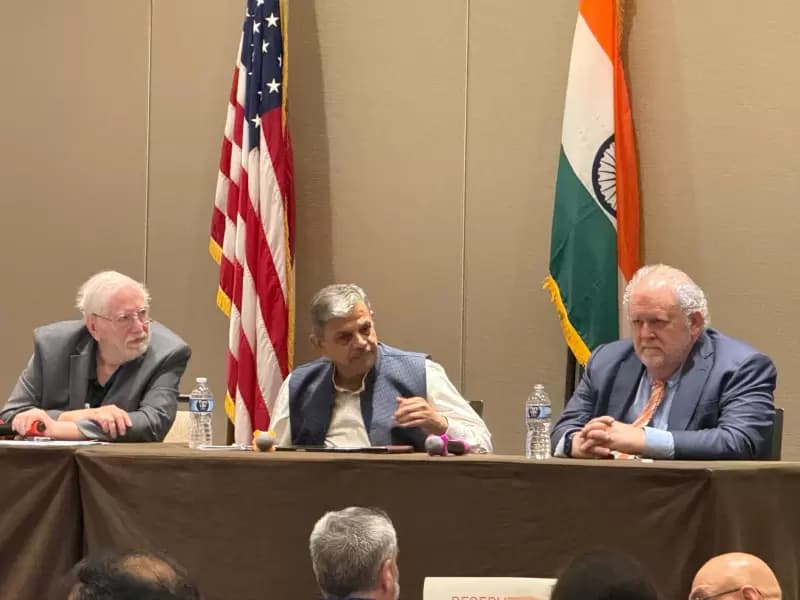
RSS General Secretary Dattatreya Hosabale during his US visit. / Courtesy photo
In an era when legacy media in the United States continues to project India’s largest volunteer organization – the Rashtriya Swayamsevak Sangh (RSS) – through the narrow lens of a “hardline,” “right-wing,” or even “paramilitary” organization, it was striking to encounter some voices of a different tenor last week in Washington, D.C.
As the RSS approaches a century of its existence, its general secretary, Shri Dattatreya Hosabale, is traveling across the United States, engaging with universities, civil society, and the media. He participated in Hudson Institute’s “The New India Conference,” in which leaders from India engaged with American thinkers. One might have assumed that the intellectual fare had been exhausted by evening. Yet, it was at the dinner reception that the most revealing moments unfolded.
ALSO READ: India’s vision can guide global unity: RSS
Walter K. Anderson, senior adjunct professor of South Asia studies at Johns Hopkins University, told the gathering that he had personally met Shri M.S. Golwalkar during his years of research in India when he focused on the role of RSS in Indian politics. He firmly rejected the characterization of the RSS as a Hindu cult-like formation. Instead, he described it as an organization engaged in the long-term work of fostering a stable and culturally rooted society, anchored in patriotism.
Dr. Anderson found it commendable that leaders such as Prime Minister Modi were emerging from the volunteers who joined the RSS to hone their organizational skills and service to society. He appreciated the RSS for its remarkable organizational depth and its spawning over a hundred autonomous organizations reaching into the fabric of Indian life. The professor also found it noteworthy that even after a hundred years, the organization had neither fractured nor lost its internal cohesion.
Walter K. Anderson, senior adjunct professor of South Asia studies at Johns Hopkins University with RSS General Secretary Dattatreya Hosabale / Courtesy photoIf Anderson’s remarks were measured, those of Walter Russell Mead, the Alexander Hamilton professor of strategy and statecraft at the University of Florida’s Hamilton Center, were unmistakably emphatic. The professor, who has taught foreign policy at Yale University, said that a strong, vibrant, and self-confident India was necessary to counter countries such as China that wish to “eat up Asia.” Dr. Mead argued that a strong, self-assured India is not merely desirable, but necessary, particularly in a century where expansionist powers seek to reshape Asia. Rising above the geopolitical, he said: “India’s growth, India’s fulfilment of its destiny is not good just for India but for all of humanity.”
Recounting his visit to the RSS headquarters in Nagpur, Dr. Mead spoke of watching young swayamsevaks train under the relentless sun, an image of discipline and resolve. More revealing, however, was his recollection of a conversation with RSS chief Mohan Bhagwat. When they discussed what an American version of RSS would look like, Dr. Mead said: “I thought he would say something about immersing yourself in Indian culture but instead he said you must start with the American Constitution.”
ALSO READ: ‘Ethics must guide scientific progress’: Dattatreya Hosabale
To serve one’s nation, one must first understand its Constitution, sacred texts, and histories. Dr. Mead interpreted this as a broader RSS vision to cultivate character, civic virtue, and a spirit of service among the young, qualities that, over time, shape leadership. He emphasized that he would like to see more young Americans visiting India and learning from the RSS to see what aspects could be applied to one’s situation.
Traditionally, the RSS has been rather understated in speaking of its achievements since a key quality nurtured by its cadres is humility, which is also embedded in the Hindu ethic of seva, service without spectacle. Whether distributing relief during floods or mobilizing citizens toward environmental responsibility, much of its work unfolds without attribution. But this self-effacement has also led to deliberate misrepresentations in a politically and religiously polarized world.
That an organization so rooted in understatement is now being explained patiently, publicly in a foreign land by its senior leadership is itself telling. Shri Hosabale’s presence in the United States reflects the times we live in. The time has come for America to move beyond caricatures and distorted narratives and instead engage thoughtfully with the RSS as an enduring institution.
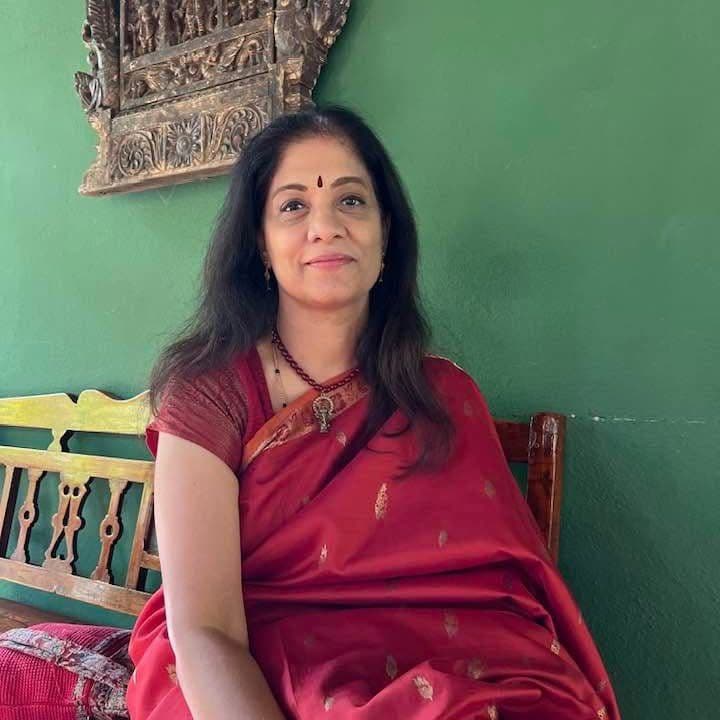
Sahana Singh is an author and public speaker engaged in uncovering forgotten narratives of Hindu civilization. She is best known for her books on India’s educational heritage and can be reached at sahana.singh@gmail.com.
(The views and opinions expressed in this article are those of the author and do not necessarily reflect the official policy or position of New India Abroad.)
Discover more at New India Abroad.
ADVERTISEMENT
ADVERTISEMENT
Comments
Start the conversation
Become a member of New India Abroad to start commenting.
Sign Up Now
Already have an account? Login