ADVERTISEMENT
ADVERTISEMENT



The new power nexus: U.S.-India partnership and an Indian sovereign wealth fund
India should learn from best practice: transparency, professional management, strong risk controls, and a firewall between political convenience and investment decisions.
-
 Dinesh Sastry
 - Mon, 09, Mar 2026
- 01:16 EDT
- 184
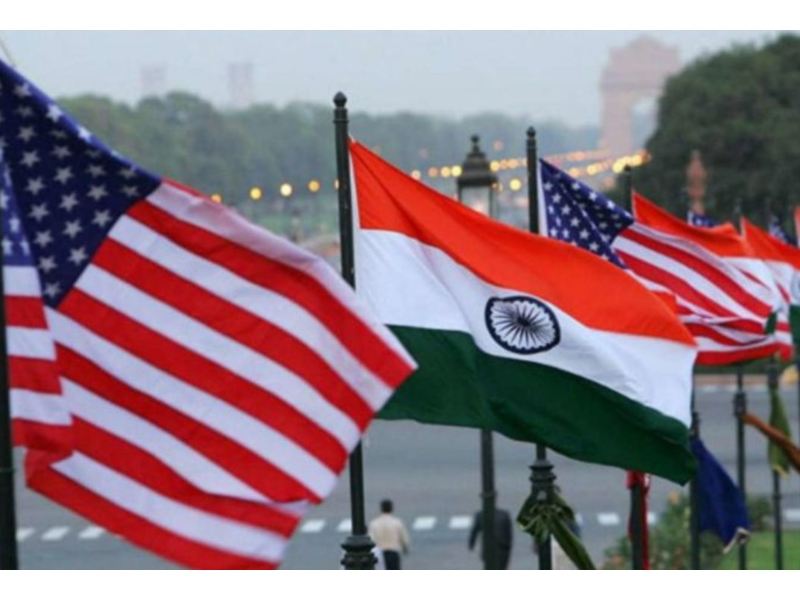 The American flag and the Indian flag / U.S. Embassies and Consulates in India website
In 1961, President Dwight D. Eisenhower warned Americans about a permanent alignment of industry, bureaucracy, and political incentives—the military‑industrial complex. His deeper insight still holds: when technology, capital, and state power lock into a self‑reinforcing loop, the results can be transformative, and dangerously hard to unwind.
Today, the loop is broader. We live inside a techno‑financial statecraft complex in which innovation, venture and sovereign capital, regulation, and geopolitics operate as one system for national influence. The question is no longer whether politics, finance, and technology intersect. The question is who can orchestrate that intersection with legitimacy, speed, and strategic clarity.
ALSO READ: India-UK conference to strengthen green hydrogen safety standards
I have watched this evolution from the inside. In California, Jerry Brown treated innovation as a public project. State support for semiconductors, universities, and applied research—often adjacent to NASA and defense priorities—helped build the ecosystem we now shorthand as Silicon Valley. That era was not pure laissez‑faire; it was strategic cultivation, executed through procurement, research funding, and a political culture that saw technology as national capability.
In the 1990s, the American model matured. Silicon Valley, Wall Street, and Washington began to coordinate more deliberately. A generation of builders and financiers—Sandy Robertson, John Doerr, Joel Hyatt, Eric Schmidt, Suhas Patil, and others—helped align the innovation economy with the Clinton‑Gore agenda. The aim was not simply fundraising; it was a posture: pro‑innovation policy, capital formation, and a national narrative that treated the digital revolution as the next moonshot. Hollywood and Los Angeles added a fourth pillar—creativity and mass distribution—so technology and finance could scale through culture as well as commerce.
Other powers studied and adapted this synthesis.
China fused technology platforms, industrial capacity, and state direction into geopolitical leverage—building supply dependencies and treating data and standards as extensions of sovereignty. The Gulf states showed another path: sovereign capital at scale. Qatar, Saudi Arabia, and the UAE used sovereign wealth to buy influence, accelerate domestic tech hubs, and turn portfolios into diplomacy. Europe demonstrated that regulation can be power: when rule‑making is backed by market size, standards and compliance costs become tools of strategy.
India is the pivotal case. It is the fastest‑growing major economy, with immense demographic energy and an expanding technology footprint—from digital public infrastructure to a startup ecosystem that increasingly competes globally. Yet India’s strategic gap is financial statecraft. India has world‑class engineers and a vast domestic market; what it lacks is a coherent sovereign capital strategy commensurate with its ambitions.
This is why an Indian sovereign wealth fund is no longer a luxury idea—it is a strategic necessity.
A well‑designed sovereign wealth fund would do three things simultaneously. First, it would convert India’s macro strength—reserves, state assets, and the cash‑flow capacity of a rising economy—into a disciplined vehicle for long‑horizon investment. Second, it would help secure strategic supply chains and technologies by taking smart positions in critical nodes: semiconductors, energy storage, advanced materials, satellite and launch ecosystems, and cybersecurity. Third, it would expand India’s diplomatic bandwidth, because patient, credible capital creates durable relationships that speeches do not.
Legitimacy will depend on governance. India should learn from best practice: transparency, professional management, strong risk controls, and a firewall between political convenience and investment decisions. A sovereign fund that becomes a vehicle for cronyism would weaken India’s democracy and repel global partners. But a sovereign fund built to institutional standards—independent board, published mandate, audited performance, and clear strategic priorities—would signal that India is ready to play at the highest level of global economic strategy.
The parallel imperative is U.S.–India alignment. I have long believed that after the Cold War, the world’s most consequential democratic partnership would be Washington and New Delhi. I worked to advance that convergence—urging American leaders to recognize Prime Minister P.V. Narasimha Rao’s reform agenda as historic, and supporting higher‑level engagement that culminated in the Clinton era’s renewed attention to India. Even when relations were strained—such as after India’s nuclear tests—the strategic logic remained: two democracies, one Indo‑Pacific, and a shared interest in a stable, rules‑based technology order.
Now that logic must become operational. The partnership should focus on a small number of tangible projects: semiconductor capacity and supply security; defense co‑development and co‑production; AI safety and applied AI in public services; resilient digital infrastructure; and energy transition technologies that are scalable and affordable. The goal should be an “innovation corridor” that links capital formation in the United States with engineering depth and market scale in India—while ensuring that standards, security, and governance reflect democratic values.
For India, the sovereign wealth fund should complement—not replace—private enterprise and diaspora capital. Its role is to anchor long-horizon bets that markets underprice: strategic minerals, clean baseload power, dual-use R&D, and industrial clusters that take a decade to mature. Done well, it would also give Indian pension and household savings a professional global channel, and it would allow India to partner more confidently with U.S. capital on joint platforms, not just one-off deals.
The American experience also offers a warning. When the politics‑finance‑technology nexus becomes corrupt—when policy is monetized and institutions lose credibility—the model becomes brittle. Democracies must compete without abandoning the rule of law that gives their innovation and capital ecosystems trust.
The next era will not be decided only by armies, or even only by GDP. It will be decided by who can integrate innovation, capital, and state capacity into coherent strategy—while maintaining the legitimacy that attracts talent and investment rather than forcing compliance.
The United States and India can lead that era, but only if they treat this moment as a design challenge. India should build the financial instruments—starting with a sovereign wealth fund—worthy of its technology and demographic trajectory. The United States should deepen partnership with India as a first‑order strategic priority, not a periodic diplomatic initiative. Together they can build a democratic model of techno‑financial statecraft that outcompetes authoritarian capital not by imitating it, but by surpassing it—through openness, institutional credibility, and strategic execution.
Discover more at New India Abroad.
Leave A Comment
Related











ADVERTISEMENT

ADVERTISEMENT
E Paper
Video

Comments
Start the conversation
Become a member of New India Abroad to start commenting.
Sign Up Now
Already have an account? Login